Showing posts with label CBGB. Show all posts

Sunday, 27 December 2020

Shrapnel: Daniel Rey Recounts The History Of The Group "Punk" Magazine Dubbed "The Brat Patrol."

Originally published in Teenage Kicks #3 (Spring 1999)
By Devorah Ostrov

Shrapnel strike a suitably militaristic pose for this publicity pic.
Photo: Tom Hearn
You might have seen guitarist Daniel Rey's co-writer credit on such Ramones' faves as "Poison Heart," "Pet Sematary," and "I Wanna Live." He's also produced records for the Ramones, the Misfits, White Zombie, Green Apple Quickstep, D Generation, and "a bunch of other stuff" he can't remember. 

However, what initially caught my attention in Punk magazine was his militaristic-styled late-'70s band, Shrapnel. And when I met Rey (aka Rabinowitz) at the recent Thunder Road benefit (where he backed-up Joey Ramone on a handful of songs), he was happy to fill me in on a brief history of the group Punk once dubbed "The Brat Patrol."

"Combat Love" b/w "Hey"
(Salute Records - 1979)
Comprised of a bunch of camo-clad juvenile delinquents, Shrapnel hailed from the 'burbs of New Jersey. "But as soon as we were old enough, we were hanging out in New York," says Rey. 

Along with Rey, the band's teenaged lineup featured Dave Wyndorf (vocals), Philip Caivano (bass), Dave Vogt (guitar), and Dan Clayton (drums).

"The Dictators were one of my favorite bands," Rey declares. "They totally changed our lives. We went to see the Ramones in the summer of '76, the last time they played the Jersey Shore, and Top Ten from the Dictators was there. He was amazed that anyone recognized him! He told us about this place on Bleeker and Bowery called CBGBs. So, we went up there the next weekend. And we never left."

"There was a time in New York..." Rey trails off. "In '76, the Dictators and the Ramones were the two hot bands. Then the Dead Boys came around. Shrapnel used to open for them all the time. We used to open for the Ramones a lot, probably 100 times."

Rey describes Shrapnel's early sound as a "sort of rave-up, militant, MC5 sort of thing. With a little bit of pop thrown in. Real American punk rock 'n' roll."

Shrapnel and their Spidey friend
(Illustration by Frank Miller for Marvel Comics)
The band "conned" Legs McNeil from Punk magazine into managing them, and in issue #14, the 'zine announced: "Next Big Thing — Kid Groups. Kids too young to drink are playing clubs in N.Y.C." And Shrapnel, along with the Blessed and Middle Class, were listed as the best of them all.

In 1979 Shrapnel released the first of two now impossible to find 45s on their own label, Salute Records. Produced by McNeil and Jonathan Paley, the single "Combat Love" b/w "Hey" featured the tag line "Commandos of Rock 'N Roll," underlining the group's B-movie militaristic stance.

Shrapnel's self-titled EP
(Elektra Records - 1984)
In his review of the 45, Punk's music critic Jolly poked fun at McNeil when he wrote: "A good band but they lack that certain something, that certain guiding light, that maybe a director or manager could provide. In the long run, it may be what stands between them and greatness."

In a corresponding write-up, Punk's Assistant Publisher Richard Tucksmith pointed out: "Hey" is a good song. Shrapnel is also good live, in case you're interested. Buy this record so their manager can get some new clothes. But seriously, it's a good record."

That same year, Shrapnel lost Punk's "Best New Group" award to the B-52's, but the magazine's March/April issue featured them in a photo/comic send-up as the Brat Patrol. The concept went something like this:

"The Plot — Shrapnel — the Janitors of Justice, are out to sanitize New Jersey by eradicating their arch enemy — the Unknown Gook — a bald, aging, fanatical flower child, driven mad by excessive banana-peel smoking."

Shrapnel
(photographer unknown)
However, according to Rey, the fun had gone out of the New York punk scene by then. 

When Dead Boys' drummer, Johnny Blitz, was brutally stabbed outside a Lower East Side deli, it was "a turning point for the whole scene," he says. 

"It had been kind of carefree," recalls Rey. "There was a camaraderie, an innocence to it. And the Dead Boys were the hot band. At that moment, they were the greatest band. But they were never the same after that."

"We used to go to the same place to eat after CB's," he notes about the location of the attack. There were only two or three places you could go to back then in the East Village, late at night. And everybody used to end up there after Max's or CB's. I remember that night vividly; the innocence was lost."

Shrapnel played the "Blitz Benefit" at CBGBs, sharing the bill with Blondie and the Dead Boys. Comedian John Belushi guested on drums in Blitz's absence. As Rey remembers it, "Belushi came into the dressing room all coked up, going, 'Who's got drumsticks? Who's got drumsticks?' Our drummer gave him drumsticks."

In 1984 Shrapnel released a five-song EP on Elektra Records that included a strong cover of Gary Glitter's "Didn't Know I Loved You (Till I Saw You Rock-N-Roll)." 

Shrapnel as the "Brat Patrol" - excerpt from Punk's photo/comic. 
(Written by Legs McNeil & Jolly/Photos by Tom Hearn)
But the no-frills cover art didn't picture the guys in their usual army-surplus garb. Instead, it made them look like an airbrushed new wave band.  

Rey simply states that the EP was "bad."

"We kind of got caught up in the '80s new wave thing," he adds. "We used to play these dance clubs... We were young when we got signed, and like most bands, we listened to the label."

Now older and wiser, Rey imparts this piece of wisdom: "When you get signed, and someone from the label tells you to do something, you have to do the exact opposite. That's very important. And then you'll be okay."

Shrapnel broke up "right after we got signed," says Rey. "It was just time, 'yknow."

Shrapnel
(publicity photo)

Monday, 1 October 2018

The Dictators: Tracing The Group's History With Handsome Dick, Top Ten & Ross The Boss

Originally published in American Music Press (September 1993)
By Devorah Ostrov

The Dictators — circa Bloodbrothers
Photo: Lynn Goldsmith
Handsome Dick Manitoba doesn't think the Dictators have received the respect they deserve. "Every time they mention the graduation class of '76, I always see the Ramones, Talking Heads, Television, Blondie, Dead Boys..." Manitoba reels off the names in the trademark BOOM that makes whatever he says sound like a WWF challenge. "You never see the Dictators mentioned. Like the Dead Boys were the great punk band or something. I feel we were just as influential as them. They didn't sell any records; we didn't sell any records."

Of course, a second later and Manitoba's not sure he likes the Dictators being referred to as a punk rock band. "We were a band that rehearsed and practiced and did things in a legitimate way," he contends. "We were called 'punk' but I dunno... We were just at that place at that time. And we were snotty, know-it-all guys from the Bronx. So, I guess in a sense we were real punks!"

* * *

Top Ten & Handsome Dick Manitoba
on the cover of New York News magazine
September 19, 1976
Named Richard Blum by his parents, the Dictators lead singer was born on January 29, 1954, in Manhattan's Jewish Memorial Hospital. His formative years were spent in the Bronx.

"It was a nice place to grow up," he recalls of his old neighborhood. "I played ball, ate dinner with the family, and did my homework — like everyone else in America."

Manitoba and future Dictators guitarist Scott "Top Ten" Kempner met when they were ten years old and quickly became best friends. "We walked to Hebrew school together and talked about Marvel comics," says Manitoba.

It was the (aptly nicknamed) Top Ten who first immersed himself in the world of rock 'n' roll. "Scott became an absolute maniac for the Who," reflects Manitoba. "He saw Pete Townsend, and he went out and got a guitar and learned how to play it by himself. He had his walls papered with every band... and basically, by hanging out with him I learned about the bands."

In 1971, bassist Andy (aka Adny) Shernoff was attending SUNY New Paltz in upstate New York. He'd put together his first group (Grand Funk Salinsky), published a mimeographed fanzine (Teenage Wasteland Gazette), and occasionally contributed to CREEM magazine.

The Ramones, the Dictators, Widowmaker,
and the Nuns at SF's Winterland  
July 30, 1977
A mutual friend introduced Manitoba to Shernoff. "The guy said, 'This is my friend, rock 'n' roll Andy,'" Manitoba remembers.

Meanwhile, budding guitar hero Ross "The Boss" Friedman (aka FUNichello) opted not to enroll at Lehman College. Instead, he hooked up with a hippie outfit called Total Crudd and moved to New Paltz. An article in issue #11 of Punk magazine (which charted the Dictator's early career on an almost daily basis) claimed that Friedman aimed to "hang out upstate, drink beer, get laid and play guitar."

"Ross was one of those 'gunslinger' guitar players from the neighborhood," says Manitoba. "He was one of the guys with a rep."

Total Crudd lived and rehearsed at the Out Of It House — so named because everyone there was so stoned and drunk all the time they really were "out of it." Punk described a typical night at the house: "They'd throw wild parties for 200 people and more, handing out baggies at the door to those people they knew would throw up. The parties ended at about 5:00 A.M. Most people would pass out on the floor. At 6:00 A.M. Ross would wake up everyone playing along to MC5 records at full blast."

Shernoff, Kempner, and Manitoba all hung out there.

Advert for the Dictators' debut LP
Epic Records (1975)
Towards the end of '72, Shernoff stopped editing Teenage Wasteland Gazette and handed the 'zine over to cub reporter Manitoba. The final issue, which would have featured a Nick Toshes-designed cover, still sits unfinished in a drawer. "It's about 60 or 70% done," says Manitoba.

By '73, Shernoff had convinced Friedman to leave Total Crudd and form a band with him, Kempner, and the first of a couple of drummers before their pal Stu Boy King joined. The Dictators was one of several potential names for the new band. Other options included Fireman's Friend and Tommy the Truck. Or they could have called themselves Beat the Meatles.

During this initial stage, Shernoff was the group's undisputed leader. He wrote the songs, played bass and sang lead.

Manitoba wasn't even part of the original lineup. He'd dropped out of City College ("I took a lot of English courses, mythology, stuff like that") and was working as a mailman. On weekends he would cook and roadie for his buddies. Sometimes they'd let him sing "Wild Thing."

"I'd be like, 'Wild thing! Get on up and get my ham and eggs!'" He laughs at the memory.

All that changed when Shernoff invited the roadie onstage at a Brooklyn bar called Popeye's Spinach Factory. Punk magazine provided this narrative: "He slammed into 'Wild Thing,' giving one of the great live performances of that song in this century … Something happened. All the bums in the bar — proud to see a fellow derelict make it big — went NUTS. They liked this degenerate so much they started climbing the bar stools, throwing bottles, and screaming for more, more, more! They danced and ranted and raved..."

The Dictators circa Manifest Destiny
with bassist Mark "the Animal" Mendoza
Photo: Jonathan Postal
And Handsome Dick Manitoba was launched upon the world. The stage name came about through the band's love of flashy wrestlers. "The Valiant Brothers were around," explains Manitoba. "There was Handsome Jimmy and Luscious Johnny. I was like, 'Handsome Richard? Nah, I gotta shorten it. Handsome Dick!'" The Canadian province that became his surname was apparently Shernoff's idea, but its inspiration is a mystery. "I dunno..." offers Manitoba, "maybe he was looking at a globe."

But it took a little more nudging before Manitoba became the group's acknowledged frontman. In fact, it took a massive shove.

Handsome Dick Manitoba & the American
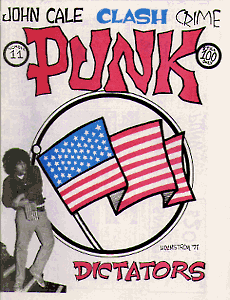
 flag share the cover of Punk magazine #11 
Oct/Nov 1977
A couple of months after the Popeye's gig, 600 people came to see the Dictators play a party in the Bronx. Billed as a "special surprise guest," Manitoba came on dressed in somebody's father's bathrobe. He did his usual "Wild Thing" and played Sonny to Shernoff's Cher for a rousing version of "I Got You Babe."

As it happened, Sandy Pearlman and Murray Krugman — the team who managed and produced Blue Oyster Cult — were in the crowd that night (probably brought there by rock writer Richard Meltzer who was a friend/hero/mentor of Shernoff's).

Punk magazine noted that Pearlman and Krugman were "stupefied" by Manitoba and wanted to sign the band with him as an official member.

"None of the Dictators understood why," stated Punk. "Richard could not sing. Sandy and Murray thought that the guy was funny. They thought it would be a good joke to get this group signed to a record contract. They threatened to take a bigger percentage of the royalties if Manitoba didn't join. Richard was welcomed with open arms."

Once Pearlman and Krugman were involved, the Dictators were swiftly signed to Epic Records, and the summer of '74 was spent recording their debut LP.

The Dictators circa Go Girl Crazy with 
drummer Stu Boy King
While waiting for the album to be released, the group regularly played at the Coventry in Queens. (A May 1974 Village Voice review of one such appearance showed uncanny foresight when it termed the Dictators "the first true punk-rockers of the '70s.") 

And sometimes they supported BOC and Nazareth at larger venues — although the latter told them to leave after one gig in Winnipeg. And there are references to a BOC concert where Manitoba "got the crowd so crazy they started throwing their chairs at him."

Even early on, it seemed the Dictators weren't going to easily fit into the arena rock mold their managers envisioned for them. But at the time, there were few alternatives.

In March 1975, a bit behind schedule, Epic issued The Dictators Go Girl Crazy. The record's cover might have displayed Manitoba in all his wannabe-wrestler glory, but there was still an obvious internal struggle going on for the microphone: Shernoff sang lead on most songs, while Manitoba "guested" on a few. The back-cover credits didn't even include Manitoba as a band member; he's listed as a "Secret Weapon" well below the producers (Krugman and Pearlman) and just above guest keyboardist Alan Glover.

The Dictators - punk rock trading card
"Andy resisted it," states Manitoba of his impending takeover. "I didn't really get going until he realized that the band was boring without me as the lead singer."

The Dictators Go Girl Crazy contained track after track of Shernoff-penned, humor-packed celebrations of teen America including "The Next Big Thing," "(I Live For) Cars and Girls," and "Teengenerate." Plus, there were a couple of perfectly selected covers ("California Sun" and "I Got You Babe"). And topping it all off was the group's sublime manifesto — "Master Race Rock":

"We're the members of the master race
Got no style and we got no grace
Sleep all night, sleep all day
Nothin' good on TV anyway..."

CREEM's review excitedly called every tune "an uncouth dream." And Trouser Press said it was "a wickedly funny, brilliantly played and hopelessly naïve masterpiece of self-indulgent smartass rock 'n' roll." Even Robert Christgau (who gave it a "B") grudgingly allowed: "If you love the Dolls, you'll like the Dictators. Maybe."

It's estimated that about 5,000 people rushed out and bought a copy of the LP, and Epic dropped the Dictators. But not before they opened for Rush at the Electric Ballroom in Atlanta, Georgia. Manitoba chuckles as he recollects their reception: "Imagine a 210-pound guy wearing a wrestling outfit, screaming and yelling and throwing french fries at the audience. They were agog, aghast!"

The Dictators Go Girl Crazy — inside sleeve
Unsurprisingly, the Dictators were removed from the bill after two nights of a four-night run.

The final show with Rush was also Stu Boy King's last with the band. It seems King was driving the van back home that night but was told his services were no longer required at the George Washington Bridge.

"He was so obnoxious for so long," fumes Manitoba. "He was such a fuck up, and he was so mean to us. We gave him so many chances... We finally dumped him at the bus terminal at the bridge."

With no drummer and unable to promote their album, the Dictators effectively broke-up. According to Punk magazine, following the group's demise: "Scott and Ross formed a band with Helen Wheels, Andy went back to writing, and Richard lived with his mom, dad and little sister in Co-Op City."

In an interview with Ira Robbins for Trouser Press, Kempner revealed: "That period … was one in which everyone in the band attained the lowest point in their personal lives. Guys in the band were fighting; Andy was out of the group; Handsome Dick and I were handing out leaflets on the street in Brooklyn so that no one would recognize us."

The Dictators headline the Roundhouse
with support from 999 and the Stukas
November 18, 1977
By early '76, the Dictators were rehearsing again but without Shernoff. While he continued to write their songs, he didn't want to rejoin the band. Supposedly, he wrote "Steppin' Out" to account for his absence.

"That would've been great if he did that," muses Manitoba, who has always maintained a part brotherly/part adversarial relationship with Shernoff. But he draws a complete blank on the episode. Although he's been clean and sober for over a decade, Manitoba admits to being very messed up during most of this period.

Advert for Manifest Destiny
Asylum Records 1977
"I guess that's when we got Mark..." he speculates.

If there was an interesting backstory to his arrival, it's been forgotten. But at some point, bassist Mark "The Animal" Mendoza (aka Mark Glickman) from West Hempstead, New York, started showing up at Dictators' rehearsals. One erudite member of the rock press portrayed him as a "hulking six-footer with his hair frizzed out nearly the width of his well-muscled shoulder blades..." The writer affectionately added, "Mendoza appears to be of unearthly, or subearthly origin."

"To this day, Mark has a heart of gold," asserts Manitoba. "He's a maniac tough guy, but if you're his friend, he's the best friend to have. He's got your back covered, and he's there for you."

With Mendoza installed on bass, Shernoff was finally persuaded/coerced by the management team to become the band's keyboardist. In the meantime, auditions for a new drummer yielded Ritchie Teeter. Legend has it he was turned down the first time around, but Manitoba doesn't recall the audition process. I tell him what I've read in Punk: "[Teeter] went back a second time because no one had ever had the nerve to do that to him before. When they heard him sing 'I Can't Explain' they realized they had a great drummer and the only guy in the group who could sing."

"Oh, that's great!" Manitoba enthuses. "I don't remember that."

Advert for CBGB's 2nd Ave. Theatre 
Grand Opening Week featuring the
Dictators & the Dead Boys 
Just when things were starting to look up, the Navy yard loft the group rehearsed in collapsed, destroying their equipment. The story goes that Manitoba, depressed over the band's troubles, stumbled into CBGB's and got rip-roaring drunk.

Under the inspired headline "Wayne County And Handsome Dick Manitoba: War Of The Gargantuas," CREEM's Susan Whitall reported on what happened next: "One early spring evening at CBGB's Wayne County was wrapping up his parody of Patti Smith when a disturbance erupted. All the participants will agree upon is that Handsome Dick Manitoba of the Dictators was at one time or another on the stage, that he said 'things' to Wayne, that some mention of 'spit' was made, and that Wayne nailed him with a microphone stand."

When the dust cleared, Manitoba had a broken collarbone, Wayne County was detained in the Tombs, and the Dictators were basically blacklisted in New York. "It was a stupid, drunken night," concedes Manitoba. "And when it was over, people hated us. They branded me as a fag-basher, which is bullshit!"

However, the heaps of publicity that followed "The Wayne County Incident" (as it came to be known) unexpectedly made the Dictators something of a hot property. Elektra/Asylum Records became the Dictators' new label and in 1977, they released Manifest Destiny. Six months in the making, it included many moments of outright Shernoff genius. Yet it was an uneven album that presented the group in a somewhat more mature light with mainstream inclinations.

"Heartache" b/w "Search and Destroy" 
Spanish issue single (Asylum Records 1977)
Robert Christgau observed: "... their galumphing beat, their ripped-off hooks, and their burlesqued melodrama are funnier than ever, and I admit that after dozens of playings I like this almost as much as I did their first. But I liked their first instantly, which is the way dumb jokes should work..."

But some band members weren't quite that enthusiastic about it. "I hated that record!" Manitoba shouts. He also confirms that the more serious approach of Manifest Destiny was a knee-jerk reaction to Go Girl Crazy's lack of success.

"We were bummed out because we'd made a record that we thought was the coolest record ever and no one jumped on it," he says. "We were so weird of a thing that people didn't get it, but we should have just kept being that and lived or died with it. Instead, we decided we were gonna be big stars. It was like, 'We've got Sandy and Murray and we're gonna open up for Blue Oyster Cult and Kiss and Bob Seger — so we have to be ARENA ROCK!'"

In his Trouser Press feature, Ira Robbins defined Manifest Destiny as "less tongue-in-cheek, nearly adult." And he echoed Manitoba's feelings when he wrote: "For the Dictators, the way to avoid the frustrating failure of their debut was to follow bands like Kiss into the arena — playing simplified heavy metal for teenagers that found nothing at all funny about songs like 'Teengenerate.' They hoped to produce a technically perfect, guitar virtuoso album of songs that could be played to twenty thousand Deep Purple fanatics."

Flyer for the Dictators & the Nuns 
at the Mabuhay Gardens
In the article, Shernoff states: "I think we were selling out … There was no real personality behind the second album." And Kempner says: "We didn't know there was an alternative to going out and doing the Kiss circuit."

"I remember when we were making Manifest Destiny, we had no idea what to look like anymore or what to sound like," Manitoba tells me. "It's not like we invented songs that we never would have done, but we just stopped being as goofy. We tried to write songs that would sound good on the radio with lush vocal harmonies that we couldn't duplicate live."

In May and June, the Dictators opened a dozen mostly Midwest arena gigs for Uriah Heep (the possibly more appropriate Starz, Styx, Foreigner, and Blue Oyster Cult alternated as support). And on July 30, they played Winterland with the Ramones, Ariel Bender's Widowmaker, and local punk heroes the Nuns. Nevertheless, as Robins pointed out in Trouser Press: "Despite the conscious effort to reach a mass audience, the album failed commercially."

A tour of England later that year, where they supported the Stranglers and headlined gigs with 999, reinvigorated the band, and they took a tougher stance with 1978's Bloodbrothers.

Recorded in Studio A at the Record Plant (Bruce Springsteen was next door in Studio B, completing Darkness On The Edge Of Town), the group's third and final LP took its title from a gritty coming-of-age novel by Richard Price (who also authored The Wanderers and Clockers). The album also found the group streamlined back down to a five-piece with Mendoza exiting to join Twisted Sister and Shernoff returning to bass. And for the first time, Manitoba ably handled all the lead vocals by himself.

The Dictators — Asylum Records publicity photo
"Bloodbrothers is the album Dictators' fans have been waiting for," gushed Paul Goldberg in Bomp! magazine — and he wasn't wrong. Without a doubt, it was their crowning achievement.

To start with, there were eight magnificent new tunes, including Shernoff's tribute to Richard Meltzer with "Borneo Jimmy," the heart-wrenching "Stay with Me," and the super fun "Baby Let's Twist." There was the patriotic anthem "I Stand Tall," with its litany of "lots of pizza, ice-cold cokes, Johnny Carson telling jokes, and lots and lots of American good good girls." (Shernoff told Trouser Press that being away on the UK tour made him "proud to be an American.") 

Plus, there was a crushing cover of the Flamin' Groovies' "Slow Death" (chosen over the Beach Boys' "Dance Dance Dance" at the last minute) and an uncredited superstar seal of approval from Springsteen, who joined in on "Faster & Louder."

Thin Lizzy headline the Music Hall in Omaha, 
Nebraska, with support from AC/DC and 
the Dictators — September 24, 1978
The album had so much going for it, that for a split second everything seemed possible. The Dictators could be — had to be — ROCK STARS! It was almost unbelievable when Bloodbrothers flopped.

Following a two-month-long US tour (which had them opening for Thin Lizzy or sharing a mismatched bill with Canadian prog-rockers Max Webster), Asylum dropped the Dictators.

But by then, it wouldn't have mattered if the masses had suddenly discovered them because, in the end, the group shattered apart from the inside.

"Y'know, sometimes you're watching a boxing match and the guy gets knocked out, but it doesn't seem like that hard of a punch. It's because he's taken a lot of punches, and then he just kind of collapses." It's somehow logical that Manitoba invokes the image of a punch-drunk boxer to depict the Dictators break-up.

"We had three albums out on two major labels," he continues. "We lost both of our deals, a bunch of different people coming and going... I think our spirit and drive were so diluted from taking all the knocks." There's a lengthy pause before he adds, "I was into a lot of drugs and alcohol, and that wasn't helping things. I didn't give a fuck. I just wanted to get high. They came to my house one day and said, 'We're gonna break-up the band.'"

The Dictators in London, 1977
Photo: Bob Gruen
Shernoff went into production; Teeter briefly joined Mendoza in Twisted Sister. Other bands were formed: Manowar, the Del-Lords, and Manitoba's Wild Kingdom. And sometimes the Dictators still pack 'em in for reunion shows, like the one at the Stone in San Francisco a couple of years ago.

In 1981, ROIR issued a cassette-only live recording of a Dictators reunion called Fuck 'Em If They Can't Take A Joke. Richard Meltzer fittingly supplied the tape's liner notes and summed up the group's struggles better than perhaps anyone else could:

"Rock & roll made a man out of no one (least of all the Tators) — the whole adventure didn't exactly backfire, it's just that being so obnoxious made it hard for 'em to, y'know, earn a living, particularly in a biz placing increasing emphasis on sophisticated adult entertainment. Step by step they became career-oriented semi-grownups, surrendering more than a tad of post-teen kick-out-the-etc. in process. They switched from wrestling to Don Kirchner, and finally the news. Meanwhile, a career on the burgeoning punk bandwagon had passed them by, the whole metal bizness struck a new generation of kids as so much mainstream hokum, and even their haircuts weren't quite right anymore. They fought amongst themselves (as post-teens often do) and finally … it was over."

* * *

Poster for the Dictators reunion 
at Bottom of the Hill in SF
(Artwork: Alan Forbes)
On May 15, 1999, the Dictators played at Bottom of the Hill in San Francisco, and I was able to do a couple of quick interviews with Top Ten and Ross The Boss. These interviews were never published.

Top Ten (Scott Kempner)

I understand you and Richard have known each other since you were kids.
Top Ten: Yep. Since we were ten years old. We met at Hebrew school. We got into an argument over comic book superheroes. We were both into Marvel comics, that's how it began — who was cooler than who? I think I was into Thor at the time. And he liked the Human Torch, which was a good choice. Y'know, you could go with Stingray... I could kind of understand that. I was looking at it more from a superhero point of view, and he was more: "Hey, this guy has a really cool car!"

Were you into rock 'n' roll at that point?
Top Ten: I was totally into it! That's all I've ever been into! Rock 'n' roll, baseball... Rock 'n' roll has always been the thing. I'm one of those people who saw the Beatles on Ed Sullivan, and it changed absolutely everything. For me, it's like that was the day I was born. I can play it in my head; that moment in my life is so vivid.

What was it that caught your attention? Was it the music? The girls screaming?
Top Ten: In the beginning, it was hard to pick out what it was. But as time has gone on, it was really the music. To me, any day that I can get up and play music is a great day!

Top Ten at the Stone - 1991
Photo: Devorah Ostrov
How long was it before you started playing guitar?
Top Ten: A long time. It took me a long time to piece stuff together. I really didn't start playing until I was sixteen or seventeen, right before we started the band.

Did you go to New Paltz?
Top Ten: I didn't go to New Paltz; I was a year behind Andy. I met Andy... I think it was his first year at college and I was still in high school. And I met Ross around the same time. A friend introduced me to Andy and Ross. And then I started going up to visit all my friends who were all going to New Paltz.

Did you ever see Total Crudd?
Top Ten: I saw Total Crudd a bunch of times! They were like the neighborhood freak band.

Who gave you the nickname Top Ten?
Top Ten: Actually, that was a friend of ours. He was sort of the "nickname guy" — you need a nickname! He said, "Hank Aaron." I went, "No." He said, "Top Ten." I went, "Alright."

As well as the Beatles, I've also heard that you're a big fan of the Who.
Top Ten: Yeah! The Who were the band that made me realize I actually wanted to play music myself. That was when I got a guitar.

Scott Kempner (on the right) with the Del-Lords.
(photographer unknown)
Did Pete Townshend's style of playing attract you?
Top Ten: Everything about that band lifted me out of my life and into my real, true calling. The first time I saw them, I think they were like the eighth act on an eight-act bill. And then I got to see them do a full show about a year later when I was 14. Everything about that band... I can't think of anything that I didn't... I mean, obviously, the guitar was the thing I was into, so I focused somewhat on Pete Townshend. But every single thing about that band... I guess I was a fanatic. I couldn't get enough of them. I couldn't get enough rock 'n' roll in general. Every time I got my hands on a dollar, I bought something — a magazine, a single... whatever.

Are you self-taught?
Top Ten: Yeah, I'm totally self-taught. I picked up what I could, where I could, and with whoever I could — but it was like doing a gigantic jigsaw puzzle. Y'know, you've got a little piece here and a little piece there... I made progress, but I still couldn't see the picture. It was like doing a puzzle without the picture on the cover of the box. So, it was a little bit here and a little bit there.

2010 reissue of Tenement Angels
 Scott Kempner's debut solo album
What was the first song you played all the way through?
Top Ten: "Manic Depression" [from the Jimi Hendrix LP Are You Experienced] and "Gloria." But a friend of mine who was already a great guitar player showed me "Manic Depression." I had no idea what I was doing. I just knew where the notes were. The same thing with "Gloria." I pieced it all together. I had no formal training. You think you don't need it for rock 'n' roll, but it's actually a good thing. Knowledge is actually... you don't have to use every bit of it, but it's good to know it. It would've given me that picture. It took me years and years...

Were you intimidated by Ross?
Top Ten: I wasn't so much intimidated as like, "Well, I'm not playing any solos in this band." I mean, he was the only one who could really play in the beginning anyway. I was an aspiring lead guitar player, singer, songwriter the whole time. But during the life of the band... Y'know, with the Dictators, I'm Top Ten. That's what I do. After that... Since 1982, I've been basically making a living off my own songs.

Your solo work seems to veer more towards the style of Springsteen rather than punk or heavy rock...
Top Ten: Yeah, I'm definitely more of a singer/songwriter — American rock 'n' roll. I'm not a heavy rock fanatic. I like loud, but I'm not a heavy metal fan. I like Springsteen and Woody Guthrie...

Top Ten at Bottom of the Hill - 1999
Photo: Devorah Ostrov
Dylan...
Top Ten: Yeah, those people were very important to me. I was also a Beach Boys freak. All of them helped me piece together who I was. Springsteen is my favorite artist in the world. He's an incredible musician, and I think he's painted himself in a very admirable way. He's shown people that there's another map you can follow that doesn't end in premature death, and it doesn't end in drugs or a lot of people that you stepped on.

Richard told me he felt the Dictators never got the respect they deserved. Do you agree?
Top Ten: Absolutely. What Andy wrote about on the first record... All that stuff about our lifestyle — White Castle hamburgers, wrestling, cars and girls — overshadowed the music to the point where the music was almost... I don't think people realize how good we are. I mean, we're actually really good, y'know! But the sense of humor overshadowed the band. I hate it when people say that it's a comedy act, because the music is there. Without the music, it would be a comedy act.

It also seemed like the group wasn't sure about what direction to go in. Each album seemed like a reaction to the previous one. 
Top Ten: We were children! We were 19/20 years old. And I think everyone's taste... or everyone's idea about what the band should be doing got tried. I didn't feel as close to the way the first album was received as the rest of the band. I'm not really sure; we never really talk about this.

The Dictators
Epic Records promo photo
It's one of my all-time favorite albums, but you didn't like Go Girl Crazy?
Top Ten: I love what it's about. I love that it's affected people. I love the songs. But the execution of it renders it absolutely unlistenable to me. I put it on, and I hear every mistake.

But compared to what was out there at the time... 
Top Ten: Oh, I know. That's why we started the band. It was a reaction... As much as it was something that we wanted to do, it was caused a lot by what was happening at the time. And we railed against that in a big way. But y'know, it was about the music for me. We had no intention when we made that first record of existing in some little margin of the whole big picture. We thought we were a great American rock 'n' roll band.

Is that why you signed with Sandy Pearlman and Murray Krugman? Did you hope they could do for the Dictators what they did for Blue Oyster Cult?
Top Ten: They came along before there was... anything. They were professional managers. They had a band on a major label. They said they could get us a deal. Blah, blah, blah. Sandy was connected to Richard Meltzer, who was like our spiritual godfather. And we didn't know anybody else who could tell us what was a good idea and what wasn't. Anybody that would help us pay our rent and enable us to be in a rock 'n' roll band was OK by us. At that time, it was Sandy and Murray. In hindsight, if they had just managed us and not produced the records, it probably would've been better because they were not competent producers. And then perhaps Girl Crazy would have satisfied both you and me.

D.F.F.D. (Dictators Forever, Forever Dictators)
released in 2001
Was the direction the group took with Manifest Destiny a reaction to the commercial failure of the first album?
Top Ten: It wasn't only about running scared from commercial failure... We deserved better. Andy's a better writer than that; we're a better band than that. So, we got Ritchie Teeter; he could play in time. And Mark The Animal, for all his heavy metal tendencies, was a fabulous musician. And all of a sudden, we had guys who were as good as Ross. Manifest Destiny had a lot to do with that, with the band living up to what it should be. And we tried to make a record that could compete with any of the nitwits that were out there. And there were nitwits aplenty — Styx and REO and whatever.

What were your thoughts going into Bloodbrothers?
Top Ten: Y'know, Bloodbrothers was the best we could do. It was stripped down... That was at least who we were. We decided we were gonna go back to clubs. If there were two people... If they were there to see us, we played for two people. And it was a very successful philosophy, but for a label like Elektra, it was too little too late. And that was that.

Advert for Bloodbrothers
You can find lots of info about the Dictators and
fabulous ephemera like this at: https://dffdblog.com/
There have been a number of reunions over the years, and I know you guys are working on a new album. Did the Dictators ever really break-up?
Top Ten: Yeah, we broke-up. But we broke-up in a way that was like, "Okay, there's no more band. Alright, I'll see ya tomorrow."

And the next day, you were rehearsing again...
Top Ten: We were at least together all the time. Eventually, in the '80s everybody went their separate ways professionally. But we were best friends, so whenever we were all around it was like, "Hey, you wanna do a show?" And finally, it was like, "Maybe we could make the record that we always wanted to make, and we can sort of rescue the legacy." I think the new record will do that.

How far along are you with recording the new LP?
Top Ten: We're about halfway through recording it. And that brings us here. We're here to let people know we're alive and there's a record coming.

Is the Dictators an everyday concern for you again?
Top Ten: It is. We've all got lives, but this is an everyday concern. We all have a lot of love and respect for what we've done together. Y'know, we've done this for a quarter of a century together. That's a hell of a thing!

Ross The Boss

Manowar — featuring Ross The Boss
Tell me about Total Crudd.
Ross: My very first band! I was a teenager.

Did you do covers or original songs?
Ross: We did a lot of covers — Flamin' Groovies, Randy Newman, MC5... We were doing all sorts of weird stuff. It was an eclectic mix of musicians. It was pretty good; we had our moments... That's where I met Andy.

I heard about the house you guys all lived in.
Ross: We had the Out Of It House. It was like the original hippie house. We had parties and people were coming around all the time... Everyone in the place was a drug dealer — except me. There was so much pot and stuff going around; I was just partying all the time! New Paltz was just a total party town.

Is it true that you used to annoy people by playing MC5 records at the crack of dawn?
Ross: Yeah! I was into that high-energy stuff. I was listening to the Stooges and the MC5 and picking up all this new stuff. And everyone else was listening to New Riders of the Purple Sage and the Grateful Dead. I didn't really fit into that crowd, y'know.

Ross The Boss at Bottom of the Hill - 1999
Photo: Devorah Ostrov
Did Total Crudd ever record anything?
Ross: There's some tapes, and someone said they could blackmail me with them.

Who were your guitar heroes?
Ross: When I first started playing, it was Eric Clapton and Cream. That was it. Leslie West and Mountain, those guys can really play. And Jimi Hendrix, of course. But when Clapton left Cream, I was devastated. When he stopped playing through Marshalls, to me it was just... That's music! Anything less than that is just unacceptable. Of course, there's other people that play very good stuff, but that's why I idolized him — wailing, loud, beautiful solos.

So, you met Andy at the Out Of It House...
Ross: Yeah. Andy said, "This stuff is lame, Ross. We gotta do something." So, we started jamming together.

Did he already have the Dictators in mind?
Ross: We didn't have the Dictators in mind. He was a writer; he was doing fanzine writing. And he knew all these people, like Richard Meltzer. And Richard Meltzer knew Sandy Pearlman. So, we got this house up in Kerhonkson... The boonies, man! We were living upstate and practicing and practicing...

Was Richard just hanging around?
Ross: He was our friend, our roadie; he cooked breakfast for us. We didn't have any idea what his talent was! Haha! He came onstage one night at Popeyes... I remember Chris Stein was in the audience. So, Richard came up and sang "Wild Thing." And the place went insane! The place went crazy! We said, "We think we found somebody."

Ross The Boss at Bottom of the Hill - 1999
Photo: Devorah Ostrov
Were you already playing some of the material from the first album at that point?
Ross: We had a few songs... "Two Tub Man" was the first Dictators' song that we ever wrote, and every night we still play that song. But it's been really amazing, the whole evolution of the band. And we're still here. It's amazing!

The Dictators were around before clubs like CBGBs started featuring punk rock bands.
Ross: Yeah, yeah...

Did you mostly play at the Coventry?
Ross: That was the only real place we could play. Kiss was playing there at the time. They'd already started; they pre-dated us by a little bit. At one point, there were three bands that had record contracts in the City: the Dolls, the Dictators, and Kiss.

How did you get your recording contract with Epic?
Ross: It was through Sandy Pearlman. He was Blue Oyster Cult's manager, and we were able to parlay that. He was pumping money into us!

The Dictators headline the Palladium with
the Michael Stanley Band and (introducing) AC/DC.
August 24, 1977
Did you open a lot of shows for BOC?
Ross: Yeah, it was easy to play with them. Of course, we didn't fit at all!

What were the audiences like at the arena gigs you were doing?
Ross: Audiences were... Some nights it was amazing. I remember one night we opened for ZZ Top in Binghamton, New York, and they loved us! I mean, we got encores! And Alice Cooper, we'd get encores! But other nights, the audiences were like, "What is this?" Back then, people said to us, "What the fuck are you guys doing? I mean really, what the fuck are you doing? This is the worst pile of shit that we've ever heard." Back then, there was Uriah Heep and all these lame beer-guzzling... I fucking hated it!

Shakin' Street (CBS Records 1980)
It seemed like the group got worried and switched direction when Go Girl Crazy didn't sell well...
Ross: We got worried because we didn't sell a fucking lick, and no one understood us. We just had to do something a little different. I don't know why...

What was the relationship between Richard and Andy like back then? Was there a lot of friction between them?
Ross: That relationship... I mean, it's a very strange relationship still to this day. Andy and Richard... It's a double-headed monster.

What happened after Bloodbrothers?
Ross: After Bloodbrothers, we sort of went on hiatus. I took a gig with this band Shakin' Street from France. We played a lot in the Bay Area; we actually recorded the album at the Automat. That was in 1980.

And then you formed Manowar?
Ross: Shakin' Street was on tour supporting Black Sabbath in England, and Ronnie James Dio introduced me to Joey [DeMaio, bassist], who turned out to be my future partner in Manowar. We decided to form a band... We didn't even have to play a show. We met this guy from EMI who signed me right off — he liked my idea, my concept — and Battle Hymns came out in 1982. I recorded six records with them, and in 1988 I left the band.

Iconic photo by David Godlis, 1976
Why did you leave Manowar? 
Ross: I didn't like the direction the band was going in. Y'know, the usual things. But they're still going. They're huge in Europe and South America, and I still get my checks. They've put out two live albums with my songs on them, which I'm very happy about.

And you're recording a new Dictators' album.
Ross: Yes, the album's going to be done pretty soon. This is our last show and then we're going to finish the record. As a matter of fact, I have another project that I'm doing called the Spinatras. That album [@midnight.com] is coming out in August.

Finally, how did you get the nickname Ross The Boss?
Ross: It's from when I was a kid, playing baseball. My friends always said, "Ayyy, it's Ross The Boss." And I kept it because Ross Friedman is really not a rock 'n' roll name. And Funichello isn't even my name. To this day, I can't stand it!

* * *

* The album the Dictators were working on at the time of these interviews would be called D.F.F.D. It was released in 2001.

* Drummer Ritchie Teeter passed away on April 10, 2012, due to complications from esophageal cancer.

* Drummer Stu Boy King passed away on May 1, 2018, following a brief battle with pancreatic cancer.
Thursday, 23 March 2017

Punk Magazine: The Birth Of A 'Zine And A Genre

Originally published in American Music Press (February 1994)
By Devorah Ostrov

Debbie Harry & Anya Phillips as Nazi Dykes in "The Legend Of Nick
Detroit: A Film Starring Richard Hell" — a "lost" panel from Punk #6.
(Photo by Chris Stein with graphics by Bruce Carleton)
Magazine staffs are a lot like bands. And the best magazines, like the best bands, are infused with a heavy dose of their creator's (often warped) personalities. Such was the case with Punk, which existed for 17 issues between 1976 - 1979.

"Punk wasn't about the bands," emphatically states its founding editor and art director John Holmstrom. "It was about us."

In 1971 Holmstrom graduated from high school — where he had been the star of the school play, winner of the Kiwanis English award, and the first to be caught by the police for smoking pot. In '72, he moved from the small town of Cheshire, Connecticut, to New York, where he attended the School of Visual Arts. There he studied cartooning under such masters as Will Eisner and Harvey Kurtzman. But when Kurtzman offered him a job (albeit at a non-existent magazine), Holmstrom felt he was ready for the real world.

After stints at Screw ("It wasn't considered smut back then. It was this radical underground magazine that explored the frontiers of sexuality.") and Scholastic's Bananas (his "Joe" strip paid the rent for ten years), he went back to Cheshire. It was here while working with a theater group called the Apocalypse Players that Holmstrom met Eddie "Legs" McNeil, the troupe's P.R. Agent.

John Holmstrom
"Legs was supposed to get us gigs and make us famous," laughs Holmstrom. "See how famous we are?"

At the time, McNeil was a high school freshman who, says Holmstrom, "would drink one or two beers and pass out."

Before Holmstrom returned to New York, the two, along with a third friend, Ged (G.E.) Dunn Jr. collaborated on a 16-millimeter film called The Unthinkable (in which four mentally retarded gangsters escape from a mental institution and steal all the town's toilet paper; McNeil produced).

Soon after, McNeil dropped out of high school and followed Holmstrom to New York to pursue a career in film. Dunn, bored with university life, joined them, using his school money to finance the threesome's new venture.

Initially, there was talk of two enterprises: a film company headed by McNeil and a publication headed by Holmstrom. And Holmstrom already had the magazine's unique blueprint in mind. "I always thought that if you could marry comics and rock 'n' roll — kind of Zap and Creem — you'd have the perfect hybrid," he remarks.

A 'Zine and a Genre Are Christened: "Let's see... I think it was while we were stealing trees..." reminisces Holmstrom.

CBGB Summer Rock Festival advert
It was the summer of '75, and McNeil's film company needed trees to transform a rooftop into a forest. While driving back from digging oaks out of the nearest woods, Holmstrom proposed they call their 'zine Teenage News (after the New York Dolls' song). McNeil thought that name was "stupid." Instead, he suggested Punk.

Around the same time, the groups playing at a Bowery bar known by the acronym CBGB were starting to get some media attention, but their stance and sound didn't yet have a label. Owner Hilly Kristal was calling the music of the Ramones, Patti Smith, and Television "street rock." However, says Holmstrom, the term "punk rock" was already in use amongst some journalists.

"Bomp magazine would use it to describe the garage bands of the '60s. Lester Bangs had used it to describe Iggy and the Stooges in the early '70s. The Bay City Rollers were then being called punk rock; Eddie and the Hot Rods were being called punk rock. The term was all over Creem, but I don't think Legs knew this. I knew it because I read Creem. That's why I liked the word."

In John Savage's tome, England's Dreaming, McNeil recounts the conversation that followed the naming: "John said, 'I'll be the editor'; our friend Ged said, 'I'll be the publisher'; and they both looked at me and said, 'What are you going to be?' 'I'll be the resident punk!' It was all decided in seconds."

In July, Holmstrom went to the CBGB Summer Festival, where he discovered the Ramones. "This was it! I thought it was the greatest thing I'd ever heard!"

In October, Holmstrom, McNeil, and Dunn moved into their new headquarters — an abandoned trucking company storefront at 356 10th Avenue, which they rented for $195 a month.

Debbie introduces Joey to her dad.
"Mutant Monster Beach Party" - Punk #15
In November, they began gathering material for the first issue. Their first interview was with the Ramones.

"Lou Reed was there with [Ramones' manager] Danny Fields," states Holmstrom. "Legs went up to Lou and asked if we could interview him. Lou was just about to lose his label deal over Metal Machine Music and said, 'Okay.' We ended up hanging out with him for hours!"

By the end of the year, there were posters up all over the city announcing:

Watch Out! Punk Is Coming!

The folks who hung out at CBGB thought it was some cheesy out-of-town band they were supposed to be watching for.

"Everybody at CBGB was waiting for New York Rocker," states Holmstrom. "We beat New York Rocker's first issue by a week or two and flipped everybody out!"

Printed on 50 lb. offset paper in a broadsheet format, Punk #1 was published on New Year's Day 1976. Instead of typesetting (they couldn't afford it), each and every word was painstakingly handwritten; photographs were turned into cartoons, and cartoons were used to tell entire stories.

David Johansen imparts his wisdom
to Legs McNeil.
John Savage describes the visual impact of one story: "...the surrounding artwork is as important as [Lou] Reed's insults: the Ramones play on the interview tape and one can see them in photograph form. When the interviewers follow Reed down the block, there they are in the cartoons. The effect was both immediate and distanced, a formal innovation on a par with Mad magazine..."

Much like the music it chronicled, Punk could be silly, as in this exchange between Legs McNeil and Richard Hell in issue #3:

Legs: I'm gonna throw up.

Richard: Go in there first okay?

Legs: Yeah, will you talk...

Richard: While you're gone? No, I'll turn off the tape recorder.

Or it could be intellectual (from the same interview with Richard Hell):

Richard: Did you ever read Nietzsche... he said that anything that makes you laugh, anything that's funny indicates an emotion that's died.

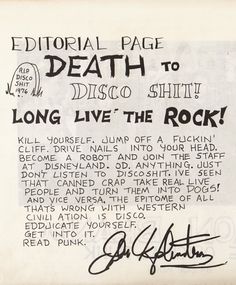
But its real accomplishment was in unifying all the disparate CBGB's groups into an identifiable "scene." Holmstrom's opening editorial — Death To Disco Shit — was an ultimatum:

Editorial - Punk issue #1
ISSUE #1: Published on January 1, 1976. A Holmstrom-drawn caricature of Lou Reed graces the cover; inside is a four-page comic strip interview with Reed. "A lot of people told me, 'It's the best thing you've ever done and it's the best thing you'll ever do,'" says Holmstrom.

There's also a feature on Marlon Brando: The Original Punk, as well as a Legs McNeil "Famous Persons Interview" with cartoon personality Sluggo ("It gets tiring playing a stupid tramp..."), a Ramones centerfold, and a photo essay called "Cars and Girls" which outlines McNeil's dating tips.

Lou Reed - cover of Punk #1
Dunn put up the $5,000 needed to print 5,000 copies. Folding the 17x22 sheets would have cost extra, so this was done by hand. Two thousand copies were given to a distributor who was "supposed to" put them on newsstands all over New York. Supposed to? "He didn't," says Holmstrom. The remaining copies were all sold or given away.

In fact, the first issue became such a sought-after collector's item that back issues were priced at $25 to discourage ordering. "We heard that somebody broke into an apartment in Detroit, and the only thing they stole was a copy of Punk #1," boasts Holmstrom.

Creem, Rock Scene, the Soho News, and The Village Voice all gave the first issue enthusiastic write-ups. Lester Bangs said he wanted to leave Creem, so he could move to New York and write for Punk. Danny Fields proclaimed Holmstrom a genius, and Lou Reed said the 'zine "knocked him out."

"Everybody was falling all over themselves to praise us," verifies Holmstrom. "Girls who wouldn't look at us before were suddenly trying to pick us up. It was great!"

ISSUE #2: Published March 1976. Using two different photos of Patti Smith on the cover was, reflects Holmstrom, "dopey." As well as an interview with Smith, this issue includes the Talking Heads, Marbles ("What a mistake"), and Television ("Boring"). A three-word review of Bob Dylan's Desire album reads: "Sludge, mud, suds."

Patti Smith - cover of Punk #2
"It was a mess," sums up Holmstrom of #2. "The whole issue is so wimpy. People said it was horrible. And it killed us because we printed more [7,500] copies."

ISSUE #3: Published April 1976. "Boy, that came out quick!" marvels Holmstrom. A brilliant issue, beginning with a beautifully illustrated cover of Joey Ramone drawn by Holmstrom. Inside, Joey reveals that he likes girls who are fun and out of their minds. Tommy's fave TV show is Zorro. Dee Dee's pet peeves are crummy sound systems and nagging, pushy girls. And Johnny's dream date is a meal at Jack in the Box. There's also a year-by-year diary that tracks our heroes from high school in Forest Hills to the release of "Blitzkrieg Bop."

Half-a-dozen pics taken by then-novice photographer Roberta Bayley accompany the Ramones story. Holmstrom remembers the photo session and how it led to the cover of the Ramones' debut LP: "First we shot them in their loft in front of their banner. Then Legs said there was a cool playground around the corner, 'Let's take them there!' So, we took all these pictures in front of a brick wall for the magazine. Then Danny Fields called us up, 'Have you got anything? Any pictures at all?' The Ramones had hired some famous photographer to do their record cover... 'The pictures look horrible.' They looked through Roberta's and found that one great picture from the session that became the album cover. They only paid her like $100."

Joey Ramone - cover of Punk #3
Plus, the gang interviews ex-New York Doll David Johansen, who observes: "We maintained [the Dolls] on a very democratic level. I mean, you can ask Jerry about that." Pam Brown interviews the Heartbreakers, and Jerry Nolan says: "There was a certain member of the Dolls that sorta had most of the say and I disagreed with him completely."

Holmstrom's mother writes a Letter to the Editor: "Please pay your bills. Find a job that will pay you and let the cartooning be a sideline. You have wasted a lot of time already. Love, Mom." Debbie Harry models Punk t-shirts, and Legs conducts a "Famous Persons Interview" with Boris and Natasha:

Boris: We have certain members of de so-called "Free World" which have plagued our organization for years... a certain squirrel...

Natasha: And a very dumb moose.

"This issue was really sharp!" enthuses Holmstrom. "$850 worth of ads in it according to my copy."

By this time, Rough Trade was distributing Punk, air-shipping thousands of copies to the UK. "I would have to say that Punk helped create and fuel the English scene," states Holmstrom. "I don't think it ever would have happened like it did if it weren't for this magazine. When Blondie went over there, Chris Stein told me that everyone was throwing up because Legs threw up in the Richard Hell story." (And there's no doubt that Punk influenced such British do-it-yourself fanzines as Sniffin' Glue and Ripped & Torn.)

Beware of Imitations! Punk is the BEST! Advert from issue #11.
ISSUE #4: Published July 1976. Iggy Pop is on the cover. "We let Pam Brown interview him," says Holmstrom, "and that was kind of a mistake. Iggy wanted to talk to me. I met him later on; we talked about insects and stuff." In addition, there's an interview with Richard Hell's female alter-ego Theresa Stern; Legs goes to Gilligan's Island; Debbie Harry is the pin-up centerfold; and Lester Bangs contributes "Diary of a Cabby," a story based on Taxi Driver.

Iggy Pop - cover of Punk #4
"Lester was obsessed!" discloses Holmstrom. "He would play the movie instead of music, and he would force everybody to listen to it."

Perhaps most surprising was a Holmstrom-penned review remarking favorably upon the new Donna Summer record. Did he really like Donna Summer?

Holmstrom: Yeah...

What about that "Death to Disco Shit" editorial in issue #1?

Holmstrom: I wrote that as a joke! I was shocked when everybody took it seriously, and this big anti-disco movement happened.

ISSUE #5: Published August 1976. Holmstrom dubbed #5 the Ultra Wimpy Dull Issue. "It wasn't that interesting," he acknowledges. "I ran into Lou Reed at a party, and he told me how fucked up the magazine was. That's when I got determined to do something cool." This decision led to...

The Monkees - cover of Punk #5
ISSUE #6: Published October 1976. "The Legend Of Nick Detroit: A Film Starring Richard Hell." Legs McNeil wrote and directed; Roberta Bayley and Chris Stein (among others) operated the cameras.

The first of Punk's photo/comic special issues follows the adventures of Government Agent/ inhuman killing machine Nick Detroit (Hell) and his faithful sidekick Norris McGillicuddy (McNeil). The cast features a plethora of New York's finest, including Lenny Kaye (Special Agent Victor Martino), Tina Weymouth and Chris Frantz (ruthless murderers in barbershop), David Byrne (Special Agent Reed), David Johansen (Tony the Rose), Tuff Darts (a squad of armed goons), the Marbles (coppers), Helen Wheels (General George the Dyke), and Debbie Harry and Anya Phillips (Nazi Dykes).

It had been a couple of months between issues #5 and #6. "We had pretty much stopped publication," states Holmstrom. "We ran out of money after #5." 

Enter Tom Forcade, publisher of the very successful High Times magazine.

"The Legend Of Nick Detroit: A Film Starring
 Richard Hell" - cover of Punk #6.
"Tom came into the office in the summer of '76," recalls Holmstrom. "He put his feet up on the table and said, 'I'm gonna make you rich and famous.' He was going to distribute Punk and set up a company to sell advertising for us."

With the publication of "Nick Detroit," Holmstrom and McNeil were the toasts of CBGB. "I remember after it came out, Legs got mobbed! Twenty people surrounded him! He was freaking out. He didn't know what to do."

An optimistic 10,000 copies were printed, but the issue bombed, and High Times backed out of its deal.

"In retrospect it's wonderful," muses Holmstrom about issue #6. "But nobody wanted to read it then. Everybody wanted to read record reviews, I guess."

(Update: According to illustrator Bruce Carleton, the "Nick Detroit" panel featuring Debbie Harry and Anya Phillips used at the top of this article "didn't appear in #6, but was done a year or so later for a version that was supposed to be published in Germany. That never happened, and I had thought all the boards were lost.")

ISSUE #7: Published February 1977. The special Upside-Down issue — every other article was printed upside-down. "I went nuts!" declares Holmstrom. Patti Smith was on the cover for a second time. "It was between her, Blue Oyster Cult, Eddie and the Hot Rods, or Satan," says Holmstrom. This issue also includes Lou Reed's rapidograph drawings, an interview with rock journalist R. Meltzer, and comic strip record reviews.

Patti Smith - cover of Punk #7
Punk was back in business thanks to Tom Katz (a pseudonym). Katz had received a $20,000 settlement from the City of New York for the wrongful death of his brother; he gave the entire amount to the struggling magazine.

ISSUE #8: Published March 1977. For the first time, there's an English band on Punk's cover — the Sex Pistols, of course!

Johnny Rotten discourses while Bob Gruen takes photos; Holmstrom does a phoner with Frank Zappa; McNeil interviews Hitler; there's an advertisement for a Battle of the Bands between the Ramones and the Dictators (it never happened — "The gig fell through," comments Holmstrom); and a letter to their landlord exposes the conditions in which Punk was produced: "Front door lock must be installed and secured properly, raw sewage leaking from ceiling frequently, gaping hole in the ceiling must be patched, leaky toilet and plumbing fixed, regular heating — we have not had any heat in two days..."

"I'll never forget when they came to fix [the leaking sewage]," says Holmstrom. "Somebody flushed the toilet upstairs, and sewage was gushing all over Legs. He was sleeping, and he wouldn't wake up. I was like, 'Legs! Raw sewage is on you! Get up!' And he was like, 'I don't care. I wanna sleep.'"

The Sex Pistols - cover of Punk #8
Publisher Ged Dunn was fired after this issue. "He didn't know what he was doing," asserts Holmstrom, emphasizing that the $20,000 given to them by Tom Katz was now gone.

According to Holmstrom, "He wasted what little money we had on some typically crazy publishing philosophy: put out a glossy product and get the advertising... blah, blah, blah. We should have just been run efficiently and economically. Instead, we were going out of business every six months."

As an early indication of the problems to come, Holmstrom refers back to the naming of the magazine: "Ged wanted to call it The Punk Journal. He wanted it to be very pretentious."

ISSUE #9: The first of the fabled "lost" issues of Punk. If it had come out, it would have featured the Damned on the cover. Inside, you might have read the interview with KISS. "We ran into them at Lou Reed's party," mentions Holmstrom. "Paul and Gene made a point of talking to us. They seemed like cool people, and I didn't mind their music." You could have perused the excerpt from William Burroughs' Junkie or chuckled over a comic strip entitled "Life of a Fly." Alas, #9 never saw the light of day.

Holmstrom states that the printers had been paid in advance and adds, "We gave them the original layout, so they'd have high-quality artwork to reproduce from." However, when he went to collect the 'zines, the print shop had disappeared — along with all the artwork.

"All the machines, printing presses and stuff were gone! The worst thing about it was we had rare, one-of-a-kind photographs of William Burroughs hanging out with Allen Ginsberg and Jack Kerouac — priceless stuff. The last thing I expected was that the printer would evaporate into thin air."

David Johansen as Tony the Rose & Cyrinda Fox as Tony's Lady.
"The Legend Of Nick Detroit: A Film Starring Richard Hell"
Punk #6
ISSUE #10: Published Summer 1977. A cartoon version of Debbie Harry strikes a Betty Boop pose on the cover. The issue opens with photos from the Punk Benefit Concert hosted by CBGB. The two-night affair (May 4 & 5, 1977) raised $2,000. Performers included Alex Chilton, the Dead Boys (joined by the Dictators' Ross the Boss), Suicide, the Patti Smith Group, the Cramps, the Lester Bangs Conspiracy (Bangs' stage debut, not counting playing the typewriter with BOC), Richard Hell & the Voidoids, and Blondie. An auction also helped raise funds. "Debbie Harry's underwear went for $25 or $50!" exclaims Holmstrom.

Elsewhere in this issue: Eno gets philosophical ("...the most embarrassing aspects of the things you do are normally the ones that are most interesting..."); Blondie goes on tour and Chris Stein snaps some pics to prove it; Twiggy chats about fashion ("I think people are gonna do what they want, which I think is lovely"); and the Ramones are #1 on the new Top 99 list. (Other stuff deemed cool by Punk readers: towels #16, carbon monoxide #51, and parking lots #71.)

Debbie Harry - cover of Punk #10
Lining up acts for the benefit was easy. Holmstrom says the CBGB bands were grateful for Punk's coverage, and in return, they were always happy to lend a hand.

"What happened was, we would often write an article on a band and the next month they'd get a record contract. At the time it happened, the Ramones credited us with getting them signed. Danny Fields told us, 'Thanks a lot for the publicity you did. It helped get us the deal.' Blondie told us the same thing. They said, 'We'll be forever in your debt.' And the Dead Boys the same."

Did Holmstrom ever use this power for evil? "I do remember one [unnamed] band who offered us $500 if we'd put them on the third cover, but we didn't do it. So, we were pretty committed to whatever vision we had, as screwed up as it was." (Hint: When the mystery group broke up, their newly solo lead singer did make it onto a cover. For free!)

ISSUE #11: Published October/November 1977. Handsome Dick Manitoba and an American flag fittingly share the cover. "We wanted to do the ultimate Dictators' story," says Holmstrom. And they did. Beginning in 1971 ("Andy started his first band — Grand Funk Salinsky..."), their history is charted on an almost daily basis. (October 31, 1974 — "Manitoba does his infamous White Castle french fries act, during which he ate hamburgers and threw bags of french fries at the audience, yelling 'Rock 'n' roll? BAH! Who needs it?!'")

Handsome Dick Manitoba - cover of Punk #11
In the news: Russ Meyers is directing Johnny Rotten in a major punk rock movie, and Blondie is recording their second LP. Plus, John Cale holds court ("People aren't stupid — they can tell when someone's disinterested in what they're doing") and Lester Bangs reviews the Dead Boys ("They are evil, they are everything you would not want your mother to marry"). And San Francisco's punk scene gets a nod with our representatives, Crime.

Putting Manitoba on the cover was a risky move. "We really went to the wall for the Dictators," confirms Holmstrom. The previous March, Manitoba was involved in what became known as "The Wayne County Incident." As Punk reported: "Dick was on his way to the men's room so he stepped over the stage. He called Wayne County a homo. Wayne County called him a fat fuck and slugged him with a microphone stand."

"Everybody was for Wayne County," states Holmstrom. "The Dictators were basically blacklisted. Everybody in New York hated them." Issue #11 was not a big seller in New York.

ISSUE #12: Published January 1978. Robert Gordon (recently split from Tuff Darts) is this issue's cover boy, and eight-year-old Nellie Kurtzman (cartoonist Harvey Kurtzman's daughter) is the "Punk of the Month." Meanwhile, the New York Dolls garner a five-page photo spread with text that contends: "If they stuck it out they could've been like the Beatles — leaders of a new sound/generation"; a photo/comic pairs Debbie Harry and DEVO in "Disposable DEVO"; the Turtle Mountain Community School in Belcourt, North Dakota, cancels its subscription in a huff ("We were under the impression the magazine was for kindergarten and elementary levels"); and the Ramones are still #1 on the Top 99.

Robert Gordon - cover of Punk #12
"I didn't like this issue very much," admits Holmstrom. "Legs was in the hospital for drinking." (One page features a fun maze titled "Help Legs get out of the mental hospital.") However, Holmstrom points out, "this issue sold fantastically!"

Issue #12 also saw the return of High Time's support (the full-color ad for e-z wider rolling paper is a dead give-away). "We didn't have the money to print this issue," says Holmstrom. "So, I went back to Forcade, and he said, 'That's funny, I was just going to get back in touch with you. I think it's time for us to try again.'"

ISSUE #13: The second "lost" issue. Some of the pieces scheduled for this issue were carried over to #14 (the Bay City Rollers interview), while others were scrapped (the cover story on boxer Sugar Ray Leonard). Ostensibly, they skipped this issue because of superstition. In reality, Forcade was pushing for "a big thing on the Sex Pistols," states Holmstrom.

ISSUE #14: Published May/June 1978. Johnny Rotten and Sid Vicious portrayed as puppets (perfect!), are on the front cover. The Bay City Rollers, portrayed as gigantic people-eating, building-crushing monsters (perfect!), are on the back cover. In between, Holmstrom reports on the Sex Pistols' tour of America:

Atlanta: Sid managed to get lost and gave himself a nice wound in his arm...

San Antonio: They played "New York," John spitting the words "You fucking little faggots" at the audience.

The Sex Pistols - cover of Punk #14
Dallas: A punkette from L.A. gave [Sid] a bloody nose so he wiped the blood all over himself. He was so out of it he was playing with three busted strings on his bass.

Tulsa: I walked to the elevator carrying a six-foot pair of steerhorns. John was waiting there with his bodyguard... "What the FUCK is THAT?" "Steerhorns," I mumbled... "Want them?" Greed overcame his face in a strange smile...

San Francisco: Malcolm was extremely depressed after the show. "Fuckin' awful show, wasn't it? They were just like any other rock band." Everyone connected with the band felt the same way.

For their part, the Rollers are shown to be even more heinous than the Pistols. The writer complains: "These guys never spend any money! They eat McDonald's food... They can't even buy their own cigarettes..."

This 56-page, action-packed issue also gives us Dorian Zero: "That was one of my finest moments!" chortles Holmstrom. "He says to me, 'Put it this way, if I can get over by being called punk rock, I'll do it.' He's not a punk, but he's calling himself a punk because he wants to be famous! How stupid can you get?" In other news: Amanda Lear — sex change or not? Legs conducts a "Famous Persons Interview" with Combat star Sgt. Saunders ("Live hard, fight hard and dig a lot of foxholes. That's my motto"), and Holmstrom talks about girls with Angus Young:

John: What kind of girls do you like?

Angus: Dirty ones.

John: Girls who don't wash?

Angus: No, just dirty cows.

Plus, Edith Massey gets aggressive about cereal: "Pebbles... that's what I had for breakfast, and these little punks better have the same thing. Maybe with a little raisin or two on it." Lou Reed's Street Hassle is reviewed ("Of course it's great" — J. Holmstrom), and it's not too late to order your 1978 Punk calendar featuring Suicide, Iggy Pop, the Paley Brothers, cartoons, and important dates — like Heckle and Jeckle's birthdays!

A Legs McNeil "Famous Persons Interview"
with Boris and Natasha - Punk issue #3.
Punk was looking mighty spiffy by issue #14. There were lots of full-color photos, and some of it was professionally typeset. "Forcade was trying to get us to come out on time and be a real magazine," moans Holmstrom. "It was killing me."

But now there was big-time competition in the form of a new bi-monthly, nationally distributed magazine ingeniously called Punk Rock. Published by a conglomerate called Stories, Layouts and Press, Inc., it was a shoddy attempt to cash-in on the bandwagon. Its staff had names like Nancy New Age and Sheena Ramona. And the editorials insulted its readers en masse ("Hello, all you spoiled, middle-class little assholes..." began one) and Holmstrom personally. "They called me an asshole," he says. "It was awful."

"Mutant Monster Beach Party" - Punk #15
In this issue, Punk responded to its rival: "We are not jealous of our honestly acquired position or of other worthy publications devoted to modern music," stated Holmstrom's proclamation, which urged "fans and readers" to check out other underground 'zines like Slash, Bomp and ZigZag. "These magazines, for the most part, are put out by people who believe in what they write. They don't write for money. They're not covering the latest youth fad."

ISSUE #15: Published July/August 1978. "Mutant Monster Beach Party: an original Punk International Production." Holmstrom designed this issue, while Bruce Carleton illustrated the cover; Roberta Bayley took the photographs.

Punk's second photo/comic special — and its most ambitious undertaking — stars Joey Ramone as a dreamy surfer boy and Debbie Harry as the beach bunny he loves. It's a simple boy-meets-girl tale. Until a mad scientist accidentally turns his assistant into a hideous blob of quivering nuclear slime which escapes from the lab. The slime helps some Bothersome Bikers stomp all over the surfers and kidnap the girl. Martians in a flying saucer help the boy get the girl back. The monster turns into Peter Frampton and the girl turns into Edie the Egg Lady.

The sizable cast included Andy Warhol (mad scientist), Chris Stein (Debbie's dad), Peter Wolf (head biker), Scott Kempner and Ivan Julian (surfers), John Cale and Lester Bangs (bikers), David Johansen (priest), and Joan Jett (maid of honor).

"Mutant Monster Beach Party" - Punk #15
The wedding photoshoot.
Advertised as "coming soon" as far back as issue #10, "Mutant Monster Beach Party" was two years in the making.

"We were shooting this all the time," says Holmstrom. "When Debbie introduces Joey to her father, that was shot at the sound studio when the Ramones were recording Rocket To Russia."

During the creation of this issue, some of the cast went from obscurity to worldwide fame, but Holmstrom only recollects one slightly tense episode. "We were doing [Joey and Debbie's] wedding shot. It was one of the last pictures we did, and Debbie was visibly agitated. You can tell she's getting tired of hanging around all day waiting to do a photo shoot for us."

Sadly, like "Nick Detroit" before it, this photo/comic sold "horribly," states Holmstrom. "It put us out of business." Again.

ISSUE #16: Published March/April 1979. A cartoon send-up of John Travolta's Saturday Night Fever character is on the cover. "[The movie] had come out six months earlier," notes Holmstrom. "It was a very smart thing to do."

Inside, Shrapnel star in the "Brat Patrol" photo/comic ("Shrapnel — the janitors of justice, are out to sanitize New Jersey..."), and Bob Geldof insists he's not just in a band to get rich, famous and laid more often ("I'm in it for revenge as well, to prove to people that in fact I was never a nobody, that I was always a somebody and that the rest of them can eat shit!"). An interview of sorts with Sid and Nancy (an extract from the upcoming film D.O.A.) fills up the centerfold:

Mutant John Travolta - cover of Punk #16
Nancy: Wake up and answer him.

Sid: I'm answering...

Nancy: He asked you a question... It's no time to go to sleep!

Sid: Grunt... What was the question again?

Punk's new Resident Punk, 15-year-old Jolly (Legs retired from the post to manage Shrapnel), reviews some records:

The Doors/An American Poem
"Who said this was good?!? This stinks!!!"

The Ramones/Road To Ruin
"Best album of the year."

Plus, the Bottom 99 makes its debut (Studio 54 is listed three times), and the Ramones are still #1 on the Top 99.

It had been nearly half a year since the "Mutant Monster Beach Party" issue. The magazine was being sued for an old printer's bill and was declaring bankruptcy.

On October 13, 1978, Punk held its 1st (and last) Annual Awards Ceremony — as much to say farewell as to thank all the groups. Posters for the celebration promised: "Meet Jolly! Mutant Monster Live In Person! Be Able To Buy Drinks! A Special Concert By A Surprise Rock 'n' Roll Band!" The day prior to the show, Sid (or someone) killed Nancy.

Poster advertising the 1st Annual
Punk Magazine Awards Ceremony.
"Everybody flipped out," understates Holmstrom. "There were television cameras all over the place, and nobody wanted to talk to the media. Nobody wanted to be there."

Not quite the spectacular event he'd hoped for? "Oh, it was spectacular all right. Lou Reed [winner of the Class Clown award] hasn't talked to me since."

Some of the grisly details were printed in issue #16. "[Jolly] was the emcee and provided a fine target for the evening's beer bottles, glasses, pieces of table and assorted projectiles... The awards themselves — various novelty items such as plastic dog turd, lemons, brooms, or baseball trophies mounted on Budweiser cans left over from the night before — proved totally worthless as most of the recipients were too embarrassed or afraid or smart to go on stage anyhow."

Issue #16 sold "like hotcakes," and John Spacley ("the one drunk who was so obnoxious he had to be thrown out" of the awards show) became Punk's new publisher.

ISSUE #17: Published May/June 1979. The last official issue. In a Punk exclusive, Jolly interviews "that fantabulous rock band," the Rolling Stones:

The Clash - cover of Punk #17
Q: What's your favorite color?

Rolling Stones: Red.

Q: Are you playing any dates soon?

Rolling Stones: Yes.

Undeterred, Jolly also gives the Clash a go...

Jolly: I saw the show last night and it wasn't so great...

Topper: Then don't do the fuckin' interview, then.

David Johansen answers the musical question: Does rock and roll go in ten-year trends? ("I think locusts come out every fourteen years or something like that. That's about the only thing you can count on. Locusts.") McNeil and Alice Cooper compare booby hatch info (Alice: "There was one girl who smashed the stereo every three or four days... she went for the TV one night and I had to stop her... If she broke the TV, I couldn't watch The Odd Couple"). Holmstrom reviews the London Symphony Orchestra's new one and the state of things in general: "This record, more than disco, more than Billy Joel, or Sid Vicious, more than the fact that punk rock and new wave is being swept under the carpet by radio programmers, Jimmy Carter, and dullards, spells the end of rock 'n' roll." Destroy All Monsters' lead vocalist signs her pin-up centerfold "I love you, but you're dead," and Shaun Cassidy's mug is the backdrop for a graffiti contest.

From the outset, Holmstrom had wanted to produce an underground 'zine that combined rock 'n' roll and comics. McNeil's fondness for rock tilted the early issues in that direction. But as Legs became less involved, Holmstrom began working closely with illustrator Bruce Carleton, tipping the scales towards humorous art.

"Blondie In Punk" - Debbie Harry models the Punk t-shirt in issue #3.
Photos by Chris Stein
Carleton designed this issue's cover collage of rock 'n' roll mayhem. And inside, there were more examples of his work: a subscription coupon set amid the Monolithic Punk Meat Grinder, and a spread depicting Leonid Brezhnev as the Punk Playmate (Goals: "...to become a successful fashion model and to bury the U.S.A.").

Other cartoons included "Ze Artiste" and "Joe's Pimple Pop Boffo" — both drawn by Holmstrom. "By this point, I was really thinking of making Punk a humor magazine instead of a rock magazine," he confesses.

Holmstrom's disenchantment shows in his summation of issue #17: "This is sorta like the last Sex Pistols' gig — an Alice Cooper interview with [record company] publicity photos, some humor, but... who needs it?" The final issue sold "really badly."

ISSUE #18: Holmstrom owns the only extant copy of #18, nicknamed the "Rock 'N' Roll High School" issue in honor of the Ramones' movie it (would have) publicized. This issue also contains another comic strip interview with Lou Reed, and the Plasmatics take over the #1 position on the Top 99.

All pasted-up and ready to go, #18 never made it to the newsstands. "The owner of the printing company took one look at it and said, 'I'm not gonna print this shit!' We had trouble with printers. A lot of them refused to print the magazine. We were too sleazy." But fussy printers weren't the magazine's only nemesis. In the end, it was Punk's stubborn refusal to go corporate that actually doomed it.

Surf's up! Joey rides the waves in "Mutant Monster Beach Party." 
Punk #15
Schedules? We Don't Need No Stinking Schedules! Punk's printing schedule was, at best, erratic. A voucher in #10 inquires: "new address?" then warns, "You better let Punk know in case another issue ever comes out." Needless to say, this charming unpredictability scared off many potential advertisers. And although more advertising would have meant more income and thus more issues, Holmstrom stresses: "We were trying to do something creative and different and exciting, and you can't always do that on schedule."

And then there were the subscribers. There were just too many of them. One promotion with Creem netted 2,000 of the buggers alone! "So, we had to print at least 2,000 copies of anything we did," grumbles Holmstrom. "And when you get into the printing and mailing of 2,000 copies — who's got the money?"

But all in all, Holmstrom is content with Punk's historical niche. "I knew when I was doing it that I was doing something important, and something that would be enjoyed for a long time. And at the same time, something that wouldn't last long."

* * *

A few updates:
The 25th Anniversary issue

After the demise of Punk, Holmstrom worked for several publications including The Village Voice and Heavy Metal. In 1986, he contributed a comic-based chronology of punk rock for a special edition of Spin.

In 1993, Holmstrom and McNeil teamed up once again to produce the short-lived (four issues) but wonderfully eclectic Nerve magazine. Over the years, several special editions of Punk have been published. In 2000, an issue featuring Murphy's Law marked the magazine's 25th Anniversary, and they paid "A Tribute To CBGB" in 2007.

In 1996, Legs McNeil and Gillian McCain published Please Kill Me, considered to be the definitive oral history of punk rock.

The Best of Punk Magazine
book cover
In 2012 HarperCollins published The Best Of Punk Magazine, an oversized book containing high-quality reproductions of the original issues, behind-the-scenes stories, and an interview with Joey Ramone from the unpublished "Rock 'N' Roll High School" issue.

For more information about Punk, please visit: punkmagazine.com