By Devorah Ostrov
 |
The Strawberry Alarm Clock - circa 1967 publicity photo
|
In the fall of 1967, Lulu's theme from the film To Sir With Love had been the #1 song in the country for an astounding five weeks, successfully holding off both the Association's "Never My Love" and the Young Rascals' "How Can I Be Sure." However, the week ending November 25 saw Lulu knocked to #2 by six Southern California teenagers dressed in "psychedelic pajamas" and brandishing an absurd moniker: The Strawberry Alarm Clock.
"Incense and Peppermints," SAC's loopy "flower-power anthem" (as it was later termed), was released in May 1967 on Uni Records. It entered the Billboard Hot 100 in September and hit #1 eight weeks later. But the tune for which the group is best known actually started out earlier that year on the All-American label as the B-side of the gimmicky "Birdman of Alkatrash" by Thee Sixpence.
* * *
 |
Uni Records promo poster
|
The members of the group initially included vocalist Michael Luciano, guitarist Ed King, vocalist/guitarist Lee Freeman, guitarist Steve Rabe, bassist Gary Lovetro, and drummer Gene Gunnels. Their manager, Bill Holmes, also owned All-American Records, the small-time label for which the band recorded.
By the time they went into Original Sound studios in early 1967, Thee Sixpence had already issued several singles, including covers of "Fortune Teller" and "Hey Joe," without garnering much attention.
This time, the plan was to record "The Birdman of Alkatrash" — a garage-punk nugget written and sung by their new keyboardist Mark Weitz — as the A-side of their next 45. Without giving it much thought, they also laid down a bouncy untitled instrumental written by Weitz and King for the B-side.
In the meantime, their producer, Frank Slay, contacted John Carter (co-writer of the minor hit "That Acapulco Gold" for psych group the Rainy Daze) to ask if he was working on anything new. This was the moment that Carter mentioned an idea he had for a song title: "Incense and Peppermints."
 |
The Strawberry Alarm Clock with the Voxmobile!
|
Legend has it that Carter and Gilbert used a rhyming dictionary to string together the (as stated in the lyrics) "meaningless nouns" that make up the bulk of the tune:
 |
Advert for the 1st Annual Sacramento Pop
Festival with the Jefferson Airplane, the
Strawberry Alarm Clock & Spirit
October 15, 1967
|
Good sense, innocence crippling mankind
Dead kings, many things I can't define
Occasions, persuasions clutter your mind
Incense and peppermints the color of time...
While the verses are just a nifty jumble of words that don't really mean anything, the world-weary hook ("Who cares what games we choose/Little to win, but nothing to lose") gives the song some gravitas and is most likely what elevates it to "anthem" status.
Shortly thereafter, Carter was invited to hear Thee Sixpence record "Incense and Peppermints." And that's when things got a bit complicated.
Of this historic get-together, Carter has been quoted as saying: "It was the first time I met the band, and they resented the fact that someone had written a song to their track."
However, when I recently interviewed SAC bassist George Bunnell (who joined after the recording of "Incense and Peppermints") about the group's history, he related a very different scenario.
 |
14-year-old Sara Zito calls the Alarm Clock's music
"fire-rock" in this teen 'zine article.
|
The story continues with a dilemma over who would actually sing the song.
One report alleges that Carter originally recorded the vocals himself, but the band was dissatisfied with that version.
Another says Carter flatly told Freeman he was wrong for the song. Other accounts describe how various band members also gave it a go but struggled to get it right.
Supposedly, Carter finally chose a young guy he thought was in the group to sing lead on the track.
Another says Carter flatly told Freeman he was wrong for the song. Other accounts describe how various band members also gave it a go but struggled to get it right.
Supposedly, Carter finally chose a young guy he thought was in the group to sing lead on the track.
But when he returned the following day and asked where the singer was, the band had a good laugh. "Oh, him? He was just a friend of ours," they guffawed. The tale concludes with the mystery vocalist conveniently disappearing off the face of the earth.
In April 1967, "The Birdman of Alkatrash" b/w "Incense and Peppermints" by Thee Sixpence was issued locally on All-American (there are rumors of an early pressing where Peppermints is misspelled). And thanks in large part to KIST music director Johnny Fairchild who flipped the single over, they soon found themselves with a regional #1 record.
"He played 'Incense and Peppermints' like it was the biggest hit in the country!" enthuses Bunnell of the Santa Barbara DJ.
On the strength of the song's local success, the band was quickly signed to Uni Records, a then-new subsidiary of MCA. But with the signing came the realization that other groups were working under variations of Thee Sixpence, so finding a new name became a priority.
The oft-repeated explanation of how they became the Strawberry Alarm Clock begins with Weitz turning to the Billboard Hot 100, closing his eyes and putting his finger down on the Beatles' "Strawberry Fields Forever." Which may or may not be true.
"It's one of those things I've never asked Mark," says Bunnell. "We used to make up different stories all the time just for fun!"
The finger on the Hot 100 anecdote is good, but it has some possible holes that need researching.
"I'm not sure if 'Incense and Peppermints' came out before or after 'Strawberry Fields Forever,'" admits Bunnell. (And was it in the Hot 100 during the necessary time frame?)
(Mark Weitz has since verified that Strawberry did indeed come from "Strawberry Fields Forever." He says, "It's one of my favorite Beatles songs.")
At least the inspiration for the Alarm Clock portion is straightforward. "The whole group was sitting in Mark's bedroom trying to think of something to go with Strawberry," recollects Bunnell. "Mark had an alarm clock that made a swishing sound when the second hand went across the 12, which you couldn't hear unless it was deadly silent. They'd all been throwing out names [Strawberry Toilet was rejected] and finally they were all quiet for a while, and everyone heard the swish of his clock. They all looked up at the same time and said, 'Alarm Clock!'"
In May, Uni reissued "Incense and Peppermints" as the A-side of the new Strawberry Alarm Clock 45. Almost instantly, it became the most requested song (two weeks running) in Los Angeles, at which point it went national.
It's definitely an understatement when Bunnell exclaims, "It started to go crazy all over the place!"
On September 23, 1967, SAC performed "Incense and Peppermints" on American Bandstand, immediately after which it entered the Billboard charts at #88. By late November, it was the #1 song in the country, and by December it had gone gold.
But Uni didn't wait that long to capitalize on the success of the single. As soon as "Incense and Peppermints" began to take off in LA, studio time was booked for the Alarm Clock to record a full-length album.
This could have been difficult for a group whose setlist was packed with covers. But before the band changed its name, several alterations had been made to the lineup — one of which landed them a second bassist who was a prolific lyricist and his flute-playing co-writer.
Vocalist Michael Luciano and guitarist Steve Rabe left Thee Sixpence around the same time that Mark Weitz joined, which was sometime before the initial All-American recording session. (Bunnell notes that Rabe went on to found SWR Engineering, a specialist manufacturer of bass guitar amps and speaker cabinets.)
And once he'd finished recording the drum track for "Incense and Peppermints," Gene Gunnels quit the group. According to one account, his father insisted he go to college; another says his girlfriend insisted he get a job.
Either way, Gunnels replacement was a blond teenager named Randy Seol, who proved crucial to the Alarm Clock's future.
Seol and his friend Bunnell were seniors at Taft High School in Woodland Hills, where they had a band called Waterfyrd Traene (which included freshman Steve Bartek on flute).
The drummer first met his future SAC bandmates when Waterfyrd Traene shared a bill with Thee Sixpence at a party in Northridge, and he was recruited into the group in time to add some background harmonies on "Incense and Peppermints."
From the beginning, Seol lobbied to bring Bunnell in on bass, but the band wasn't keen to replace Lovetro. However, he was able to bring in several original Waterfyrd Traene tunes co-written by Bunnell and Bartek.
Perhaps Waterfyrd Traene's most important asset, the Bunnell/Bartek team had been collaborating for three years, amassing an impressive catalog of over 100 songs.
"We read dictionaries, encyclopedias, novels and poetry to find ideas," states Bunnell, explaining how the two youngsters came up with such inspired weirdness as "Paxton's Back Street Carnival":
Bunnell is adamant there was no LSD involved ("We didn't even know about that!") and claims, "We didn't even know what we were writing about."
(There's an amusing story about a girl at Taft High who told Bartek, "I really know what you're talking about in these songs." To which he replied, "You do?")
When it came time to record the LP, Bunnell and Bartek were asked to play on the material they'd written, and then invited to join the band. Both boys said, "Okay." But Bartek's mom said, "No!"
"He came back and said, 'My mother says I can't do it,'" chuckles Bunnell. (The 15-year-old wasn't allowed to join the group, but Bartek did play flute on several album tracks. And when he grew up, he became the lead guitarist and producer of Oingo Boingo.)
Curiously, at this point, Bunnell didn't replace Lovetro. The album credits list Lovetro as first bassist and Bunnell as a second bassist — something which must be peculiar only to the Alarm Clock's lineup. And while they did sometimes play dual bass parts, Bunnell describes himself as more of a "utility guy."
He reels off a long list of job duties: "I was singing, playing guitar and a minimando [small mandolin], maracas, tambourine..." Bunnell also mastered the art of banging wood blocks together, which falls under the mysterious credit of "special effects."
Titled after their hit single, SAC's debut LP (which reached #11 on the Billboard charts) was recorded in just two weeks. "The record company had to have it right away," emphasizes Bunnell.
The album featured nine originals, most credited to the band as a whole, although four — "Birds in My Tree," "Strawberries Mean Love," "Paxton's Back Street Carnival," and "Rainy Day Mushroom Pillow" — also singled out Bunnell and Bartek. One number, "Hummin' Happy" (a charming ditty about squished dead birds and ladies falling into manholes), gives credit to Bunnell and Seol, who wrote the song when they were (to quote Bunnell) "teenage sadists."
Almost all the tracks can be classified as "psychedelic," but in a way you won't hear elsewhere. For instance, the "weird sounding guitar thing" (as Bunnell calls it) at the beginning of "Rainy Day Mushroom Pillow" was achieved by Seol picking out the guitar chords with his drumsticks!
Bunnell partially attributes the album's quirky trippiness to the spontaneity of working quickly in the studio. "We were rehearsing and recording at the same time," he says, "inventing while we went along, bouncing ideas off each other, and we were real open!" However, he also acknowledges the varied influences each band member contributed: "Mark's background was mostly classical; Randy's was jazz..."
Surprisingly, although Bunnell states that Uni exercised typical total creative control over the group — "They said what went and what didn't" — the label was pretty lax about the placement of the LP's title cut.
If Weitz and King weren't unhappy about ripped-off royalties, outside writers and a non-band singer before, they were certainly smarting now that the song was a massive hit.
Or maybe they were just trying to be cool when they buried "Incense and Peppermints" deep into side two and kicked off the album with "The World's on Fire," an almost 8⅟² minute epic — something even Dick Clark commented on during SAC's American Bandstand performance. "It's kind of an oddball thing," agrees Bunnell, "but that was what we wanted to do."
Once they'd finished recording the album, all that remained was finding a suitable image — apparently, Uni didn't dig the "long-haired, rock 'n' roll, garage band-type thing" they already had going on.
Bunnell recounts how they came upon the colorful East Indian attire, which became their trademark look: "We took a photographer and went to a bunch of different clothing stores and tried on stuff — silk shirts, shirts with big collars... Everything looked horrible! We thought, we're not gonna do this; we're not gonna wear uniforms. We just couldn't deal with it."
Bunnell continues, "But then Mark came upon this shop called Sat Purush and they had what they call kurtas, a traditional East Indian dress — psychedelic pajamas! The whole outfit was really funny... drawstring pants. Nobody wore drawstring pants! Nobody wore the Nehru collars yet either, except for East Indians. So, we put all this stuff on. We were laughing hysterically! But we liked it; the clothes were real comfortable."
Noted rock photographer Ed Caraeff snapped the LP's cover pic during a photo session at the Sat Purush shop in Westwood.
"They put us all over these pillows," remembers Bunnell, "and they had these rattan chairs, fans... all this weird stuff that we sat amongst. They took our picture in the store, and that was the album cover."
On the minus side, Caraeff's iconic photo firmly cemented SAC's psychedelic-chic persona, and the group that hated the idea of uniforms now had uniforms (albeit super comfy ones). "And we did it to ourselves," laughs Bunnell.
On the plus side, the guys got to go barefoot! "We were the only band playing barefoot," points out Bunnell. "The clothes looked funny if you wore shoes with them."
Around Southern California, the Alarm Clock earned a reputation as the best support band for the big touring acts of the day. They opened for the Jimi Hendrix Experience at the Earl Warren Showgrounds in Santa Barbara, the Yardbirds at the Santa Monica Civic, and for the Herman's Hermits/Who concert at the Anaheim Convention Center (where they were famously carried through the audience while sat on Persian rugs).
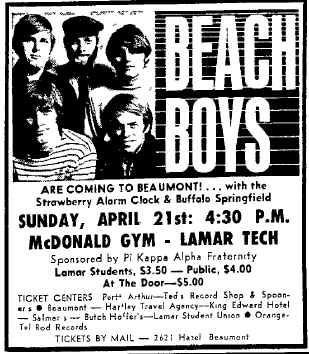
But when "Incense and Peppermints" went national so did they, playing 120 shows across the country on a bill with the Beach Boys and the Buffalo Springfield, which kept them busy for several weeks during November 1967 and April 1968.
"It was the biggest thing we ever did," says Bunnell excitedly. "We were flying in Lear jets and riding in limos, doing TV shows, staying in suites. It was unbelievable!"
"Unbelievable" is also the adjective rock writers began to throw at the band about this time. The screaming teenyboppers at their live gigs probably didn't notice that the guy singing "Incense and Peppermints" wasn't the one who sang it on the record. But it didn't escape the critics' attention that the vocalist lip-syncing the tune on the group's television appearances was someone else entirely.
"There were all kinds of rumors that the band wasn't the band," confirms Bunnell. "It was a very confusing mess."
Bunnell maintains that reproducing "Incense and Peppermints" live wasn't a problem, at least musically. "And vocally, it wasn't really a problem either," he adds, "because Lee sang the song just like Greg Munford. But our manager decided that on these TV shows, Randy should lip-sync the song because he was cute, and all the girls would go crazy. So, everybody thought that the drummer sang the song."
Seol might have been the group's designated sex symbol — "Every girl screamed his name everywhere we went," grumbles Bunnell — but the drummer was also famous for playing with his hands ablaze!
Publicity reports made it sound like he did it all the time, but Bunnell says the stunt was only done once and only during one song.
"It was at the Who show," he states. "Randy had gas jets coming down his sleeves, and when he played the bongos during 'The World's on Fire,' flames would come up through the vibes. It almost became something he had to do at every show, but the gas jets got real hot and left pipe burns on his wrists, so physically he couldn't do it."
While "Incense and Peppermints" was in the charts, teen 'zines ran "Win A Date With The Band" competitions ("Some girl got to go on a Universal Studios tour with me and Randy," Bunnell vaguely recalls). There were "Win The Kurtas Off Their Backs" contests ("To tell you the truth, I don't know whose clothes they gave the winner," he remarks). And there was a lot of fan mail ("Most of it was about Randy").
Throughout 1968 they guested on several TV variety programs, including Rowan & Martin's Laugh-In and The Jonathan Winters Show; Seol won an episode of The Dating Game; they even popped up in the Dick Clark-produced hippie flick Psych-Out.
But the hysteria was relatively short-lived. The week after it hit #1, "Incense and Peppermints" fell to #3, displaced by the Monkees' "Daydream Believer" and the Cowsills' "The Rain, the Park & Other Things." And it was all downhill from there.
In early 1968, the band's second album was issued with remarkably little fanfare. Wake Up...It's Tomorrow found the group not only whittled down to a five-piece with the departure of Gary Lovetro but also taking a more polished, almost easy-listening approach to their music.
Although many now consider this LP to be the Strawberry Alarm Clock's finest achievement, at the time, it didn't trouble the charts.
To make matters worse, in a bid to exploit the success of "Incense and Peppermints," Uni rush-released the (sort of) title track 45. "Tomorrow" — a breezy pop tune with mild psychedelic leanings — actually preceded the LP by several months and reached a respectable #23 on the Billboard Hot 100. Unfortunately, by the time the album was released, the single had exited the charts and taken any momentum with it.
Bunnell asserts that the group's stylistic shift with Wake Up...It's Tomorrow was an "experiment."
"The first album was an experiment and so was the second," he states. "It was just a different experiment. We were more crafty about the studio. By that time, we could come up with incredible effects and we were trying to use them, sort of leaving songwriting in the dust at least for me, and mostly coming up with instrumental-type things. It threw everybody off."
You could say that. But even with most of their audience having wandered away to listen to "Honey" and "Lady Madonna," in an amazing show of fortitude, Uni actually issued a few more SAC records.
A second single from Wake Up...It's Tomorrow — "Sit with the Guru" b/w "Pretty Song from Psych-Out" — was issued in March 1968, but it only went to #65 in the charts.
Bunnell and Seol stayed for a third LP, The World In A Sea Shell, which once again saw the input of outside songwriters, including Carter and Gilbert, on several tracks.
Following their departure, Bunnell and Seol joined up with some friends to form Buffington Rhodes, although they don't seem to have issued anything. Meanwhile, the Alarm Clock reorganized and carried on. Ed King switched from guitar to bass, original drummer Gene Gunnels returned, and former Nighcrawler vocalist/guitarist Jimmy Pitman was brought in.
In 1969 they released Good Morning Starshine, SAC's fourth and final album on Uni. By and large, it went unnoticed, and the title track single — the same song released at the same time as Oliver's version — peaked at #87 in the Hot 100. It was a dark day for the Strawberry Alarm Clock when Oliver soared to #3.
By 1970 it was pretty much over. A regional tour of the South (as replacements for an imitation SAC put together by the group's ex-manager) introduced King to his future bandmates in Lynyrd Skynyrd.
And that same year, the group (now a foursome fronted by vocalist Paul Marshall) could be seen in the Russ Meyer-directed trashy cult classic Beyond The Valley Of The Dolls.
"I've been to parties where they dance to records by the Strawberry Alarm Clock," announces Dolly Read's character Kelly McNamara, "but this is the first time the Strawberry Alarm Clock have ever been to the party!"
And other than a couple of "best of" compilations, everyone thought that was it. Until 1982 when the Music Machine club in LA advertised an upcoming Strawberry Alarm Clock gig, which came as a complete surprise to the former band members! "So we called," says Bunnell. "They said, 'We figured we'd get you. We want you to play.'" And assorted incarnations of the group have been playing the rock revival circuit ever since!
But wait! There's more...
In 2012 — a full forty-three years after their final Uni LP and nineteen years after this interview — the Strawberry Alarm Clock released a new album!
Of course, that's not what really happened. Bunnell says the above narrative is a "nice" depiction of the day's events and hints at an Alarm Clock scandal when he reveals, "Lee thought the session was over and he disappeared with a couple of girls. Our manager was really upset with him and had Greg Munford sing it."
 |
Incense And Peppermints LP (Uni Records 1967)
Wake Up…It's Tomorrow LP (Uni Records 1968)
|
Munford was the 16-year-old singer for Shapes Of Sound, another outfit managed by Holmes. Interestingly, even though he sang the group's signature song, Munford never became an official member of the Strawberry Alarm Clock and never sang "Incense and Peppermints" onstage with the band.
(Mark Weitz wants to ensure that the "Incense and Peppermints" vocalist gets some long-overdue recognition. According to Weitz: "If it wasn't for Greg Munford's lead vocal track, the song never would've made it. His voice fit the part perfectly. We all tried to sing the lead, but none of us sounded right on the playback. Greg's voice was unique, and I think he deserves a lot of credit!" And Munford didn't quite disappear off the face of the earth. The Shapes Of Sound 45, "Lost Weekend" b/w "Twisted Conversation" on All-American, is now a sought-after collector's item.)
(Mark Weitz wants to ensure that the "Incense and Peppermints" vocalist gets some long-overdue recognition. According to Weitz: "If it wasn't for Greg Munford's lead vocal track, the song never would've made it. His voice fit the part perfectly. We all tried to sing the lead, but none of us sounded right on the playback. Greg's voice was unique, and I think he deserves a lot of credit!" And Munford didn't quite disappear off the face of the earth. The Shapes Of Sound 45, "Lost Weekend" b/w "Twisted Conversation" on All-American, is now a sought-after collector's item.)
 |
Advert for the Beach Boys, the Strawberry
Alarm Clock & Buffalo Springfield at Lamar
Tech in Beaumont, Texas - April 21, 1968
|
"He played 'Incense and Peppermints' like it was the biggest hit in the country!" enthuses Bunnell of the Santa Barbara DJ.
On the strength of the song's local success, the band was quickly signed to Uni Records, a then-new subsidiary of MCA. But with the signing came the realization that other groups were working under variations of Thee Sixpence, so finding a new name became a priority.
The oft-repeated explanation of how they became the Strawberry Alarm Clock begins with Weitz turning to the Billboard Hot 100, closing his eyes and putting his finger down on the Beatles' "Strawberry Fields Forever." Which may or may not be true.
"It's one of those things I've never asked Mark," says Bunnell. "We used to make up different stories all the time just for fun!"
 |
"Incense and Peppermints" picture sleeve 45
released on the German Hit-ton label (1967)
|
"I'm not sure if 'Incense and Peppermints' came out before or after 'Strawberry Fields Forever,'" admits Bunnell. (And was it in the Hot 100 during the necessary time frame?)
(Mark Weitz has since verified that Strawberry did indeed come from "Strawberry Fields Forever." He says, "It's one of my favorite Beatles songs.")
At least the inspiration for the Alarm Clock portion is straightforward. "The whole group was sitting in Mark's bedroom trying to think of something to go with Strawberry," recollects Bunnell. "Mark had an alarm clock that made a swishing sound when the second hand went across the 12, which you couldn't hear unless it was deadly silent. They'd all been throwing out names [Strawberry Toilet was rejected] and finally they were all quiet for a while, and everyone heard the swish of his clock. They all looked up at the same time and said, 'Alarm Clock!'"
 |
Lobby card for Beyond The Valley Of The Dolls
featuring the Strawberry Alarm Clock
|
On September 23, 1967, SAC performed "Incense and Peppermints" on American Bandstand, immediately after which it entered the Billboard charts at #88. By late November, it was the #1 song in the country, and by December it had gone gold.
But Uni didn't wait that long to capitalize on the success of the single. As soon as "Incense and Peppermints" began to take off in LA, studio time was booked for the Alarm Clock to record a full-length album.
 |
| All aboard the Strawberry Alarm Clock Special |
And once he'd finished recording the drum track for "Incense and Peppermints," Gene Gunnels quit the group. According to one account, his father insisted he go to college; another says his girlfriend insisted he get a job.
 |
Poster for the Jimi Hendrix Experience,
Country Joe & the Fish, and the Strawberry
Alarm Clock - July 1, 1967
|
Seol and his friend Bunnell were seniors at Taft High School in Woodland Hills, where they had a band called Waterfyrd Traene (which included freshman Steve Bartek on flute).
The drummer first met his future SAC bandmates when Waterfyrd Traene shared a bill with Thee Sixpence at a party in Northridge, and he was recruited into the group in time to add some background harmonies on "Incense and Peppermints."
From the beginning, Seol lobbied to bring Bunnell in on bass, but the band wasn't keen to replace Lovetro. However, he was able to bring in several original Waterfyrd Traene tunes co-written by Bunnell and Bartek.
Perhaps Waterfyrd Traene's most important asset, the Bunnell/Bartek team had been collaborating for three years, amassing an impressive catalog of over 100 songs.
"We read dictionaries, encyclopedias, novels and poetry to find ideas," states Bunnell, explaining how the two youngsters came up with such inspired weirdness as "Paxton's Back Street Carnival":
 |
"Incense and Peppermints" picture sleeve 45
released on the Mexican Gamma label (1967)
|
Ferris wheels spinning round
From the sky to the ground
While your mind's swirling down
Caught within all the sounds
Of the joy at the back street carnival...
Bunnell is adamant there was no LSD involved ("We didn't even know about that!") and claims, "We didn't even know what we were writing about."
(There's an amusing story about a girl at Taft High who told Bartek, "I really know what you're talking about in these songs." To which he replied, "You do?")
When it came time to record the LP, Bunnell and Bartek were asked to play on the material they'd written, and then invited to join the band. Both boys said, "Okay." But Bartek's mom said, "No!"
"He came back and said, 'My mother says I can't do it,'" chuckles Bunnell. (The 15-year-old wasn't allowed to join the group, but Bartek did play flute on several album tracks. And when he grew up, he became the lead guitarist and producer of Oingo Boingo.)
 |
The Strawberry Alarm Clock on the
cover of Cash Box - July 20, 1968 |
He reels off a long list of job duties: "I was singing, playing guitar and a minimando [small mandolin], maracas, tambourine..." Bunnell also mastered the art of banging wood blocks together, which falls under the mysterious credit of "special effects."
Titled after their hit single, SAC's debut LP (which reached #11 on the Billboard charts) was recorded in just two weeks. "The record company had to have it right away," emphasizes Bunnell.
The album featured nine originals, most credited to the band as a whole, although four — "Birds in My Tree," "Strawberries Mean Love," "Paxton's Back Street Carnival," and "Rainy Day Mushroom Pillow" — also singled out Bunnell and Bartek. One number, "Hummin' Happy" (a charming ditty about squished dead birds and ladies falling into manholes), gives credit to Bunnell and Seol, who wrote the song when they were (to quote Bunnell) "teenage sadists."
Almost all the tracks can be classified as "psychedelic," but in a way you won't hear elsewhere. For instance, the "weird sounding guitar thing" (as Bunnell calls it) at the beginning of "Rainy Day Mushroom Pillow" was achieved by Seol picking out the guitar chords with his drumsticks!
 |
The World In A Sea Shell LP (Uni Records 1968)
Good Morning Starshine LP (Uni Records 1969)
|
Surprisingly, although Bunnell states that Uni exercised typical total creative control over the group — "They said what went and what didn't" — the label was pretty lax about the placement of the LP's title cut.
 |
| The Strawberry Alarm Clock circa 1967 |
Or maybe they were just trying to be cool when they buried "Incense and Peppermints" deep into side two and kicked off the album with "The World's on Fire," an almost 8⅟² minute epic — something even Dick Clark commented on during SAC's American Bandstand performance. "It's kind of an oddball thing," agrees Bunnell, "but that was what we wanted to do."
Once they'd finished recording the album, all that remained was finding a suitable image — apparently, Uni didn't dig the "long-haired, rock 'n' roll, garage band-type thing" they already had going on.
Bunnell recounts how they came upon the colorful East Indian attire, which became their trademark look: "We took a photographer and went to a bunch of different clothing stores and tried on stuff — silk shirts, shirts with big collars... Everything looked horrible! We thought, we're not gonna do this; we're not gonna wear uniforms. We just couldn't deal with it."
 |
Uni ad for "Incense and Peppermints"
|
Noted rock photographer Ed Caraeff snapped the LP's cover pic during a photo session at the Sat Purush shop in Westwood.
"They put us all over these pillows," remembers Bunnell, "and they had these rattan chairs, fans... all this weird stuff that we sat amongst. They took our picture in the store, and that was the album cover."
On the minus side, Caraeff's iconic photo firmly cemented SAC's psychedelic-chic persona, and the group that hated the idea of uniforms now had uniforms (albeit super comfy ones). "And we did it to ourselves," laughs Bunnell.
On the plus side, the guys got to go barefoot! "We were the only band playing barefoot," points out Bunnell. "The clothes looked funny if you wore shoes with them."
 |
"Tomorrow" picture sleeve 45
released on the Italian Durium label (1968)
|
But when "Incense and Peppermints" went national so did they, playing 120 shows across the country on a bill with the Beach Boys and the Buffalo Springfield, which kept them busy for several weeks during November 1967 and April 1968.
"It was the biggest thing we ever did," says Bunnell excitedly. "We were flying in Lear jets and riding in limos, doing TV shows, staying in suites. It was unbelievable!"
"Unbelievable" is also the adjective rock writers began to throw at the band about this time. The screaming teenyboppers at their live gigs probably didn't notice that the guy singing "Incense and Peppermints" wasn't the one who sang it on the record. But it didn't escape the critics' attention that the vocalist lip-syncing the tune on the group's television appearances was someone else entirely.
 |
| Uni advert for "Tomorrow" b/w "Birds in My Tree" |
Bunnell maintains that reproducing "Incense and Peppermints" live wasn't a problem, at least musically. "And vocally, it wasn't really a problem either," he adds, "because Lee sang the song just like Greg Munford. But our manager decided that on these TV shows, Randy should lip-sync the song because he was cute, and all the girls would go crazy. So, everybody thought that the drummer sang the song."
 |
Poster for the 1968 film Psych-Out
featuring the Strawberry Alarm Clock |
Publicity reports made it sound like he did it all the time, but Bunnell says the stunt was only done once and only during one song.
"It was at the Who show," he states. "Randy had gas jets coming down his sleeves, and when he played the bongos during 'The World's on Fire,' flames would come up through the vibes. It almost became something he had to do at every show, but the gas jets got real hot and left pipe burns on his wrists, so physically he couldn't do it."
While "Incense and Peppermints" was in the charts, teen 'zines ran "Win A Date With The Band" competitions ("Some girl got to go on a Universal Studios tour with me and Randy," Bunnell vaguely recalls). There were "Win The Kurtas Off Their Backs" contests ("To tell you the truth, I don't know whose clothes they gave the winner," he remarks). And there was a lot of fan mail ("Most of it was about Randy").
Throughout 1968 they guested on several TV variety programs, including Rowan & Martin's Laugh-In and The Jonathan Winters Show; Seol won an episode of The Dating Game; they even popped up in the Dick Clark-produced hippie flick Psych-Out.
 |
SAC meet Jonathan Winters during an
appearance on his TV variety show
|
In early 1968, the band's second album was issued with remarkably little fanfare. Wake Up...It's Tomorrow found the group not only whittled down to a five-piece with the departure of Gary Lovetro but also taking a more polished, almost easy-listening approach to their music.
Although many now consider this LP to be the Strawberry Alarm Clock's finest achievement, at the time, it didn't trouble the charts.
To make matters worse, in a bid to exploit the success of "Incense and Peppermints," Uni rush-released the (sort of) title track 45. "Tomorrow" — a breezy pop tune with mild psychedelic leanings — actually preceded the LP by several months and reached a respectable #23 on the Billboard Hot 100. Unfortunately, by the time the album was released, the single had exited the charts and taken any momentum with it.
Bunnell asserts that the group's stylistic shift with Wake Up...It's Tomorrow was an "experiment."
 |
| Magazine pin-up of the band circa 1967 |
You could say that. But even with most of their audience having wandered away to listen to "Honey" and "Lady Madonna," in an amazing show of fortitude, Uni actually issued a few more SAC records.
 |
| Uni advert for "Sit with the Guru" |
Bunnell and Seol stayed for a third LP, The World In A Sea Shell, which once again saw the input of outside songwriters, including Carter and Gilbert, on several tracks.
Following their departure, Bunnell and Seol joined up with some friends to form Buffington Rhodes, although they don't seem to have issued anything. Meanwhile, the Alarm Clock reorganized and carried on. Ed King switched from guitar to bass, original drummer Gene Gunnels returned, and former Nighcrawler vocalist/guitarist Jimmy Pitman was brought in.
In 1969 they released Good Morning Starshine, SAC's fourth and final album on Uni. By and large, it went unnoticed, and the title track single — the same song released at the same time as Oliver's version — peaked at #87 in the Hot 100. It was a dark day for the Strawberry Alarm Clock when Oliver soared to #3.
By 1970 it was pretty much over. A regional tour of the South (as replacements for an imitation SAC put together by the group's ex-manager) introduced King to his future bandmates in Lynyrd Skynyrd.
 |
Advert for the Strawberry Alarm Clock
at the Cheetah in Venice, California - circa 1967
|
"I've been to parties where they dance to records by the Strawberry Alarm Clock," announces Dolly Read's character Kelly McNamara, "but this is the first time the Strawberry Alarm Clock have ever been to the party!"
And other than a couple of "best of" compilations, everyone thought that was it. Until 1982 when the Music Machine club in LA advertised an upcoming Strawberry Alarm Clock gig, which came as a complete surprise to the former band members! "So we called," says Bunnell. "They said, 'We figured we'd get you. We want you to play.'" And assorted incarnations of the group have been playing the rock revival circuit ever since!
* * *
 |
Wake Up Where You Are
released by Global Recording Artists (2012)
|
In 2012 — a full forty-three years after their final Uni LP and nineteen years after this interview — the Strawberry Alarm Clock released a new album!
Produced by Steve Bartek, Wake Up Where You Are (subtitled "It's About Time") combines new tunes with reinterpretations of the group's classic tracks and side-project material.
As well as "new" guitarist Howie Anderson (who joined in 1986), original SAC members George Bunnell and Mark Weitz were involved with the project. And as a humorous footnote, Bunnell observes: "This time around we have two drummers!"
Yep, both Randy Seol and Gene Gunnels took part in the recording. After all, it just wouldn't be the Strawberry Alarm Clock without two of something!
Bunnell mentions that he, Weitz, Anderson and Bartek have continuously performed as SAC since 2006. He adds that "Lee Freeman was also with us till early 2008 when he became too ill to continue."
To bring the story fully up to date, Bunnell says, "Last year we recorded a new version of 'Incense and Peppermints.' We haven't released it yet because we did it for licensing purposes. The cool thing is we had all the original [band members]: Ed King, Greg Munford, Gene Gunnels, Mark Stephen Weitz, Randy Seol and myself. Bartek's schedule didn't allow him to participate. (His day job as Danny Elfman's chief orchestrator and then some, takes precedence.)"
Also, many thanks to Mark Weitz for supplying the following information about the creation of "Incense and Peppermints" (as well as some important details surrounding the song's erroneous credits). Mark writes...
A couple of fine points that somehow never get reported properly that I'd like to clear the air on... The musical idea for the yet unnamed song "Incense and Peppermints" was solely mine. I sat down at the piano one day and knocked out the majority of the music.
It was the second original song that I wrote. The first one was titled "Heart Full of Rain" (which was recorded and released on the All-American label that our manager Bill Holmes owned).
When the label [for "Heart Full of Rain"] was pressed and I saw the 45, I asked [Holmes], "Where is my name on this record? I wrote the music and the lyrics and sang it!"
He put his name on as the writer and told me he was paying for the session and all the costs of making the record — so that's what you have to do. I couldn't believe it!
Back to the story: I got stuck on the "bridge" of ["Incense and Peppermints"], and I asked Ed King to drive over and help me come up with some chords. We knocked it out in about 45 minutes, and the basic music was finished.
For some reason (and I know this is a small detail to some people), I always see song credit going to Ed King's name first, then mine, like it was his idea. The intro, verse, and ending were written solely by me. Ed came up with the bridge, that was it!
Anyway, I will always be sensitive to the credit given for writing "Incense and Peppermints." Especially since I never received a penny on it. Over $500,000 in royalties went to Carter and Gilbert due to that infamous argument between Frank Slay and Bill Holmes over who exactly the writers should be on the song.
Holmes insisted his name should be on the song, too. Slay turned him down and said, "I need four names only," which should have been Mark Weitz, Ed King, John Carter, and Tim Gilbert.
But Holmes disagreed, and Frank Slay went ahead on his own (for some reason which I will never know) and put Carter and Gilbert's names only as writers and released it — never expecting that track would go to number one!
(At least I got my name on the B-side, and I made a small amount of money on "The Birdman of Alkatrash" — which I wrote in the studio in about an hour! Lee Freeman helped with the lyrics on that song.)
The process was similar on the songs "Tomorrow," "Sit with the Guru," and "Barefoot in Baltimore." I had the idea for a song (the majority of the music) and would ask Ed to help come up with some chords that I was missing. In essence, Ed and I were co-songwriters — a team so to speak.
But I wanted to bring attention [to the fact] that the four songs which charted on the Billboard Top 100 were all musically my ideas. Ed King helped me complete the songs. Without Ed helping me, those songs probably would've never been completed. Ed was great to work with. He always seemed to come up with the music to help finish the songs! He was very talented musically, and remember he was only 18 years old (I was 21 at the time). I miss him a lot. I had this fantasy of getting back together and writing some new songs, but we know the rest of the story and that's not going to happen.
For the record, only three of us played on the basic music track [for "Incense and Peppermints"]. I played organ and piano, Ed played bass and lead and rhythm guitar, and Gene played drums. The rest of the band performs the vocal harmonies. Ed pointed this out to me about a year ago. I'd completely forgotten about it.
* R.I.P. Lee Freeman who passed away February 14, 2010
* R.I.P. Ed King who passed away August 22, 2018
Follow the Strawberry Alarm Clock on Facebook. Here's a link: https://www.facebook.com/StrawberryAlarmClockOfficial/
For more information, check out SAC's official website: https://strawberryalarmclock.com/
As well as "new" guitarist Howie Anderson (who joined in 1986), original SAC members George Bunnell and Mark Weitz were involved with the project. And as a humorous footnote, Bunnell observes: "This time around we have two drummers!"
Yep, both Randy Seol and Gene Gunnels took part in the recording. After all, it just wouldn't be the Strawberry Alarm Clock without two of something!
Bunnell mentions that he, Weitz, Anderson and Bartek have continuously performed as SAC since 2006. He adds that "Lee Freeman was also with us till early 2008 when he became too ill to continue."
 |
| The band pose for an updated pic of their 1967 LP cover |
* * *
Also, many thanks to Mark Weitz for supplying the following information about the creation of "Incense and Peppermints" (as well as some important details surrounding the song's erroneous credits). Mark writes...
A couple of fine points that somehow never get reported properly that I'd like to clear the air on... The musical idea for the yet unnamed song "Incense and Peppermints" was solely mine. I sat down at the piano one day and knocked out the majority of the music.
 |
"Heart Full of Rain" 45
All-American Records (1966)
|
When the label [for "Heart Full of Rain"] was pressed and I saw the 45, I asked [Holmes], "Where is my name on this record? I wrote the music and the lyrics and sang it!"
He put his name on as the writer and told me he was paying for the session and all the costs of making the record — so that's what you have to do. I couldn't believe it!
Back to the story: I got stuck on the "bridge" of ["Incense and Peppermints"], and I asked Ed King to drive over and help me come up with some chords. We knocked it out in about 45 minutes, and the basic music was finished.
For some reason (and I know this is a small detail to some people), I always see song credit going to Ed King's name first, then mine, like it was his idea. The intro, verse, and ending were written solely by me. Ed came up with the bridge, that was it!
 |
"Incense and Peppermints" picture sleeve 45
released in Japan on MCA Records (1970)
|
But Holmes disagreed, and Frank Slay went ahead on his own (for some reason which I will never know) and put Carter and Gilbert's names only as writers and released it — never expecting that track would go to number one!
(At least I got my name on the B-side, and I made a small amount of money on "The Birdman of Alkatrash" — which I wrote in the studio in about an hour! Lee Freeman helped with the lyrics on that song.)
 |
| The Strawberry Alarm Clock - publicity photo |
But I wanted to bring attention [to the fact] that the four songs which charted on the Billboard Top 100 were all musically my ideas. Ed King helped me complete the songs. Without Ed helping me, those songs probably would've never been completed. Ed was great to work with. He always seemed to come up with the music to help finish the songs! He was very talented musically, and remember he was only 18 years old (I was 21 at the time). I miss him a lot. I had this fantasy of getting back together and writing some new songs, but we know the rest of the story and that's not going to happen.
For the record, only three of us played on the basic music track [for "Incense and Peppermints"]. I played organ and piano, Ed played bass and lead and rhythm guitar, and Gene played drums. The rest of the band performs the vocal harmonies. Ed pointed this out to me about a year ago. I'd completely forgotten about it.
* R.I.P. Lee Freeman who passed away February 14, 2010
* R.I.P. Ed King who passed away August 22, 2018
Follow the Strawberry Alarm Clock on Facebook. Here's a link: https://www.facebook.com/StrawberryAlarmClockOfficial/
For more information, check out SAC's official website: https://strawberryalarmclock.com/


.jpg)


