By Devorah Ostrov
 |
The members of KISS enjoy some Boy Howdy! beer
Photo: Charles Auringer
|
Throughout the '70s and '80s, Creem arrogantly billed itself as "America's Only Rock 'n' Roll Magazine." And it pissed people off (mostly record companies and pretentious bands, but also quite a few music fans) by blatantly suggesting the writers were more interesting than the musicians they wrote about — which was always true.
 |
The Rolling Stones
Creem magazine — January 1973
|
"About the only thing they revolutionized was haircuts. Sure they set the whole country on its ear for awhile, but if it hadn't been them, it would have been somebody else half an hour later. We think Carpentermania or the whole human race going deaf would've been just as good, don't you?" — Who Needs The Beatles? (Rick Johnson & J. Kordosh, April 1983)
Or at the height of Depeche Mode's career, fabricate hilarious but unlikely answers to an interview with Alan Wilder:
"Why are we so popular now? Beats me! We're just churning out more of the same gray pablum. Maybe the harmful rays burning through the ozone have started to affect people's minds." — Spreading A Pack Of Lies About Depeche Mode, Or New Ways To Have Fun (Jon Young, April 1988)
J. (John) Kordosh began writing for Creem as a freelance contributor in 1980 before he joined the editorial team under Susan Whitall, Dave DiMartino, and Bill Holdship. When Whitall and DeMartino left, he and Holdship became co-editors.
Over the phone from his Southern California home, Kordosh is candid about what drew him to the magazine. "I got into it because I wanted to trash bands," he asserts. "I thought there was a lot of junk out there. I honestly don't like music unless I can find something funny about it."
Kordosh's wacko sense of humor fit in perfectly at Creem, and he merrily went about poking fun at the high, mighty, and self-important.
"I think the story I did on Howard Jones was my favorite one because he was absolutely livid! Although, I guess my most infamous story was the one I wrote about Rush. After the story was published, Rush never spoke to anyone from Creem again."
"And a crowd did gather outside a great hall in El Paso, but not to hear of Stryper, but to rebuke them mightily with picket and bullhorn. For, yea, they were believers and sore afraid of Stryper. And so it happened that one of Stryper's money-handlers spake unto the crowd, 'Be not afraid of this sound, for it shall not harm you, no, not the least among you. In fact, the show's on us, come on in for free.' Or something like that. But their ears were like stone and they heard him not, and not one did enter unto that hall. Kordoshians, 13:1-19" — Stryper: The Newest Testament Yet! (J. Kordosh, June 1986)
And I particularly love this awkward exchange with Culture Club's Boy George...
"But you do look kind of feminine. Right?" I added, just on the off-chance I was wrong.
"Yeah, I suppose so."
Good supposing there.
"Do you want to talk about it?" (This is what's known as loading the pistol.)
"Yeah, we can talk about it. We can talk about whatever you want." (Bullseye!)
"OK, are you a homosexual?"
"No."
"Are you a transvestite?"
"No."
Hmmm, what does that leave... "Are you nice to your parents?" — Culture Clubbing With George And The Boys (J. Kordosh, June 1983)
Then there was his fabulous assessment of the new Styx LP...
"Well, there's your latest Styx boombah. Yeah, the old cockaroach in the spaghetti, the aggravating little concept album. Even though this plot is so thin you'll need a micrometer to measure it, Styx — everybody's favorite imaginary band — manages to screw it up. There's really no doubt that these clowns would be over their heads in a teacup, let alone trying to grapple with big-league issues like no mo' rock. They're so insecure about their so-called idea that they've included a written history of the Kilroy saga, just in case you have as little imagination as they do." — Kilroy Was Here (J. Kordosh, June 1983)
Meanwhile, his "non-interview" with Dire Straits in the February 1981 issue was responsible for this marvelous headline...
"Nine Or Ten Unbelievably Interesting Facts About Dire Straits Plus The Usual Unsubstantiated Opinions, Speculations, And Outright Inventions."
Never mind the musicians, what did Creem's serious and staid competitors — Hit Parader, Rolling Stone, Circus — make of all this rampant silliness?
"They thought we were pompous twits," says Kordosh. "Either that or we were crazy, or on drugs, or some combination of those. All of us liked music a lot; we just didn't care that much about it. Everyone thinks they've got to treat this like they're honest to God reviewing the works of Mark Twain, or something. This stuff is disposable. It comes and it goes. For people to sit around and pontificate about it... I've never understood that."
Kordosh continues, "One thing we all believed — all the editors — was that we honestly had the best writers of any rock magazine in the United States, and some of them were really weird guys too. Richard Walls, and I'm speaking literally here, won't leave his house. But he's a brilliant writer!"
Kordosh also speaks fondly of writer John Mendelssohn (although Mendelssohn always referred to Creem with the snarky comment: "America's only rock 'n' roll magazine that bills itself as such"), saying he was a "real character."
"But at least one member of the Forum audience that night — the one in the orange velour tie — was old enough to have been a Kinks fan from the night during Christmas vacation in 1964 when 'You Really Got Me' got him so excited when it came on his car radio for the first time that he nearly made a complete mess of one of lower Sunset Blvd.'s more treacherous curves, and consequently nearly didn't: report back for the rest of his senior year, graduate without honors (how could he continue to overachieve in the classrooms of his high school when there was a British invasion raging outside?), and grow up to be the rock critic the West Coast most loved to loathe. For that old chap, who'd adored the Kinks for seven of the best years of his life (and who, in his thirties, had developed a penchant for the melodramatic turn of phrase), the concert was sort of the Altamont of the soul." — The Kinks: A Sad Commentary (John Mendelssohn, August 1983)
Without a doubt, the biggest character ever employed by Creem was Lester Bangs. Bangs began his journalism career at Rolling Stone with a negative review of the MC5's Kick Out The Jams album (April 5, 1969). More than a hundred and fifty reviews later, Rolling Stone editor Jann Wenner banned him from the magazine for "disrespect toward musicians."
It was at Creem, where Bangs worked for five years as head staff writer and in various editorial capacities that he found his niche and well-deserved fame. Five years after his death in 1982 (due to an accidental overdose of cough medicine, Valium and NyQuil), a selection of his work was edited by Greil Marcus and published under the title Psychotic Reactions And Carburetor Dung.
In the introduction to the book, Bangs winds up a wonderfully bombastic description of himself by declaring he's "...a contender if not now then tomorrow for the title Best Writer In America (who was better? Bukowski? Burroughs? Hunter Thompson? Gimmie a break. I was the best. I wrote almost nothing but record reviews, and not many of those...")
 |
Rockpile
Creem magazine — February 1981
|
"I think the story I did on Howard Jones was my favorite one because he was absolutely livid! Although, I guess my most infamous story was the one I wrote about Rush. After the story was published, Rush never spoke to anyone from Creem again."
"The best thing that can be said about these musicians-by-innuendo is that Alex Lifeson is a competent post-Page guitarist. Geddy Lee, who played — excuse me, strapped on — a double-necked bass during one song, plays with all the gusto of a teenaged girl who's thinking about giving up ballet lessons for punk rock. And Neil Peart can hide behind every triangle, gong, bell, empty paint can, and any other percussion instrument he can think of — adults will prefer one good wallop from Charlie Watts from now until 2112. Wait a minute, I forgot that Geddy Lee is also the group's vocalist. At least, I wanted to." — Rush: But Why Are They In Such A Hurry? (J. Kordosh, June 1981)
The following extracts are from some of this writer's personal faves in the Kordosh collection. Firstly, his intro to an article about Christian rockers Stryper...
 |
The Go-Go's are the Creem Dreem
|
 |
Iggy Pop
Creem magazine — April 1974
|
"Yeah, I suppose so."
Good supposing there.
"Do you want to talk about it?" (This is what's known as loading the pistol.)
"Yeah, we can talk about it. We can talk about whatever you want." (Bullseye!)
"OK, are you a homosexual?"
"No."
"Are you a transvestite?"
"No."
Hmmm, what does that leave... "Are you nice to your parents?" — Culture Clubbing With George And The Boys (J. Kordosh, June 1983)
"Well, there's your latest Styx boombah. Yeah, the old cockaroach in the spaghetti, the aggravating little concept album. Even though this plot is so thin you'll need a micrometer to measure it, Styx — everybody's favorite imaginary band — manages to screw it up. There's really no doubt that these clowns would be over their heads in a teacup, let alone trying to grapple with big-league issues like no mo' rock. They're so insecure about their so-called idea that they've included a written history of the Kilroy saga, just in case you have as little imagination as they do." — Kilroy Was Here (J. Kordosh, June 1983)
Meanwhile, his "non-interview" with Dire Straits in the February 1981 issue was responsible for this marvelous headline...
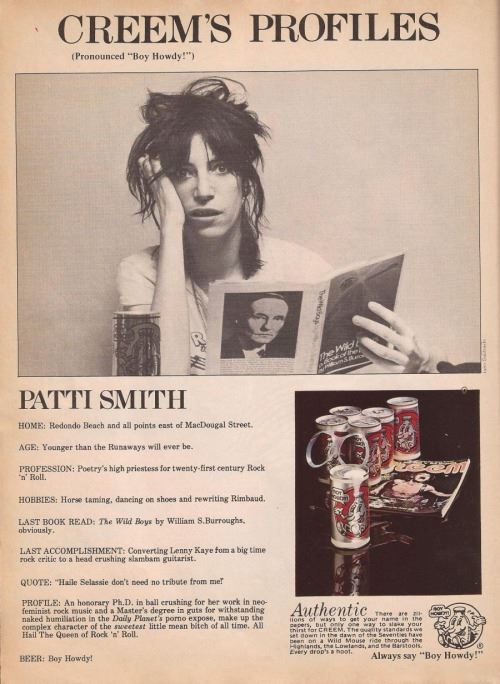 |
Creem's Profiles — Patti Smith
December 1976
|
Never mind the musicians, what did Creem's serious and staid competitors — Hit Parader, Rolling Stone, Circus — make of all this rampant silliness?
"They thought we were pompous twits," says Kordosh. "Either that or we were crazy, or on drugs, or some combination of those. All of us liked music a lot; we just didn't care that much about it. Everyone thinks they've got to treat this like they're honest to God reviewing the works of Mark Twain, or something. This stuff is disposable. It comes and it goes. For people to sit around and pontificate about it... I've never understood that."
Kordosh also speaks fondly of writer John Mendelssohn (although Mendelssohn always referred to Creem with the snarky comment: "America's only rock 'n' roll magazine that bills itself as such"), saying he was a "real character."
 |
Tom Petty
Creem magazine — April 1983
|
Without a doubt, the biggest character ever employed by Creem was Lester Bangs. Bangs began his journalism career at Rolling Stone with a negative review of the MC5's Kick Out The Jams album (April 5, 1969). More than a hundred and fifty reviews later, Rolling Stone editor Jann Wenner banned him from the magazine for "disrespect toward musicians."
 |
Slade drink Boy Howdy! beer
Photo: Charles Auringer
|
Sadly, he never finished filling in the parenthesis.
"Perhaps," argues Greil Marcus, "what this book demands from a reader is a willingness to accept that the best writer in America could write almost nothing but record reviews."
For me, this New York Dolls' record review best sums up Bangs' unquestionable genius for wordplay...
"The Dolls are a load of raggle clatter and they know it and spit it right back in your face whistling like twisto bastard Terry-Thomas progeny thru gapbuck front teeth: NYAAA! They ain't the Stones and they can't play for much past prattle but who gives a whackdoodle so stop making claims that'll blotch your mugs come uppance morn." — Too Much Too Soon (Lester Bangs, July 1974)
But Bangs did indeed write more than just record reviews, and I hope you'll enjoy these excerpts from a few of his most memorable articles. In this first passage, Bangs recounts the night he joined the J. Geils Band on lead typewriter at Detroit's Cobo Hall...
"It was at that point that I realized the absolute ludicrousness of what I was now doing before a packed house of umpteen thousand sneering peers. The first decision I had to make was whether to treat it as a total joke and just peck at the thing desultorily, or really get into the funky bloozy woozies and try to peck along in rhythm. Hell, they had it miked, I started trying to play on the beat, grinning and nodding at the rest of the group who grinned and nodded back as the peanut galleries gawked, hawked and kfweed. The writing was coming out great too: 'VDKHEOQSNCHSHNELXIEN(&H-SXN(E@JN?)' … I even threw in a bit of Townsend/Alice Cooper destructo theatre: for the song's climax, I stood up and kicked over the typewriter, bench and all. Then I jumped up and down on it till I smashed it to bits, or two of them at least. It felt good, purging somehow." — My Night Of Ecstasy With The J. Geils Band (Lester Bangs, August 1974)
His encounter with a cantankerous Lou Reed in a hotel restaurant is another legend of rock journalism...
"He's sitting there vibing away in his black T-shirt and shades, scowling like a house whose fire has just been put out, muttering to himself as he picked desultorily at indistinct clods of food on his plate: 'Goddam fucking place...what a shithole...dump... fucking nerve...assholes...' Turned out he'd been refused entrance to Trader Vic's because of the way he was dressed, and he was fuming about it. I walk up, shake hands: 'Hi Lou...I believe you remember me.' Dead cold fish handshake. 'Unfortunately.' Just sat there. Didn't move. Didn't smile. Didn't even sneer. Concrete scowl. Solid veneer, with cement behind that." — Let Us Now Praise Famous Death Dwarves (Lester Bangs, March 1975)
However, Bangs' true rock-writing philosophy can be found in the piece that gave its name to his anthology. First printed in the June 1971 issue of Creem, the article began as a historic look at the Yardbirds, but as he often did, Bangs soon veered off in a completely different direction and turned it into a thesis about one-hit wonders Count Five. Not content with just the one album actually released by the band, Bangs goes on for paragraphs about their other LPs: Snowflakes Falling On The International Dateline, Ancient Lace And Wrought-Iron Railings, and of course, Carburetor Dung (supposedly the only Count Five album to fall totally flat). In the end, he confesses, "I'm given to fabrication of albums sometimes, like if I wish a certain album existed and it doesn't, I just make it up."
"There's no question that Bangs gave Creem a lot of credibility," says Kordosh, who was an avid reader of Bangs' material when he was "quote, learning to write."
"Some of his stuff was absolutely phenomenal," Kordosh enthuses. "I didn't care who he was writing about, I just wanted to read it 'cause the guy was brilliant. Had Bangs lived, I don't think he would still be a rock writer, but I think he would've been a great writer."
Founded by Barry Kramer, the owner of Detroit record store Full Circle, the first issue of Creem was published in March 1969. Tony Reay, a clerk at the record store, was the magazine's first editor. Reay allegedly named the 'zine after his favorite group (with a slight tweak to the spelling).
Its earliest issues weren't much more than a Detroit-centric counterculture newspaper, which covered ecology and politics as well as music. Kramer laid the foundation in issue #1, stating: "Creem Magazine is Detroit. Creem will provide a forum for the diverse areas of our 'scene' to communicate and consolidate. This paper is devoted to media with the emphasis on music and the people that live it — you. Detroit is home to many creative artists, and for a reason. We are real, receptive and quite selective."
"At first, it was like hippy-dippy days," chuckles Kordosh. "Instead of a staff box, they had a 'cast of characters' — people with names like Flower. [Dave] Marsh was the first real heavyweight editor."
Marsh was only 19 years old when he joined the Creem staff during its formative first year. Although he would later disapprove of the magazine's amusingly unconventional style of journalism (according to Kordosh, Marsh once stated that "the whole idea of Creem wasn't funny anymore because Lester had died, and he'd died because of drugs"), it was under his leadership that many much-loved regular features were developed.
Creem Profiles: A parody of the Dewar's whisky adverts in which a band/musician posed with Boy Howdy! beer cans, and the editors answered questions for them using silly puns. "Every band in the world, no matter what they thought about the magazine, wanted to do the Boy Howdy! profile," muses Kordosh. "The list of people who did those is incredible. If there was one thing that bands knew about Creem, it was the stupid beer cans."
As an afterthought, he asks, "You realize there never was Boy Howdy! beer? It's funny how many people thought there was."
Eleganza: Originally penned by rock doyen Lisa Robinson, this monthly column focused on the stylish side of the music business. "Freddie Mercury wore the usual skin-tight satin trousers at the Beacon Theater and dressed to the left," she remarked in January 1977. "Despite his album cover Ian Hunter wore sunglasses to Queen's party at Le Paulillaier. Rod Stewart wore the usual smirk, Britt Eklund the usual pout, to the Pretty Things' L.A. party. Bowie wore that ho-hum black and white and Iggy's hair was unnaturally blonde."
Beginning with Creem's July 1983 issue, John Mendelssohn's byline replaced Lisa Robinson's, and he quickly made Eleganza his own. "It was supposed to be about fashion," recalls Mendelssohn in his autobiography I, Caramba, "but I got bored with that halfway through my second column, and began devoting the space to rabid denunciations of Motley Crue..."
Letters to the Editor: "There's such a feeling of satisfaction in letting somebody make a complete jerk of themselves and then giving it a real terse one-line comment," notes Kordosh. Headed "Ridiculous Request," this missive in the July 1985 issue from Ben Shirer in La Jolla, California, is an excellent example:
"I hate rock critics who say Madonna has terrible music and say she's sex for sale. Some people have heard albums of hers and hate them (at least they heard them), but the others are up to their necks in shit. They should listen to the albums, then decide."
"What, to kill themselves?" bluntly replied the Ed.
"There was never once a made-up letter in Creem," adds Kordosh, just in case anyone wonders whether the team of RR & AR actually wrote: "How the hell can you call Led Zeppelin satin worshippers?"
Photo Captions: "We used to talk about photo captions more than anything else," laughs Kordosh. "We got some really esoteric concepts going. We developed alternate worlds where captions were occurring, and we had had a string of characters — the farmer and the cowman... Binky, Bobo, and Fifi..."
"We often had people looking for potatoes..." he continues. "A picture of U2 just flashed in my mind... God, did we hate U2! It was a promo still for the Joshua Tree album where they're walking in a field. I remember the caption said: 'Where the heck are those potatoes?'
"We'd really get into what was the proper word to italicize within quotes, where to put the emphasis. I had one where there was a picture of some Boy Howdy! beer cans and the caption was: 'Wait, we're beer cans. We can't talk!' I italicized the word 'beer' as if other types of cans could talk!"
Although its HQ was initially based in Detroit, for a while, the 1970s Creem staff lived communally at a large farm in Walled Lake, Michigan. Eventually, offices were rented in Birmingham and it was there, during the mid-'80s (when the editorial staff consisted of Kordosh, DiMartino, and Holdship —who now edits the Southern California edition of BAM), that Kordosh terms the magazine's "golden years."
"To me, that was the last great editorial staff," he observes. "In fact, I think it might have been the strongest editorial staff Creem ever had. Not to take anything away from Lester, but I don't think he had as many good people around him as we did."
Alas and alack, the hilarity was not to last. When the 1980s ended, so did "America's Only Rock 'n' Roll Magazine."
There was definitely trouble brewing when new publisher Arnold Levitt (who acquired the rights to Creem in 1986, following Barry Kramer's death) pulled up the 'zine's Midwestern roots and in early 1987 moved the offices to Los Angeles.
"After we got out here, the magazine just wasn't doing well," laments Kordosh. "Our publisher cut our budget, and he was leaning all over us about what acts we could put in the magazine. He would come in and say, 'We need to put Madonna on the cover. We need to put U2 on the cover.'"
Creem's last-gasp issues, short on humor in a grab at respectability, lost its devoted readers — and apparently, there weren't that many of us to begin with. "It's amazing how few people really bought Creem," mentions Kordosh. "Seriously enough, we used to sit around wondering, 'Who the hell's buying this thing?' Especially towards the end. We really wondered, 'Is there a point to doing this?'"
In 1989 the plug was pulled financially. "It wasn't making any money," says Kordosh. "For some reason, the national psyche is such that it will not accept a magazine like Creem."
Kordosh compares Creem's dilemma to a statement by Kinks' frontman Ray Davies, who once quipped: "At the time we were more unpopular than the Beatles and the Stones."
"Not that the Kinks were less popular," Kordosh explains, "they were more unpopular — as if they were all unpopular, but the Kinks were the most unpopular! I think Creem was more unpopular than other magazines."
However, there was one more round to come. In August 1990, an upscale and oversized magazine calling itself Creem hit the newsstands. The first issue featured a sneering Billy Idol on its glossy cover, but there wasn't a trace of fun within its pretty pages.
An article in The Los Angeles Times (September 30, 1990) stated that Marvin Jarrett — an entrepreneur and former stereo salesman with no publishing experience — purchased the rights to the name and the Boy Howdy! mascot from Levitt.
"It's the '90s," Jarrett informed The Times, "and this magazine has to change. You and I might have been sarcastic kids when we were 15, and Creem was great for that in its peak. But we're not sarcastic kids anymore."
Both Kordosh and Holdship said "no thanks" to editorship of the new Creem, which is now based in New York.
"Marvin is totally anti-caption and anti-humor," spits Kordosh. "His idea of Creem is to put Phil Collins on the cover. We told him, 'If you want a magazine, why don't you just start it with a different name?'
"I told him, 'You're gonna get the worst of both worlds. One, there's a lot of people out there who hated Creem, so they're not gonna buy it. Two, the people that do buy it are gonna hate it because it's not Creem. It's gonna look more like Rolling Stone to them. So, you're going to lose everybody.'"
Kordosh concludes: "I'm not real sanguine about the possibilities there."
"Perhaps," argues Greil Marcus, "what this book demands from a reader is a willingness to accept that the best writer in America could write almost nothing but record reviews."
 |
Alice Cooper's Alcohol Cookbook
Creem magazine — June 1973
|
"The Dolls are a load of raggle clatter and they know it and spit it right back in your face whistling like twisto bastard Terry-Thomas progeny thru gapbuck front teeth: NYAAA! They ain't the Stones and they can't play for much past prattle but who gives a whackdoodle so stop making claims that'll blotch your mugs come uppance morn." — Too Much Too Soon (Lester Bangs, July 1974)
But Bangs did indeed write more than just record reviews, and I hope you'll enjoy these excerpts from a few of his most memorable articles. In this first passage, Bangs recounts the night he joined the J. Geils Band on lead typewriter at Detroit's Cobo Hall...
"It was at that point that I realized the absolute ludicrousness of what I was now doing before a packed house of umpteen thousand sneering peers. The first decision I had to make was whether to treat it as a total joke and just peck at the thing desultorily, or really get into the funky bloozy woozies and try to peck along in rhythm. Hell, they had it miked, I started trying to play on the beat, grinning and nodding at the rest of the group who grinned and nodded back as the peanut galleries gawked, hawked and kfweed. The writing was coming out great too: 'VDKHEOQSNCHSHNELXIEN(&H-SXN(E@JN?)' … I even threw in a bit of Townsend/Alice Cooper destructo theatre: for the song's climax, I stood up and kicked over the typewriter, bench and all. Then I jumped up and down on it till I smashed it to bits, or two of them at least. It felt good, purging somehow." — My Night Of Ecstasy With The J. Geils Band (Lester Bangs, August 1974)
 |
Creem readers famously voted the New York
Dolls the best new group of 1973 and the worst
new group of 1973.
|
"He's sitting there vibing away in his black T-shirt and shades, scowling like a house whose fire has just been put out, muttering to himself as he picked desultorily at indistinct clods of food on his plate: 'Goddam fucking place...what a shithole...dump... fucking nerve...assholes...' Turned out he'd been refused entrance to Trader Vic's because of the way he was dressed, and he was fuming about it. I walk up, shake hands: 'Hi Lou...I believe you remember me.' Dead cold fish handshake. 'Unfortunately.' Just sat there. Didn't move. Didn't smile. Didn't even sneer. Concrete scowl. Solid veneer, with cement behind that." — Let Us Now Praise Famous Death Dwarves (Lester Bangs, March 1975)
However, Bangs' true rock-writing philosophy can be found in the piece that gave its name to his anthology. First printed in the June 1971 issue of Creem, the article began as a historic look at the Yardbirds, but as he often did, Bangs soon veered off in a completely different direction and turned it into a thesis about one-hit wonders Count Five. Not content with just the one album actually released by the band, Bangs goes on for paragraphs about their other LPs: Snowflakes Falling On The International Dateline, Ancient Lace And Wrought-Iron Railings, and of course, Carburetor Dung (supposedly the only Count Five album to fall totally flat). In the end, he confesses, "I'm given to fabrication of albums sometimes, like if I wish a certain album existed and it doesn't, I just make it up."
 |
"Super Punk" Johnny Rotten
Creem magazine — April 1978
|
"Some of his stuff was absolutely phenomenal," Kordosh enthuses. "I didn't care who he was writing about, I just wanted to read it 'cause the guy was brilliant. Had Bangs lived, I don't think he would still be a rock writer, but I think he would've been a great writer."
Founded by Barry Kramer, the owner of Detroit record store Full Circle, the first issue of Creem was published in March 1969. Tony Reay, a clerk at the record store, was the magazine's first editor. Reay allegedly named the 'zine after his favorite group (with a slight tweak to the spelling).
Its earliest issues weren't much more than a Detroit-centric counterculture newspaper, which covered ecology and politics as well as music. Kramer laid the foundation in issue #1, stating: "Creem Magazine is Detroit. Creem will provide a forum for the diverse areas of our 'scene' to communicate and consolidate. This paper is devoted to media with the emphasis on music and the people that live it — you. Detroit is home to many creative artists, and for a reason. We are real, receptive and quite selective."
"At first, it was like hippy-dippy days," chuckles Kordosh. "Instead of a staff box, they had a 'cast of characters' — people with names like Flower. [Dave] Marsh was the first real heavyweight editor."
 |
| Stars Cars No. 49 — Robin Zander of Cheap Trick |
 |
Debbie Harry
Creem magazine — August 1982
|
Eleganza: Originally penned by rock doyen Lisa Robinson, this monthly column focused on the stylish side of the music business. "Freddie Mercury wore the usual skin-tight satin trousers at the Beacon Theater and dressed to the left," she remarked in January 1977. "Despite his album cover Ian Hunter wore sunglasses to Queen's party at Le Paulillaier. Rod Stewart wore the usual smirk, Britt Eklund the usual pout, to the Pretty Things' L.A. party. Bowie wore that ho-hum black and white and Iggy's hair was unnaturally blonde."
Beginning with Creem's July 1983 issue, John Mendelssohn's byline replaced Lisa Robinson's, and he quickly made Eleganza his own. "It was supposed to be about fashion," recalls Mendelssohn in his autobiography I, Caramba, "but I got bored with that halfway through my second column, and began devoting the space to rabid denunciations of Motley Crue..."
 |
An early Creem cover featured "Mr. Dream Whip"
artwork by R. Crumb. He also designed the
Boy Howdy! logo. |
"There was never once a made-up letter in Creem," adds Kordosh, just in case anyone wonders whether the team of RR & AR actually wrote: "How the hell can you call Led Zeppelin satin worshippers?"
Photo Captions: "We used to talk about photo captions more than anything else," laughs Kordosh. "We got some really esoteric concepts going. We developed alternate worlds where captions were occurring, and we had had a string of characters — the farmer and the cowman... Binky, Bobo, and Fifi..."
"We often had people looking for potatoes..." he continues. "A picture of U2 just flashed in my mind... God, did we hate U2! It was a promo still for the Joshua Tree album where they're walking in a field. I remember the caption said: 'Where the heck are those potatoes?'
"We'd really get into what was the proper word to italicize within quotes, where to put the emphasis. I had one where there was a picture of some Boy Howdy! beer cans and the caption was: 'Wait, we're beer cans. We can't talk!' I italicized the word 'beer' as if other types of cans could talk!"
 |
Gilda Radner poses in a Boy Howdy! tank top in
this 1980 advert for Creem t-shirts.
|
 |
| Siouxsie Sioux is the Creem Dreem |
There was definitely trouble brewing when new publisher Arnold Levitt (who acquired the rights to Creem in 1986, following Barry Kramer's death) pulled up the 'zine's Midwestern roots and in early 1987 moved the offices to Los Angeles.
"After we got out here, the magazine just wasn't doing well," laments Kordosh. "Our publisher cut our budget, and he was leaning all over us about what acts we could put in the magazine. He would come in and say, 'We need to put Madonna on the cover. We need to put U2 on the cover.'"
Creem's last-gasp issues, short on humor in a grab at respectability, lost its devoted readers — and apparently, there weren't that many of us to begin with. "It's amazing how few people really bought Creem," mentions Kordosh. "Seriously enough, we used to sit around wondering, 'Who the hell's buying this thing?' Especially towards the end. We really wondered, 'Is there a point to doing this?'"
 |
| Creem's Profiles — The Bangles |
"Not that the Kinks were less popular," Kordosh explains, "they were more unpopular — as if they were all unpopular, but the Kinks were the most unpopular! I think Creem was more unpopular than other magazines."
However, there was one more round to come. In August 1990, an upscale and oversized magazine calling itself Creem hit the newsstands. The first issue featured a sneering Billy Idol on its glossy cover, but there wasn't a trace of fun within its pretty pages.
An article in The Los Angeles Times (September 30, 1990) stated that Marvin Jarrett — an entrepreneur and former stereo salesman with no publishing experience — purchased the rights to the name and the Boy Howdy! mascot from Levitt.
"It's the '90s," Jarrett informed The Times, "and this magazine has to change. You and I might have been sarcastic kids when we were 15, and Creem was great for that in its peak. But we're not sarcastic kids anymore."
 |
U2 are the band of the year
Creem magazine — May 1986 |
"Marvin is totally anti-caption and anti-humor," spits Kordosh. "His idea of Creem is to put Phil Collins on the cover. We told him, 'If you want a magazine, why don't you just start it with a different name?'
"I told him, 'You're gonna get the worst of both worlds. One, there's a lot of people out there who hated Creem, so they're not gonna buy it. Two, the people that do buy it are gonna hate it because it's not Creem. It's gonna look more like Rolling Stone to them. So, you're going to lose everybody.'"
Kordosh concludes: "I'm not real sanguine about the possibilities there."
* * *


