By Devorah Ostrov
 |
The Patti Smith Group
(Arista Records publicity photo)
|
He began the '70s by gathering together a collection of garage rock classics under the title Nuggets, and throughout that decade was an integral member of the Patti Smith Group as well as co-editor of Rock Scene magazine. By the 1980s, he was fronting his own band and producing some of alternative music's biggest names. These days, Kaye is hard at work co-authoring an "autobiography" of country rocker Waylon Jennings.
You Could Hear It In The Air
Lenny Kaye was born on December 27, 1946. His first year was spent living in upper Manhattan ("beneath the shadow of the George Washington Bridge"), before his family moved to the middle-class neighborhood of Jamaica, Queens. When he was eight years old, they moved again to Brooklyn. By then, it was the mid-'50s and Kaye was just discovering rock 'n' roll.
 |
Flyer for a six-night PSG/Television
residency at Max's Kansas City
August 28 - September 2, 1974
|
One Christmas, Kaye received a record player in the shape of a bongo drum — "I wish I still had it," he laments. And soon after, he purchased his first batch of 45s: "It's Only Make Believe" by Conway Twitty, the novelty hit "Purple People Eater" by Sheb Wooley, "To Know Him is to Love Him" by the Teddy Bears, and "The End" by Earl Grant.
"I feel in a lot of ways that I had the privilege of growing up with rock 'n' roll," says Kaye. "When I hit adolescence, the Beatles were happening. Certainly, in those years rock 'n' roll was 'youth music' and I was a youth! I loved listening to the radio, listening to all the AM DJs: Cousin Brucie on ABC, Scott Muni on WMCA, Murray the K on WINS... It really drew me in."
Kaye had begun taking accordion lessons when he was five but quit playing the instrument as a pre-teen. "The accordion was big in the '50s, but in the '60s it wasn't the coolest of instruments," he laughs. "Mostly, I was a record collector, and I bought faithfully off the Top 40. By the time I got to high school, I was infatuated with the doo-wop sound. And I kind of slid into the record collecting underground, which centered around Times Square Records at 42nd and 6th Avenue. That was the first place where I heard about the concept of 'rare' records. They were selling old Sun Records and the Moonglows on Chance Records."
Kaye's family relocated again, to suburban New Brunswick, New Jersey, where he spent his teenage years. "New Jersey introduced me to car culture," remarks Kaye, "which wasn't much of a possibility in the City. I got into that whole custom car idea — which I think is a real part of rock 'n' roll. Certainly, the Fender Stratocaster is a beautiful example of Southern California custom car art!"
In 1964 Beatlemania swept the world, and Kaye's interest shifted from being "a high tenor in a doo-wop harmony group to being a bass guitarist." His first outfit was an all-covers band called the Vandals ("Bringing down the house with your kind of music!"), and their bread-and-butter gigs were frat house parties. "We played four sets a night to drunken college guys," he recalls. "Animal House really did catch it with the 20-minute versions of 'Shout' and 'What'd I Say,' with all the dirty verses: 'See that girl from Trenton State/That's where they teach you to masturbate!'"
When the Vandals folded, Kaye hooked up with another covers band, the Zoo. "We'd learn all the hits of the day. That's when I first started playing 'Gloria.' It was a good learning ground, and I thought that's where it would stay. I certainly never dreamed of becoming a rock musician."
Kaye attended Rutgers University, where he studied journalism and wrote about music for the school newspaper. "I'd write about the Fugs," he remembers. "I was very much influenced by Crawdaddy. Paul Williams [Crawdaddy's editor] had a way of looking at music which opened it up. Previous to that, you just had fan magazine stuff — what's your favorite color? — which was cute, but the mid-'60s was a very important transition period for rock 'n' roll, and the Crawdaddy writers [the staff included Jon Landau and Richard Meltzer] could take an idea and run with it. They could connect the most incredible archaeological thoughts around the music, and especially in those early psychedelic days, that really influenced me."
In the fall of 1965, Kaye entered Associated Recording Studios in New York to cut his debut 45. Released the following March, both the A-side ("Crazy Like a Fox") and the B-side ("Shock Me") were penned by the team of Larry Kusik and Ritchie Adams. The former was Kaye's Uncle "Q," who later scored "Speak Softly Love" from The Godfather and "A Time for Us" from Romeo and Juliet; the latter was the vocalist for '50s combo the Fireflies.
"I guess they needed a folk/ protest kind of voice for the single," muses Kaye referring to the A-side's cheesy lyrics: "They call me neurotic and say I'm psychotic because I let my hair grow long/They say that I'm crazy and they call me lazy because I don't like to work all day long."
But curiously, the performer credited on the 45 is Link Cromwell — not Lenny Kaye. "We made up 40 first names and 40 last names," he explains. "Link is my initials disguised somewhat, and Cromwell was English in the manner of the Sir Douglas Quintet."
Based on the single, Cashbox named Kaye/Cromwell "Newcomer of the Week" for March 19, 1966, and he began to think seriously about a future in rock 'n' roll.
But it was only a fleeting thought because, like the rest of his generation, Kaye was easily distracted in the mid-'60s. "It was a time of college rebellion," he points out. "And I was pretty involved politically with smashing the state; there were protests and marches... and I was perfectly positioned for the Summer of Love."
In 1967, Kaye and his buddy Larry piled into a '56 Ford and "speeded out of our minds, spouting the philosophy of Finding Thou Self," drove cross-country to San Francisco.
"I went to the Avalon and saw Big Brother and the Holding Company," says Kaye. "I went to Golden Gate Park and saw the Grateful Dead. I can't say that it changed my life because my life was well along that path anyway, but all of a sudden I had a world in which to function."
Eventually, he returned to New York and pursued a degree in American History at NYU. One day, while he was "hanging out," someone introduced him to Patricia Kennealy [later Patricia Kennealy-Morrison], editor-in-chief of Jazz & Pop.
Kaye's first byline in the magazine was a favorable review of the Small Faces' Ogden's Nut Gone Flake. "I did two or three reviews each month and got free records," he enthuses. "I was just amazed!"
He adds that it was almost a year later before he was invited to his first press party, held to honor the publication of Lillian Roxon's definitive Rock and Roll Encyclopedia. The contacts Kaye made that night not only became lifelong friends but irrevocably set his career in motion.
Roxon (oft described as the "mother hen" of rock 'n' roll) took Kaye under her wing and introduced him to Lisa Robinson and Danny Fields. In turn, Fields introduced him to the staff at Cavalier, where he was given a monthly music column. "Before I knew it, I was writing for a living," marvels Kaye.
The two met when Smith responded to a piece Kaye had written for Jazz & Pop. "It was the one article I felt I had to write," he says, "because I thought I was the only one who knew anything about it — the a cappella doo-wop scene of the tri-state area. It was a great article! Patti read it and she called me up."
A Chicago native, Smith grew up in New Jersey. She'd moved to New York in 1967 to dedicate herself to a career in art but was leaning towards poetry.
Still, Kaye's short-lived record company stint was not entirely without purpose as it resulted in the 1972 release of Nuggets. Subtitled "Original Artyfacts from the First Psychedelic Era 1965-1968," the compilation of garage rock classics urged listeners to take a more serious look at what had been considered simply AM radio pop ditties.
While most of the tunes were only a few years old in '72, "we were far enough removed that we could see something had happened then," says Kaye.
His extensive liner notes began: "This is the story of a transition period in American rock and roll, of a changeling era which dashed by so fast that nobody knew much of what to make of it while it was around, only noticeable in retrospect by the vast series of innovations it would eventually spawn, both in the way music would be listened to and the way it was constructed."
The preliminary idea for the project was Holzman's — "He wanted to put together an album of all these great one-off cuts" — but the implementation was all down to Kaye. "I made a list of songs that I would play on Saturday night at Village Oldies; there were 50 or 60 songs on the original list! I organized it, got the information, wrote the liner notes, pushed for cool cover art... One of my models was the Yazoo blues albums [which showcased titles such as Blues of Southwest Georgia 1927-1932], very scholarly things with all the keys and tunings. The other was the Mr. Maestro oldies albums, which had teenage hoodlums on the covers." Even misspelling artifacts with a "y" was Kaye's idea: "It was like the Byrds."
Holzman did, however, make one significant decision. "I wanted to call the album Rockin' and Reelin' U.S.A." confides Kaye. "But Jac said, 'No.' He wanted to call it Nuggets, for which I'm eternally grateful!"
But when his day job ended six months later, Nuggets was still just a work in progress. "About six months after that," says Kaye, "this lawyer called me up and said, 'We have the rights to all these cuts. What should we do with 'em?'"
Kaye's inventory was pared down to 27 songs, which filled four sides. The eclectic track listing contained both Top 10 smash hits and rarely heard obscurities, including the Standells' "Dirty Water," "Night Time" by the Strangeloves, "Sugar and Spice" by the Cryan' Shames, The Magic Mushrooms' "It's A-Happening," and the Chocolate Watchband's "Let's Talk About Girls."
Patterned on film magazines of the 1930s and teenybopper 'zines like 16 and Tiger Beat — "Lots of pictures and damn few words!" Robinson once declared — the first issue of Rock Scene was published in March 1973 with David Bowie as Ziggy Stardust on its cover. The masthead listed Robinson as Managing Editor, his wife Lisa as Society Editor, and Kaye as Associate Editor. Kaye fills in the job descriptions: "Richard and I would divide up the photo spreads. We'd spend about three days smoking pot and writing captions! A lot of the information was Lisa's because she was into rock as gossip."
Rock Scene went to glamorous parties, fabulous openings, and swanky premiers. Articles featured intriguing headlines like "David And Lou: The Deadly Duo Of Rock & Roll," "Ian Hunter Rocks After Dark," and "The Ramones Go To Washington." And there were regular columnists — such as Wayne County, who doled out fashion and beauty advice to the likes of Dave from San Diego who pleaded: "My platforms are killing me! Is there a way out?"
New bands were promoted in each issue. (The Talking Heads got their initial publicity via Rock Scene, while a very early picture of a heavily made-up quartet from "New York's theatrical band scene" was captioned: "Are you ready for Kiss?") And under the heading "Doc Rock," Kaye answered music trivia questions.
Although no individual Doc Rock query stands out as his favorite ("I haven't opened that drawer in a long time," he says), Kaye does remember meeting one noteworthy letter writer: "I went to see GG Allin three or four years ago. I was sitting at the bar, and he walked up to me and introduced himself as one of the kids who used to write to Rock Scene."
Given its geographic location and hip staff (Leee Black Childers and Bob Gruen supplied the bulk of the photos, and Patti Smith sometimes contributed articles), it should come as no surprise that Rock Scene was also one of the first music magazines to cover New York's embryonic punk movement. "I'm sure we had the first pictures from CBGB," states Kaye, "because we were among the first 25 people to hang out there."
Following that show at the Hotel Diplomat, the Smith/Kaye duo began making regular appearances around town. "Her manager would get us a gig about once a month, and I would go down and play my three songs," notes Kaye.
But by the time they opened for Phil Ochs during a weeklong run of shows in late December at Max's Kansas City, the poetry and rock 'n' roll were getting equal treatment throughout the set, and a permanent piano player had been added. "We always had a different piano player," observes Kaye. "Nobody stayed with us. Nobody knew what we were doing, so it was a little tough at first. But over the course of three or four months, we became more integrated. It coalesced into a band."
An ad in the Village Voice for a keyboardist with "relentless rhythm" netted them Richard "DNV" Sohl, a classically trained pianist who wore a sailor suit to the audition. "He helped us so much to get the music out to the — astral plane," says Kaye. "He had so much technique, and yet he could space out so well. It was very telepathic."
In his book, From The Velvets to the Voidoids, author Clinton Heylin writes that during this formative period: "Smith and Kaye still conceived of themselves as an art project whose connection with rock 'n' roll was at best tangential."
Kaye agrees with Heylin. "What we were doing was so out of the ordinary," he reflects. "I don't think either of us felt there was much place for it in the world. You gonna play the Palladium with three pieces, reading poetry?"
However, between '74 and '75, a series of events turned the unusual threesome into a group whose music Lester Bangs once characterized as: "A new Romanticism built upon the universal language of rock 'n' roll, an affirmation of life so total that, even in the graphic recognition of death, it sweeps your breath away."
Easter 1974: On their way home from seeing the film Ladies and Gentlemen, The Rolling Stones, Smith and Kaye stop off to watch Television play their third show at a seedy Bowery bar called CBGB.
June 5, 1974: With Television's Tom Verlaine on lead guitar, Smith, Kaye and Sohl record "Hey Joe" b/w "Piss Factory." The band's debut single is issued through Mer Records, a purpose-made label principally financed by photographer Robert Mapplethorpe. "We wanted to see if we could get the magic we felt we were creating onstage onto a record," explains Kaye. "We recorded it in about three hours."
The A-side, a radically reworked version of the quintessential mid-'60s rocker previously recorded by both the Leaves and Jimi Hendrix, was preceded by a poem Smith had written about kidnap victim Patty Hearst called "Sixty Days." Heylin states: "This technique of prefacing covers with snippets of her own poetry was a logical extension of the early Smith/Kaye sets." Of the B-side (a frank account of the degradation she suffered while working in a New Jersey factory), Smith has said: "To me, that little 'Piss Factory' thing is the most truthful thing I ever writ."
November 1974: On a shoestring budget, the trio travel to California, where they make their West Coast debut at the Whisky in Los Angeles. A couple of days later, they travel to the Bay Area and play upstairs at Rather Ripped Records in Berkeley, which is followed by a gig at San Francisco's Winterland (legend has it that Jonathan Richman sat in on drums). "By then, the music had grown to the point where we needed somebody else," stresses Kaye. "I was really trying to keep the rhythm going. I couldn't really do anything else."
Once back in New York, they auditioned for a rhythm guitarist/bassist. "Every conceivable kind of guitar player came down," remembers Kaye. "We'd play 'Gloria' with them... They usually had no idea what we were doing. It was interesting because, for the first time, we had to define our sound. Who are we? What are we?"
It was Ivan Král, then-guitarist for Blondie (and onetime guitarist for Shaun Cassidy!), who got the job. In Heylin's book, Smith shares her memories of the audition: "Finally Ivan Král came in ... this little Czechoslovakian would-be rock star. He said, 'I am here to be in your band.' We did 'Land of a Thousand Dances' and it went on so long I thought I was gonna puke."
"He played for 20 minutes," emphasizes Kaye. "He didn't wanna stop! He also had a rock 'n' roll look to him, which was nice since the rest of us were these weird alien creatures!"
March - April 1975: Having made their CBGB debut in February, the group is booked for a memorable two-month residency at the club, playing four nights a week (Thursday-Sunday) on a bill with Television. "That was when we really homed in on all the songs," says Kaye, "a lot of which were just abstract jams. That's where 'Land' started to really blossom and 'Tales of Johnny.' Then, with 'Free Money' and 'Gloria' we started repeating moves, and the songs started taking on a very organic structure. We didn't plan it; it just came out of the playing. We'd all go to the same place at the same time, and the next night we'd remember that. Pretty soon, we had our whole set."
By the end of their residency Clive Davis had signed them to his Arista label ("For reasons that still escape me," chuckles Kaye), and Jay Dee Daugherty had been added on drums. According to Kaye: "We thought, 'Okay, it's time we become a band. We might as well get a drummer too.'"
The previous year, Daugherty had moved to New York from Santa Barbara to join the Mumps, a quirky pop-punk band led by Lance Loud and Kristian Hoffman. By February 1975, the Mumps were playing CBGB alongside Patti Smith and Television. But shortly after they'd recorded their first demo tape, Daugherty was recruited by Smith's group.
Later accounts confirmed that Smith was actively (and ruthlessly) looking for a drummer at this point, but Kaye doesn't recall Daugherty playing live with the Patti Smith Group until after the release of their first album. (In a separate interview, Daugherty told me: "I think Tom Verlaine recommended me to Patti. So, during that period, I sat in a couple of times with her, and they eventually asked me if I wanted to join them. And y'know, there wasn't really too much choice in it. I mean, I'd never seen or imagined any kind of music or person or persona like that. I felt horribly guilty about leaving the Mumps. I didn't want to leave my friends in the lurch. But it was sort of my calling to play with Patti." Follow this link to read my full Mumps interview: devorahostrov.blogspot.co.uk-mumps)
In the summer of '75, the Patti Smith Group entered Electric Ladyland studios with producer John Cale to record their debut LP, Horses. In From The Velvets to the Voidoids, Heylin contends that the emotionally charged album in which Smith draws upon the images of her heroes — Hendrix, Morrison, Rimbaud — as she rages and sometimes falters over the band's minimal-yet-forceful backing, was down to her and Cale battling for control of the studio.
"If Smith had believed that ... her songs were in recordable form, Cale was not convinced," writes Heylin. "Through his lack of conviction, he forced Smith to re-evaluate all that she had produced." Heylin's assessment is backed up by a quote from Smith, who says: "We came into the studio really half-assed and glib, then I had to pound my fists into his skull day and night."
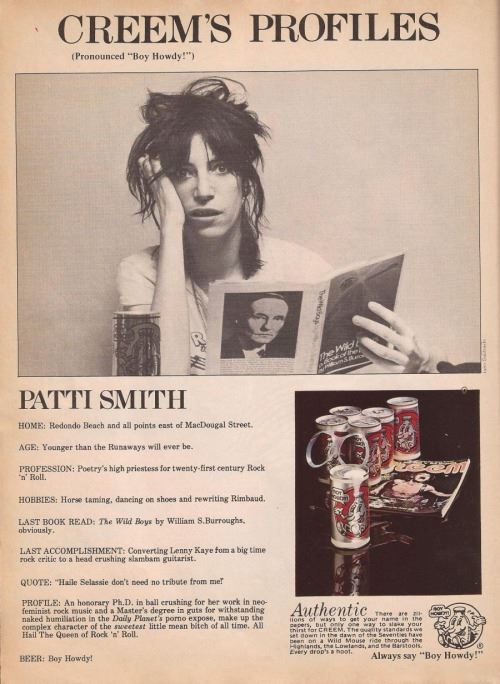
In a wide-ranging CREEM interview just prior to Horses release, Smith alludes to the studio tensions: "John kept pushing me to improvise and extend — 'Birdland' used to be four minutes onstage, but it flowed in the studio and ended up about nine minutes long." But she also seemed downright pleased with the producer's input: "I was concerned 'cause in some of my songs I take on different personas some people might not understand, like 'Gloria' is a guy singing to a girl — but I didn't want to have to think about my sex on the record. Cool thing was that John was into the chameleon thing, the changeling aspect — and I wasn't made to feel guilty or nervous about any of the subject matter."
Technically, the Dictators were the first of the New York vanguard not yet labeled punk to release an album (1974's critically acclaimed but publicly ignored Go Girl Crazy!). But PSG were the first to attain what could be called success, as Horses entered the Billboard Top 50 — "surprising everybody!" exclaims Kaye.
"I don't think it was so much what we were saying or doing or singing," he continues, "but what we represented. Sometimes a band fulfills a psyche need for people. During our first tour, I could feel that we were becoming a rallying point for all the disaffected rockers in each city. Every place we played, we'd hook into the alternative rock community — all of whom were starting bands. Patti described it as: We were Paul Revere yelling, 'Wake up! Wake up!'"
In the fall of 1976, PSG issued its sophomore effort, Radio Ethiopia, which Kaye terms their "most angry and uncompromising record."
This time around, Jack Douglas (producer of Aerosmith) oversaw the studio proceedings, which prompted influential music critic Robert Christgau to fume: "It's priggish if not stupid to complain that Radio Ethiopia's 'four chords are not well played.' If they were executed with the precise attack of an Aerosmith, then they would not be well played."
Still, Douglas rendered an air of gravity to the LP, which centered on the title track — a ten-minute free-jazz improvisation co-written by Smith and Allen Lanier — which one music journalist called "their 'Black to Comm,' their 'Little Johnny Jewel.'"
Kaye, specifically, was hugely influenced by free-jazz artists like Albert Ayler and Pharaoh Saunders. "To me, it's the place where rock, jazz, all music blends," he says. "Where all of a sudden, you can break apart structure so totally that you get beyond the beat, beyond melody, into the realm of pure sound. The Velvets — they got there. Something like 'European Son,' when that glass shatters and the band moves into warp speed... There's not much difference with the energy blasts of Roland Kurt or the Art Ensemble. It's something we always tried to do in the Patti Smith Group — to get out there."
Many considered "Radio Ethiopia" to be the group's ultimate statement — "That track is what we've been working up to for a year," Kaye said at the time. But the album itself was poorly received. Even longtime friend and fan R. Meltzer complained: "Like the title cut's great and tense and all that but it could've extracted a wee bit more from the lesson of the Fugs' 'Virgin Forest' ... 'cause like you can't do 'Goin' Home' — 'Sister Ray' — 'The End' forever cause after a while it just kinda bristles with more than a morsel of uh, dated-ness per se." And radio airplay, even with the closer-to-conventional rock tune, "Pumping (My Heart)," was nil.
When one fanzine journalist asked Smith how this made her feel, she confessed: "I cried. I mean I cried, you know. I fought. I fought with the radio stations and they told me ... either I watch my language and change titles on the songs ... or forget airplay." She added, "I think of Radio Ethiopia as the sacrificial lamb. It got us banned, it put us in a really dark place ... We had trouble getting jobs after that, we were known as troublemakers."
During the US tour in support of Radio Ethiopia, disaster (or divine intervention, if you prefer) struck. In "Ain't It Strange," Smith poses a direct challenge to God: "God make a move..." she shouts at a particularly climactic moment.
On January 26, 1977, He took her up on it. During the song's extended middle-section jam, as Smith spun about in a height of ecstasy and chanted: "Hand of God I feel the finger! Hand of God and I start to whirl! And I whirl and I whirl! Do not get dizzy! Do not fall now..." she plummeted off a 12-foot stage in Tampa, Florida.
Kaye recalls the fateful show: "It was our second night opening for Bob Seger. We hardly ever opened for people, but we were down there and we thought, why not see what we can do with an alien audience. The first night we didn't do that well, so the second night we were itching for blood. We were trying to win the crowd, and we were so in synch as a band. We started moving the rhythm around; it started getting more jerky, dizzier... Patti reached for the microphone and went off the stage."
While it wasn't life-threatening, the fall broke several bones in Smith's neck and her head required 22 stitches; she was completely immobile for three months. Afterwards, she said: "I did feel the finger [of God] push me right over ... I feel it was his way of saying, 'You keep battering against my door and I'm gonna open that door and you'll fall in.' I've had a moment where I had to make a choice, just as I was losing consciousness and I really felt like I was gonna die ... Did I want a communication with God so intimate that I'd be dead, off the earth?"
The accident proved to be something of a watershed for the band. "With Radio Ethiopia, we'd gone as far as we could," asserts Kaye. "We had pushed our own personal envelope as far as it could go. And I think it's good to know that point."
Yet he insists that the two albums which followed it — Easter and Wave — don't represent a compromise. "I wouldn't call it compromising because that's something we never thought of. If anything, we were rebellious to a fault. Those two albums represent — instead of a music of confrontation — a music of accommodation, of learning to live with one's self and one's demons."
When the band finally returned to the studio in 1978, it was to record their strongest (and certainly most commercially successful) LP: Easter.
Heylin states that the record was going to be called Rock 'N' Roll Nigger after the exuberant anthem in which Smith announces: "Outside of society they're waiting for me/Outside of society that's where I wanna be..." But within a week of her fall, Smith was thinking of the next release as "a resurrection ... it's more creatively sparking, more celebratory ... it's gonna be a celebration of the whole new scene, the whole new wave."
Gone were the experimentation and sometimes overlong ramblings of the previous albums (gone, too, was Richard Sohl, replaced here by Bruce Brody from John Cale's band). Instead, with the help of producer Jimmy Iovine, PSG crafted an album of tough, tight, confident material — and in the process achieved their only Top 40 hit with "Because the Night."
"Because the Night" was the result of a collaboration between Smith and Bruce Springsteen, a collaboration Smith was resistant to. She told CREEM's Susan Whitall: "Bruce was working at the same studio as us and he kept sending me this music ... he'd send me over these tapes and I wouldn't be into them. I was determined not to do any Bruce Springsteen songs. He kept sending these songs and I'd say, 'I ain't doin' nothin' with this guy, he ain't my type.' But then he sent me this music that, like, I wouldn't have cared if Olivia Newton-John had sent me it ... I'd probably have used it. It was so infectious and so perfect for my voice because Bruce really understands that element in it. It's strong, and there's a lot of intelligent animal sexuality in it. A lot of hope."
The liner notes for Easter included a passage from the New Testament: "I have fought a good fight, I have finished my course..." which some interpreted as Smith's way of saying she was finished with rock 'n' roll. She wasn't.
Wave, PSG's fourth (and at times most delicately beautiful) offering, was released in 1979. Heylin calls it "[Smith's] most overt testament to a new-found spirituality." And Kaye maintains: "In a lot of ways Wave is my favorite album. A song like 'Broken Flag' is a real anthem of the human condition."
Sadly, the critical backlash which had been brewing since Radio Ethiopia now came to a boil. Smith was called an "AOR sell-out" and deemed a "pretentious phony," and the LP was almost unanimously dismissed. Christgau grudgingly allowed that Wave "is an often inspired album," but moaned: "I find 'Seven Ways of Going' and 'Broken Flag' as unlistenable (and less interesting than) 'Radio Ethiopia.'"
Meanwhile, CREEM's Joe Fernbacher found Smith's lyrics "ineffective" and her vocals "childish." He called Todd Rundgren's production job "absolutely pedestrian," and in a pique of sarcasm added: "Wave is like a stagnant lagoon in search of a creature to justify its existence."
But the negative reviews didn't hurt PSG's drawing power which, especially in Europe, was at an all-time high. That summer, they sold out a 70,000-seat stadium in Florence, Italy. "And we were the only band on the bill," says Kaye.
The Patti Smith Group could have carried on indefinitely, but Wave was indeed their "wave good-bye." The band's last live appearance for a number of years was in June 1980, when they played a benefit for Detroit's symphonic orchestra.
Back then, Kaye gave a vaguely mystical and mystifying explanation for the break-up, saying: "Basically [Patti] had certain [spiritual] questions when she began as an artist, and through her art, she was able to answer them and come to the end of the rainbow." Today, his reply is more matter-of-fact: "We'd done all that we'd set out to do. We'd had our hit single. We had influenced everybody that needed influencing. And we'd played the songs every conceivable way."
And it wasn't only Smith who wanted the break. "I was ready to make my move into the '80s as well," Kaye emphasizes.
During Kaye's tenure with the Patti Smith Group, his rock writing was limited to bits and pieces in Rock Scene, and the co-authorship with David Dalton of Rock 100 — a hand-picked catalog of the all-time best bands/musicians. (Who wrote what is supposed to be a state secret, but some of Kaye's entries included the Velvet Underground, Duane Eddy, the MC5, and Love).
But as PSG wound down and Rock Scene published its final issue, he found himself a bit adrift. (One of Kaye's last "Doc Rock" columns referenced a San Francisco fanzine called Idol Worship and its teenaged staff, for which we thank him very much!)
In 1980, Kaye turned up in the Bay Area — ostensibly on holiday. As he stated in Idol Worship: "I wanted to get out of New York. I needed a little perspective on what's going on, y'know. So, I figured I'd come to another cool city. I think San Francisco's a pretty cool city." (He also revealed that he'd visited El Cerrito earlier that day.)
He played a one-off gig in San Francisco with a pick-up band dubbed Los Nuggets, which featured ex-Avengers' bassist Jimmy Wilsey and Sudden Fun drummer Derek Ritchie. Included in the setlist were "La Bamba," "Yummy Yummy Yummy," "Rock 'n' Roll Nigger," and an encore of "For Your Love."
He released a 45 through Mer Records ("Child Bride" b/w a live cover of "Tracks of My Tears"). He backed Jim Carroll on a 1982 US tour. He took a job at a radio production company, which at least made his mom happy. ("I called my mother and said, 'I got a job, it pays $30 grand a year.' She said, 'Oh, thank God!'") He fathered a child (Anna Lee, now 10 years old). And in 1984 — fronting the Lenny Kaye Connection — he released his first solo LP, I've Got a Right, on the specialist GPS label.
"In retrospect," says Kaye, "if I'd been more on top of it, I would've just started soloing and doing original stuff quickly. But I didn't really know what I wanted to say." When I ask about major-label interest, he replies: "I was never in the right place at the right time to land a deal."
In the end, Kaye found his niche — which turned out to be producing other people's records. As he puts it: "The river was flowing in that direction." Rather than focusing solely on either writing or playing, Kaye feels that production allows him the best of both worlds. "It combines my analytical/intellectual side — where I listen to something and figure out why it does or doesn't work — with my musical side, because I have to be able to relate to the musicians."
Kaye's first production credit was for Japanese artist Go Ohgami. He went on to produce Suzanne Vega's eponymous debut and its follow-up Solitude Standing. "I was brought in fairly early on by Suzanne's A&R agent," says Kaye. "She felt that Suzanne was playing in a very insular folk scene and wanted her to have some contact with her musical peers. A lot of my work with Suzanne involved opening the doors to the wider world of rock 'n' roll, as well as helping her to understand her gift and her vision."
He pauses for a few seconds in thought. "In a lot of ways, that's what my kind of production is. I don't get people 'a great drum sound.' To me, you're dealing with wild cards of talent and personality, and sometimes it's helpful to have someone be a mirror; to have someone help conceptualize the vision."
To date, Kaye has put his stamp on over two dozen albums, including James's Stutter, Soul Asylum's Hang Time, and most recently Kristin Hersh's (ex-Throwing Muses) solo debut. "I've gotten to work with some of the most wonderful people," he acknowledges. "I feel like every one of them has been shot through with genius!"
Currently (when he's not providing backing for Jim Carroll's poetry readings), Kaye can be found at home in Philadelphia, where he's writing an "autobiography" of country rocker Waylon Jennings. "I know calling it an autobiography sounds odd," he admits. "Waylon tells it to me and I 'creatively organize' it, put in the right connectives, get him to dig deep."
Kaye mentions that Jennings has already "burned through" two previous biographers but adds confidently, "I went out on the bus with him for a few days and we got along great. He likes the fact that I'm a guitar player. And he likes the fact that I'm not from Nashville; I have an outsider's perspective. He's really starting to open up to me."
And there's always the possibility that he and Patti Smith will reconnect. As he told Idol Worship in 1980: "I've been working with Patti for nine years now, and I expect to be working with her for the rest of my life."
Q: As a well-known record collector, is there anything you're still looking for?
Kaye: Not really. Anything I've looked for, I've been able to find. But there's a million records I never knew existed! I'm amazed that I can still find records I've never seen before!
Q: What's the most you've ever paid for a record?
Kaye: Maybe $30 or $40. I just paid $16 for this record by the Scramblers called Psycho Cycle, 12 weird motorcycle songs: "Steel Shoes," "In the Pits"... But I won't pay $100 or $200 for a record. Well, I would if I was crazy, but that takes the fun out of finding it for a buck somewhere. This reminds me of when I was working at Village Oldies. There were all these strange kids whose social world was one of collecting records. And to be honest, I was one of them myself. Y'know people don't give record collectors their due. They really find and keep a lot of music alive that would otherwise be lost to history.
Q: As a music critic, have you ever been totally wrong about a group?
Kaye: I've been wrong about lots of groups. I thought the New York Dolls were gonna be massive! My feeling is that no matter how objective you think you are, you're still filtering everything through your own sensibilities. We all have our internal prejudices, likes and dislikes. Obviously, if I like the Stooges and MC5, I'm not going to be as open-minded to someone like Hall and Oates. But what I write is just my opinion. A lot of critics think that what they say is the gospel truth as opposed to, "Hey, this is my opinion." And sometimes you're right and sometimes you're wrong.
A lot of [popular] records are not on my turntable, and I love a lot of records that I can't defend critically. A lot of times, records take me by surprise. I'll groove to them on the radio and then find out it's by somebody I hate. I actually own a couple Chicago records! I don't think that they contributed anything to the world, but I'm sorry, I like "Color My World."
Q: Do you see yourself as a musician first/writer second or vice versa?
Kaye: I know it seems like either you write or you play music, but I've never divided the two. When I'm really into the rhythm of writing, I feel the same sense of concentration that I do when I have a good night playing the guitar. I always felt that one of my main strengths as a rock writer was that I knew what it was like to be in a band, and one of my main strengths as a musician is that I can turn off my intellectual abilities and just get into the music.
"I feel in a lot of ways that I had the privilege of growing up with rock 'n' roll," says Kaye. "When I hit adolescence, the Beatles were happening. Certainly, in those years rock 'n' roll was 'youth music' and I was a youth! I loved listening to the radio, listening to all the AM DJs: Cousin Brucie on ABC, Scott Muni on WMCA, Murray the K on WINS... It really drew me in."
Kaye had begun taking accordion lessons when he was five but quit playing the instrument as a pre-teen. "The accordion was big in the '50s, but in the '60s it wasn't the coolest of instruments," he laughs. "Mostly, I was a record collector, and I bought faithfully off the Top 40. By the time I got to high school, I was infatuated with the doo-wop sound. And I kind of slid into the record collecting underground, which centered around Times Square Records at 42nd and 6th Avenue. That was the first place where I heard about the concept of 'rare' records. They were selling old Sun Records and the Moonglows on Chance Records."
Kaye's family relocated again, to suburban New Brunswick, New Jersey, where he spent his teenage years. "New Jersey introduced me to car culture," remarks Kaye, "which wasn't much of a possibility in the City. I got into that whole custom car idea — which I think is a real part of rock 'n' roll. Certainly, the Fender Stratocaster is a beautiful example of Southern California custom car art!"
 |
PSG play two nights at London's Hammersmith Odeon
with support from the Stranglers
|
When the Vandals folded, Kaye hooked up with another covers band, the Zoo. "We'd learn all the hits of the day. That's when I first started playing 'Gloria.' It was a good learning ground, and I thought that's where it would stay. I certainly never dreamed of becoming a rock musician."
Kaye attended Rutgers University, where he studied journalism and wrote about music for the school newspaper. "I'd write about the Fugs," he remembers. "I was very much influenced by Crawdaddy. Paul Williams [Crawdaddy's editor] had a way of looking at music which opened it up. Previous to that, you just had fan magazine stuff — what's your favorite color? — which was cute, but the mid-'60s was a very important transition period for rock 'n' roll, and the Crawdaddy writers [the staff included Jon Landau and Richard Meltzer] could take an idea and run with it. They could connect the most incredible archaeological thoughts around the music, and especially in those early psychedelic days, that really influenced me."
 |
"Crazy Like a Fox" b/w "Shock Me"
Ork Records 1977 reissue of Kaye's 1966 single
|
"I guess they needed a folk/ protest kind of voice for the single," muses Kaye referring to the A-side's cheesy lyrics: "They call me neurotic and say I'm psychotic because I let my hair grow long/They say that I'm crazy and they call me lazy because I don't like to work all day long."
But curiously, the performer credited on the 45 is Link Cromwell — not Lenny Kaye. "We made up 40 first names and 40 last names," he explains. "Link is my initials disguised somewhat, and Cromwell was English in the manner of the Sir Douglas Quintet."
Based on the single, Cashbox named Kaye/Cromwell "Newcomer of the Week" for March 19, 1966, and he began to think seriously about a future in rock 'n' roll.
But it was only a fleeting thought because, like the rest of his generation, Kaye was easily distracted in the mid-'60s. "It was a time of college rebellion," he points out. "And I was pretty involved politically with smashing the state; there were protests and marches... and I was perfectly positioned for the Summer of Love."
 |
Setlist for the 1980 Los Nuggets show in SF
|
"I went to the Avalon and saw Big Brother and the Holding Company," says Kaye. "I went to Golden Gate Park and saw the Grateful Dead. I can't say that it changed my life because my life was well along that path anyway, but all of a sudden I had a world in which to function."
Eventually, he returned to New York and pursued a degree in American History at NYU. One day, while he was "hanging out," someone introduced him to Patricia Kennealy [later Patricia Kennealy-Morrison], editor-in-chief of Jazz & Pop.
Kaye's first byline in the magazine was a favorable review of the Small Faces' Ogden's Nut Gone Flake. "I did two or three reviews each month and got free records," he enthuses. "I was just amazed!"
He adds that it was almost a year later before he was invited to his first press party, held to honor the publication of Lillian Roxon's definitive Rock and Roll Encyclopedia. The contacts Kaye made that night not only became lifelong friends but irrevocably set his career in motion.
Roxon (oft described as the "mother hen" of rock 'n' roll) took Kaye under her wing and introduced him to Lisa Robinson and Danny Fields. In turn, Fields introduced him to the staff at Cavalier, where he was given a monthly music column. "Before I knew it, I was writing for a living," marvels Kaye.
She Asked Me If I'd Back Her Up On A Couple Of Things
If you believe in fate, Kaye's life is a textbook case. On February 10, 1971, in celebration of Bertolt Brecht's birthday, Patti Lee Smith gave her very first poetry reading at St. Mark's Church and Kaye backed her on guitar.
 |
| Patti Smith and Raw Power |
A Chicago native, Smith grew up in New Jersey. She'd moved to New York in 1967 to dedicate herself to a career in art but was leaning towards poetry.
"On Saturday nights, she would come into Village Oldies, where I was working," recollects Kaye. "We'd drink a little beer, and I'd put on the Moonglows and we'd dance around the store. It was kind of sweet. She knew I dabbled in guitar, so she asked me if I'd back her up on a couple of things. We worked out three or four musical pieces. It wasn't hard figuring out what to play because even then, she had a rhythm and a certain melody to her voice. We did 'Mack the Knife' and 'Fire of Unknown Origin' [a version of which later appeared on a Blue Oyster Cult LP]. We did a song she wrote called 'Jessie James,' and this song about a car race and subsequent crash called 'Ballad of a Bad Boy.'"
Smith also read several self-penned poems that night, the first of which was "Oath." Its opening line went: "Jesus died for somebody's sins/But not mine..."
I Wanted To Call It Rockin' And Reelin' U.S.A.
That same year, Esquire featured Kaye in its Heavy 100 round-up. "I was the token rock critic," he states. On that basis, he was hired by Jac Holzman, head of Elektra Records, to "do a little A&R, although they never seemed to like anything that I turned up." One group Kaye wanted Elektra to sign was the Sidewinders — a Boston-based pop band featuring Andy Paley.
 |
Nuggets — released on Elektra Records (1972)
|
While most of the tunes were only a few years old in '72, "we were far enough removed that we could see something had happened then," says Kaye.
His extensive liner notes began: "This is the story of a transition period in American rock and roll, of a changeling era which dashed by so fast that nobody knew much of what to make of it while it was around, only noticeable in retrospect by the vast series of innovations it would eventually spawn, both in the way music would be listened to and the way it was constructed."
The preliminary idea for the project was Holzman's — "He wanted to put together an album of all these great one-off cuts" — but the implementation was all down to Kaye. "I made a list of songs that I would play on Saturday night at Village Oldies; there were 50 or 60 songs on the original list! I organized it, got the information, wrote the liner notes, pushed for cool cover art... One of my models was the Yazoo blues albums [which showcased titles such as Blues of Southwest Georgia 1927-1932], very scholarly things with all the keys and tunings. The other was the Mr. Maestro oldies albums, which had teenage hoodlums on the covers." Even misspelling artifacts with a "y" was Kaye's idea: "It was like the Byrds."
Holzman did, however, make one significant decision. "I wanted to call the album Rockin' and Reelin' U.S.A." confides Kaye. "But Jac said, 'No.' He wanted to call it Nuggets, for which I'm eternally grateful!"
 |
Advert for some 1978 PSG UK
shows with support from the Pop Group
|
Kaye's inventory was pared down to 27 songs, which filled four sides. The eclectic track listing contained both Top 10 smash hits and rarely heard obscurities, including the Standells' "Dirty Water," "Night Time" by the Strangeloves, "Sugar and Spice" by the Cryan' Shames, The Magic Mushrooms' "It's A-Happening," and the Chocolate Watchband's "Let's Talk About Girls."
In his CREEM review, Ben Edmonds commented: "[Kaye's] come pretty damn close to pleasing all of the people all of the time, and probably wound up pleasing himself most of all." But Kaye didn't stop to ponder the impact Nuggets would have because at the time of its release, he was busy creating a new type of rock 'n' roll magazine, as well as reinventing the genre itself with the Patti Smith Group.
"Not Just A Front Seat, But Backstage With The Stars..." That's how Richard Robinson defined Rock Scene magazine. He went on to say that, "somewhere between Dylan going electric and the Beatles recording Sgt. Pepper, rock and roll became art, and as art it was gulped down without a grain of salt. By the early seventies, rock journalism totally reflected this art-form consciousness; the humor and energy of rock was so bogged down with charisma analysis that it had become difficult to remember that rock was a teenage dream."
 |
Patti Smith on the cover of Rock Scene
May 1976
|
New bands were promoted in each issue. (The Talking Heads got their initial publicity via Rock Scene, while a very early picture of a heavily made-up quartet from "New York's theatrical band scene" was captioned: "Are you ready for Kiss?") And under the heading "Doc Rock," Kaye answered music trivia questions.
Although no individual Doc Rock query stands out as his favorite ("I haven't opened that drawer in a long time," he says), Kaye does remember meeting one noteworthy letter writer: "I went to see GG Allin three or four years ago. I was sitting at the bar, and he walked up to me and introduced himself as one of the kids who used to write to Rock Scene."
Given its geographic location and hip staff (Leee Black Childers and Bob Gruen supplied the bulk of the photos, and Patti Smith sometimes contributed articles), it should come as no surprise that Rock Scene was also one of the first music magazines to cover New York's embryonic punk movement. "I'm sure we had the first pictures from CBGB," states Kaye, "because we were among the first 25 people to hang out there."
What We Were Doing Was So Out Of The Ordinary
Since her debut performance with Kaye, Smith had become a published poet. She was living with Allen Lanier of Blue Oyster Cult, working in a bookshop, and writing the occasional article for music 'zines. One night in 1973, she again dropped into Village Oldies, where Kaye still worked on Saturday nights. "She said she was gonna give a reading in honor of [19th-century French poet] Arthur Rimbaud's birthday," says Kaye. "And she asked if I wanted to do a couple of songs with her — just like old times!"
 |
| Arista Records advert for the Wave LP |
But by the time they opened for Phil Ochs during a weeklong run of shows in late December at Max's Kansas City, the poetry and rock 'n' roll were getting equal treatment throughout the set, and a permanent piano player had been added. "We always had a different piano player," observes Kaye. "Nobody stayed with us. Nobody knew what we were doing, so it was a little tough at first. But over the course of three or four months, we became more integrated. It coalesced into a band."
 |
Patti Smith on the cover of Punk Rock
December 1977
|
Kaye agrees with Heylin. "What we were doing was so out of the ordinary," he reflects. "I don't think either of us felt there was much place for it in the world. You gonna play the Palladium with three pieces, reading poetry?"
However, between '74 and '75, a series of events turned the unusual threesome into a group whose music Lester Bangs once characterized as: "A new Romanticism built upon the universal language of rock 'n' roll, an affirmation of life so total that, even in the graphic recognition of death, it sweeps your breath away."
Easter 1974: On their way home from seeing the film Ladies and Gentlemen, The Rolling Stones, Smith and Kaye stop off to watch Television play their third show at a seedy Bowery bar called CBGB.
The A-side, a radically reworked version of the quintessential mid-'60s rocker previously recorded by both the Leaves and Jimi Hendrix, was preceded by a poem Smith had written about kidnap victim Patty Hearst called "Sixty Days." Heylin states: "This technique of prefacing covers with snippets of her own poetry was a logical extension of the early Smith/Kaye sets." Of the B-side (a frank account of the degradation she suffered while working in a New Jersey factory), Smith has said: "To me, that little 'Piss Factory' thing is the most truthful thing I ever writ."
 |
Sire UK reissue of "Hey Joe" b/w "Piss Factory"
|
Once back in New York, they auditioned for a rhythm guitarist/bassist. "Every conceivable kind of guitar player came down," remembers Kaye. "We'd play 'Gloria' with them... They usually had no idea what we were doing. It was interesting because, for the first time, we had to define our sound. Who are we? What are we?"
It was Ivan Král, then-guitarist for Blondie (and onetime guitarist for Shaun Cassidy!), who got the job. In Heylin's book, Smith shares her memories of the audition: "Finally Ivan Král came in ... this little Czechoslovakian would-be rock star. He said, 'I am here to be in your band.' We did 'Land of a Thousand Dances' and it went on so long I thought I was gonna puke."
"He played for 20 minutes," emphasizes Kaye. "He didn't wanna stop! He also had a rock 'n' roll look to him, which was nice since the rest of us were these weird alien creatures!"
March - April 1975: Having made their CBGB debut in February, the group is booked for a memorable two-month residency at the club, playing four nights a week (Thursday-Sunday) on a bill with Television. "That was when we really homed in on all the songs," says Kaye, "a lot of which were just abstract jams. That's where 'Land' started to really blossom and 'Tales of Johnny.' Then, with 'Free Money' and 'Gloria' we started repeating moves, and the songs started taking on a very organic structure. We didn't plan it; it just came out of the playing. We'd all go to the same place at the same time, and the next night we'd remember that. Pretty soon, we had our whole set."
 |
"Child Bride" b/w "Tracks of My Tears"
Mer Records (1980)
|
The previous year, Daugherty had moved to New York from Santa Barbara to join the Mumps, a quirky pop-punk band led by Lance Loud and Kristian Hoffman. By February 1975, the Mumps were playing CBGB alongside Patti Smith and Television. But shortly after they'd recorded their first demo tape, Daugherty was recruited by Smith's group.
Later accounts confirmed that Smith was actively (and ruthlessly) looking for a drummer at this point, but Kaye doesn't recall Daugherty playing live with the Patti Smith Group until after the release of their first album. (In a separate interview, Daugherty told me: "I think Tom Verlaine recommended me to Patti. So, during that period, I sat in a couple of times with her, and they eventually asked me if I wanted to join them. And y'know, there wasn't really too much choice in it. I mean, I'd never seen or imagined any kind of music or person or persona like that. I felt horribly guilty about leaving the Mumps. I didn't want to leave my friends in the lurch. But it was sort of my calling to play with Patti." Follow this link to read my full Mumps interview: devorahostrov.blogspot.co.uk-mumps)
 |
| Arista advert for the Horses LP |
In a wide-ranging CREEM interview just prior to Horses release, Smith alludes to the studio tensions: "John kept pushing me to improvise and extend — 'Birdland' used to be four minutes onstage, but it flowed in the studio and ended up about nine minutes long." But she also seemed downright pleased with the producer's input: "I was concerned 'cause in some of my songs I take on different personas some people might not understand, like 'Gloria' is a guy singing to a girl — but I didn't want to have to think about my sex on the record. Cool thing was that John was into the chameleon thing, the changeling aspect — and I wasn't made to feel guilty or nervous about any of the subject matter."
Technically, the Dictators were the first of the New York vanguard not yet labeled punk to release an album (1974's critically acclaimed but publicly ignored Go Girl Crazy!). But PSG were the first to attain what could be called success, as Horses entered the Billboard Top 50 — "surprising everybody!" exclaims Kaye.
"I don't think it was so much what we were saying or doing or singing," he continues, "but what we represented. Sometimes a band fulfills a psyche need for people. During our first tour, I could feel that we were becoming a rallying point for all the disaffected rockers in each city. Every place we played, we'd hook into the alternative rock community — all of whom were starting bands. Patti described it as: We were Paul Revere yelling, 'Wake up! Wake up!'"
 |
Lenny Kaye sent Idol Worship a postcard to say
"Thank You" for the interview I did with him in 1980!
|
This time around, Jack Douglas (producer of Aerosmith) oversaw the studio proceedings, which prompted influential music critic Robert Christgau to fume: "It's priggish if not stupid to complain that Radio Ethiopia's 'four chords are not well played.' If they were executed with the precise attack of an Aerosmith, then they would not be well played."
Still, Douglas rendered an air of gravity to the LP, which centered on the title track — a ten-minute free-jazz improvisation co-written by Smith and Allen Lanier — which one music journalist called "their 'Black to Comm,' their 'Little Johnny Jewel.'"
Kaye, specifically, was hugely influenced by free-jazz artists like Albert Ayler and Pharaoh Saunders. "To me, it's the place where rock, jazz, all music blends," he says. "Where all of a sudden, you can break apart structure so totally that you get beyond the beat, beyond melody, into the realm of pure sound. The Velvets — they got there. Something like 'European Son,' when that glass shatters and the band moves into warp speed... There's not much difference with the energy blasts of Roland Kurt or the Art Ensemble. It's something we always tried to do in the Patti Smith Group — to get out there."
 |
"Beware Of Imitators" — Arista advert for
the Radio Ethiopia album
|
When one fanzine journalist asked Smith how this made her feel, she confessed: "I cried. I mean I cried, you know. I fought. I fought with the radio stations and they told me ... either I watch my language and change titles on the songs ... or forget airplay." She added, "I think of Radio Ethiopia as the sacrificial lamb. It got us banned, it put us in a really dark place ... We had trouble getting jobs after that, we were known as troublemakers."
We'd Gone As Far As We Could
 |
Patti Smith on the cover of Time Out
May 1976
|
On January 26, 1977, He took her up on it. During the song's extended middle-section jam, as Smith spun about in a height of ecstasy and chanted: "Hand of God I feel the finger! Hand of God and I start to whirl! And I whirl and I whirl! Do not get dizzy! Do not fall now..." she plummeted off a 12-foot stage in Tampa, Florida.
Kaye recalls the fateful show: "It was our second night opening for Bob Seger. We hardly ever opened for people, but we were down there and we thought, why not see what we can do with an alien audience. The first night we didn't do that well, so the second night we were itching for blood. We were trying to win the crowd, and we were so in synch as a band. We started moving the rhythm around; it started getting more jerky, dizzier... Patti reached for the microphone and went off the stage."
While it wasn't life-threatening, the fall broke several bones in Smith's neck and her head required 22 stitches; she was completely immobile for three months. Afterwards, she said: "I did feel the finger [of God] push me right over ... I feel it was his way of saying, 'You keep battering against my door and I'm gonna open that door and you'll fall in.' I've had a moment where I had to make a choice, just as I was losing consciousness and I really felt like I was gonna die ... Did I want a communication with God so intimate that I'd be dead, off the earth?"
The accident proved to be something of a watershed for the band. "With Radio Ethiopia, we'd gone as far as we could," asserts Kaye. "We had pushed our own personal envelope as far as it could go. And I think it's good to know that point."
 |
Advert for Easter and a
couple of UK gigs
|
When the band finally returned to the studio in 1978, it was to record their strongest (and certainly most commercially successful) LP: Easter.
Heylin states that the record was going to be called Rock 'N' Roll Nigger after the exuberant anthem in which Smith announces: "Outside of society they're waiting for me/Outside of society that's where I wanna be..." But within a week of her fall, Smith was thinking of the next release as "a resurrection ... it's more creatively sparking, more celebratory ... it's gonna be a celebration of the whole new scene, the whole new wave."
Gone were the experimentation and sometimes overlong ramblings of the previous albums (gone, too, was Richard Sohl, replaced here by Bruce Brody from John Cale's band). Instead, with the help of producer Jimmy Iovine, PSG crafted an album of tough, tight, confident material — and in the process achieved their only Top 40 hit with "Because the Night."
"Because the Night" was the result of a collaboration between Smith and Bruce Springsteen, a collaboration Smith was resistant to. She told CREEM's Susan Whitall: "Bruce was working at the same studio as us and he kept sending me this music ... he'd send me over these tapes and I wouldn't be into them. I was determined not to do any Bruce Springsteen songs. He kept sending these songs and I'd say, 'I ain't doin' nothin' with this guy, he ain't my type.' But then he sent me this music that, like, I wouldn't have cared if Olivia Newton-John had sent me it ... I'd probably have used it. It was so infectious and so perfect for my voice because Bruce really understands that element in it. It's strong, and there's a lot of intelligent animal sexuality in it. A lot of hope."
 |
"Because the Night" 45 picture sleeve
Arista Records (1978)
|
Wave, PSG's fourth (and at times most delicately beautiful) offering, was released in 1979. Heylin calls it "[Smith's] most overt testament to a new-found spirituality." And Kaye maintains: "In a lot of ways Wave is my favorite album. A song like 'Broken Flag' is a real anthem of the human condition."
Sadly, the critical backlash which had been brewing since Radio Ethiopia now came to a boil. Smith was called an "AOR sell-out" and deemed a "pretentious phony," and the LP was almost unanimously dismissed. Christgau grudgingly allowed that Wave "is an often inspired album," but moaned: "I find 'Seven Ways of Going' and 'Broken Flag' as unlistenable (and less interesting than) 'Radio Ethiopia.'"
Meanwhile, CREEM's Joe Fernbacher found Smith's lyrics "ineffective" and her vocals "childish." He called Todd Rundgren's production job "absolutely pedestrian," and in a pique of sarcasm added: "Wave is like a stagnant lagoon in search of a creature to justify its existence."
But the negative reviews didn't hurt PSG's drawing power which, especially in Europe, was at an all-time high. That summer, they sold out a 70,000-seat stadium in Florence, Italy. "And we were the only band on the bill," says Kaye.
 |
| Arista advert for the Easter LP |
Back then, Kaye gave a vaguely mystical and mystifying explanation for the break-up, saying: "Basically [Patti] had certain [spiritual] questions when she began as an artist, and through her art, she was able to answer them and come to the end of the rainbow." Today, his reply is more matter-of-fact: "We'd done all that we'd set out to do. We'd had our hit single. We had influenced everybody that needed influencing. And we'd played the songs every conceivable way."
And it wasn't only Smith who wanted the break. "I was ready to make my move into the '80s as well," Kaye emphasizes.
The River Was Flowing In That Direction
 |
Poster marking the final concert at CBGB
|
But as PSG wound down and Rock Scene published its final issue, he found himself a bit adrift. (One of Kaye's last "Doc Rock" columns referenced a San Francisco fanzine called Idol Worship and its teenaged staff, for which we thank him very much!)
In 1980, Kaye turned up in the Bay Area — ostensibly on holiday. As he stated in Idol Worship: "I wanted to get out of New York. I needed a little perspective on what's going on, y'know. So, I figured I'd come to another cool city. I think San Francisco's a pretty cool city." (He also revealed that he'd visited El Cerrito earlier that day.)
He played a one-off gig in San Francisco with a pick-up band dubbed Los Nuggets, which featured ex-Avengers' bassist Jimmy Wilsey and Sudden Fun drummer Derek Ritchie. Included in the setlist were "La Bamba," "Yummy Yummy Yummy," "Rock 'n' Roll Nigger," and an encore of "For Your Love."
He released a 45 through Mer Records ("Child Bride" b/w a live cover of "Tracks of My Tears"). He backed Jim Carroll on a 1982 US tour. He took a job at a radio production company, which at least made his mom happy. ("I called my mother and said, 'I got a job, it pays $30 grand a year.' She said, 'Oh, thank God!'") He fathered a child (Anna Lee, now 10 years old). And in 1984 — fronting the Lenny Kaye Connection — he released his first solo LP, I've Got a Right, on the specialist GPS label.
"In retrospect," says Kaye, "if I'd been more on top of it, I would've just started soloing and doing original stuff quickly. But I didn't really know what I wanted to say." When I ask about major-label interest, he replies: "I was never in the right place at the right time to land a deal."
 |
Lenny Kaye Connection — I've Got A Right LP
Released in 1984 on the GPS label
|
Kaye's first production credit was for Japanese artist Go Ohgami. He went on to produce Suzanne Vega's eponymous debut and its follow-up Solitude Standing. "I was brought in fairly early on by Suzanne's A&R agent," says Kaye. "She felt that Suzanne was playing in a very insular folk scene and wanted her to have some contact with her musical peers. A lot of my work with Suzanne involved opening the doors to the wider world of rock 'n' roll, as well as helping her to understand her gift and her vision."
He pauses for a few seconds in thought. "In a lot of ways, that's what my kind of production is. I don't get people 'a great drum sound.' To me, you're dealing with wild cards of talent and personality, and sometimes it's helpful to have someone be a mirror; to have someone help conceptualize the vision."
To date, Kaye has put his stamp on over two dozen albums, including James's Stutter, Soul Asylum's Hang Time, and most recently Kristin Hersh's (ex-Throwing Muses) solo debut. "I've gotten to work with some of the most wonderful people," he acknowledges. "I feel like every one of them has been shot through with genius!"
 |
| "Crazy Like a Fox" — Norton Records reissue (1990) |
Kaye mentions that Jennings has already "burned through" two previous biographers but adds confidently, "I went out on the bus with him for a few days and we got along great. He likes the fact that I'm a guitar player. And he likes the fact that I'm not from Nashville; I have an outsider's perspective. He's really starting to open up to me."
And there's always the possibility that he and Patti Smith will reconnect. As he told Idol Worship in 1980: "I've been working with Patti for nine years now, and I expect to be working with her for the rest of my life."
Some Q & A
Q: As a well-known record collector, is there anything you're still looking for?
Kaye: Not really. Anything I've looked for, I've been able to find. But there's a million records I never knew existed! I'm amazed that I can still find records I've never seen before!
Q: What's the most you've ever paid for a record?
Kaye: Maybe $30 or $40. I just paid $16 for this record by the Scramblers called Psycho Cycle, 12 weird motorcycle songs: "Steel Shoes," "In the Pits"... But I won't pay $100 or $200 for a record. Well, I would if I was crazy, but that takes the fun out of finding it for a buck somewhere. This reminds me of when I was working at Village Oldies. There were all these strange kids whose social world was one of collecting records. And to be honest, I was one of them myself. Y'know people don't give record collectors their due. They really find and keep a lot of music alive that would otherwise be lost to history.
Q: As a music critic, have you ever been totally wrong about a group?
Kaye: I've been wrong about lots of groups. I thought the New York Dolls were gonna be massive! My feeling is that no matter how objective you think you are, you're still filtering everything through your own sensibilities. We all have our internal prejudices, likes and dislikes. Obviously, if I like the Stooges and MC5, I'm not going to be as open-minded to someone like Hall and Oates. But what I write is just my opinion. A lot of critics think that what they say is the gospel truth as opposed to, "Hey, this is my opinion." And sometimes you're right and sometimes you're wrong.
A lot of [popular] records are not on my turntable, and I love a lot of records that I can't defend critically. A lot of times, records take me by surprise. I'll groove to them on the radio and then find out it's by somebody I hate. I actually own a couple Chicago records! I don't think that they contributed anything to the world, but I'm sorry, I like "Color My World."
Q: Do you see yourself as a musician first/writer second or vice versa?
 |
| The Patti Smith Group (publicity photo) |