Thursday, 4 January 2018

From The Knowbody Else To Black Oak Arkansas: My 1994 Interview With Lead Rabble-Rouser Jim "Dandy" Mangrum

By Devorah Ostrov

"The sorta people who listen to Black Oak Arkansas are about the closest things to teenage Frankensteins in existence. They hide out in the hills of Tennessee and the Blue Ridge Mountains of Virginia, and about the only other music they play is junk like Z.Z. Top and Chicken Shack." — Robot A. Hull, Creem magazine, 1973

Jim "Dandy" Mangrum
and the National washboard he made famous.
Jim "Dandy" Mangrum talks a mile a minute, as anyone who's heard his between-song banter can attest to. "I don't talk between songs so I can sing," he tells me. "I learned how to sing so I could talk between songs!" And while he's worried about remembering the details of his past ("Marijuana took my memory," he says before we start the interview), his recollections about the history of Black Oak Arkansas — the band he co-founded with Rickie Lee Reynolds in 1963 — are for the most part amazingly astute.

Mangrum is charmingly cocky, he laughs a lot, and pretty much everything he says should be punctuated with an exclamation point. He plays the washboard like nobody's business, and you can tell he's from the South because he employs double negatives with dizzying expertise and throws the word "ain't" around like it's going out of style. He apologizes when he curses and calls me darlin' in a raspy drawl that turns my knees to jelly. And he isn't shy about blowing his own horn.

Black Oak Arkansas pose for a 1972 publicity photo
For instance, he makes sure I understand that for five years in a row during the 1970s, Black Oak Arkansas was one of the Top Five money-making bands in the world.

"In the world! Five years in a row!" Mangrum repeats even more loudly.

And they achieved that status despite a barrage of critical derision and a complete lack of radio airplay (except, of course, for that one song).

BOA built its reputation as a populist band with a punishing tour schedule — and make no mistake, their following was staggeringly massive and wholeheartedly dedicated. During sold-out shows with the likes of Foghat, Black Sabbath, Deep Purple, Montrose, and Spooky Tooth, Mangrum was fond of working the mostly male, mostly teenage crowd into a fever pitch with an evangelical zeal. His intro to the song "Rebel," caught for posterity on the group's 1976 Live! Mutha LP, is an excellent example:

Jim "Dandy" Mangrum - 1994
Photo by: Rickie Lee Reynolds
"We are the same kind of people," Mangrum bellows. "And I gotta ask ya... I gotta ask ya one thing here... Are there people out there in the world that try to put ya down all the time? They try to keep ya from getting high! They try to keep ya from being free! That's the way they treat me too! And I wanna tell ya something... We are the same kind — I guess we're just a bunch of rebels!"

In a 1971 article for Rolling Stone, John Mendelsohn neatly summed up the band's live prowess when he wrote: "On stage, almost scary, are Black Oak Arkansas."

But by the end of the decade — with critics accusing Mangrum of "obvious and obsessive sexism" and detractors disparaging his "consuming egomania" and "pretensions to cosmic understanding," as well as lineup, label, and management issues aplenty — BOA's magnificent run was over.

Other than a couple of commercially unsuccessful albums (billed as Jim Dandy's Black Oak Arkansas) released on niche labels during the 1980s, only a Rhino Records Best Of compilation issued in 1992 kept the group's legacy alive.

A year before the Rhino release, Mangrum fell asleep at the wheel, hit a tree and broke his back; doctors said he would never walk again. However, when I phoned him for this interview, the 46-year-old was shopping a recently finished recording and performing live again — albeit forgoing the mid-air splits and karate kicks that inspired David Lee Roth. "Life is just fine and dandy!" Mangrum quips. And I believe him.

* * * 

On the cover of Circus - September 1974
Jim Dandy Raps On Raunch, Rock & Sex
Although the group's publicity during its heyday would have you think differently, James Mangrum wasn't actually born in Black Oak, Arkansas. In fact, he wasn't even born in the South. On March 30, 1948, Mangrum was "dropped" (as he terms it) in Benton Harbor, Michigan.

"My daddy worked at the Whirlpool plant up there," he says. "My mom was pregnant in Arkansas, and she went up there and worked for six months or so. I was born in Mercy Hospital — Lord have mercy hospital! — up there. It just makes me both [Southern and Northern] and neither. I don't believe in North of what or South of what. I just think we're one big dirt clod in the sky!"

However, he does call Black Oak (where his father returned to cotton farming) his hometown. A blip on AR-Highway 18 in East Arkansas, Black Oak's population hovers around the 270 mark. Memphis, Tennessee, is an hour's drive south and Monette, Arkansas — where Mangrum and some of the guys who made up the original band went to high school — is four miles north.

What was the town like when he was growing up?

"Same way it is now. Hahahaha! Black Oak's school burnt down, and now there's a post office where it was at. It don't even have stoplights. No McDonalds, no 7-11. It's got the Black Oak cotton gin, and it's got a bunch of churches. Living in Black Oak was boring mediocrity, and that's hard to deal with. You've got to do something, even if it's wrong!"

The Knowbody Else - featuring some future BOA members
Mangrum was raised as a Southern Baptist; his mother is a Sunday school teacher. "My mama is very, very, very, very religious," he says, counting the number of times he said "very" to make sure there were enough. "She has the keys to the church. My daddy won't go into a church unless it's a funeral or a wedding, and he has to know somebody real good to do that." But he skirts the subject when it comes to his own current religious beliefs, saying, "I got plenty of my own for different occasions and different things that happen."

In 1957, LaVern Baker recorded a catchy little ditty written by Lincoln Chase and took it to #1 on the R&B charts. Mangrum's father pinched the song's title and began calling his nine-year-old son "Jim Dandy."

Black Oak Arkansas endorse Ampeg equipment
Some 16 years later, it would become BOA's signature song. However, Mangrum alleges he was completely unaware of the tune prior to his band recording it, and for many years, had no idea why his father called him "Jim Dandy."

"I hated it!" Mangrum nearly shouts. "I thought a dandy was a prissy looking guy with ruffles and socks and knee pants. It got me in a lot of fights, y'know. I got into at least five fights a week. It was almost like 'A Boy Named Sue' kinda thing. I asked my daddy about it one time. He said, 'That ain't what I'm talking about. I'm saying you're a pistol. You're something else. You ain't normal.'"

Mangrum remembers listening to "a lot of stuff" growing up. "My daddy was a big fan of Bob Wills and the Texas Playboys," he states, "and where we were, country music was predominant."

He first discovered rock 'n' roll in the form of Elvis Presley. "Everybody told me I had to leave the room whenever Elvis came on TV," he recalls, "but my grandma let me peek around the back of her rocking chair."

One day, he announced his career choice to his 4th-grade classroom. "Everybody stood up next to their desk and said what they wanted to be when they grew up. I stood up and said, 'I wanna be a rock 'n' roll singer like Elvis Presley!' They all laughed at me and made me cry. They said, 'Who the hell do you think you are?'"

Black Oak Arkansas & the James Gang
at the HIC Arena
At 13, he lost his virginity to an older cousin in a hayloft. "She had her way with me," declares Mangrum. And by the time he was 15, he was playing drums and had grown his blonde hair into a pageboy that fell just over his shoulders. "I was the only longhair in Arkansas at the time," he boasts.

Is Mangrum inferring he was the town "freak"?

"I was the whole southern region freak!" he retorts. "They called me a communist. I didn't even know what one was! Hahahaha!"

It was also about then that Mangrum met fellow teenager Rickie "Ricochet" Reynolds at Monette High School. Reynolds' family had recently returned to Arkansas from California, he played guitar, and his hair was "a little bit longer" than the other local kids. "We started playing music in 1963, me and Rickie," contemplates Mangrum. "We've been best friends for 30 years!"

Over the following months, the two boys recruited some other friends and acquaintances from around the area — including Harvey "Burley" Jett on guitar and organ, and Pat "Dirty" Daugherty on bass — to form an outfit they called the Knowbody Else. At some point during these early days, Stanley "Goober" Knight replaced Jett on guitar, but Jett returned to the fold in time to give the original BOA lineup its trademark three-guitar attack.

The group reshuffled its early lineup before a gig in Reynolds Park, when Mangrum found it necessary to switch from drums to lead vocals after a brutal bust-up (in which he might have been defending his long hair rather than his nickname). "It was one of the longest fights I ever had," he says. "I broke every finger on both hands, except for one thumb. I couldn't hold no drumsticks, so I sang that night. I had to tape the mic to my hand, and that's the first night I did the splits — oooh what a feeling!"

Advert for California Jam - April 6, 1974
featuring BOA, Deep Purple, Black Sabbath,
ELP, and the Eagles among others
The band's original vocalist, Ron "Chickie Hawk" Smith, was bumped to stage manager, and the first of several drummers (before they finally found Wayne "Squeezebox" Evans) was hired.

In 1969, the Knowbody Else traveled to Memphis to record their debut LP for Stax. "Jim Stewart [the ST in Stax] was a good friend of ours," mentions Mangrum.

The album of psychedelic and county-rock tunes ran into distribution problems and quickly disappeared, while a second LP was left unfinished (only for it to surface in 1974 as Early Times, which includes a few tracks from the first record and features some truly remarkable cover art that Mangrum likens to Snow White and the Seven Dwarves).

Yet the legend of the Knowbody Else lived on in early BOA press reports that accentuated the criminal history of some band members. It was something the guys were apparently happy to confirm, and even embellish a bit, with tales of "hiding out in the hills" like romanticized outlaws of yore. Part of their juvenile rap sheet was first made public on the back cover of The Knowbody Else LP, which somewhat proudly detailed the theft of Monette High's public-address system in the liner notes.

Black Oak Arkansas publicity photo circa 1976
with Ruby Starr and keyboardist Marius Penczner
Mangrum brushes off the PA heist as "nothing but a childish prank." However, he adds, "We got busted, and they charged us with grand larceny." (In 1975, Mangrum informed People magazine: "They was tryin' to pin everythin' in northeast Arkansas on us.") The boys were sentenced in absentia to serve time at Tucker Prison farm, although their sentences were later suspended.

To add insult to injury, the PA system didn't even work. "We had to pay for the old one and buy a new one too," grumbles Mangrum.

* * *

A Jim Dandy poster for your bedroom wall
By the end of 1969, after spending some quality time in New Orleans, the Knowbody Else had hightailed it out to Los Angeles — although it took a few tries before they settled in.

"We went out there three times," says Mangrum, "and came back twice with our tails tucked. We ran out of money; we didn't have no clue."

Third time lucky, as they say. "The third time, we stayed out there. We started doing a lot of the free things out at Griffith Park, and we started playing at the Topanga Corral and the Beach House in Santa Monica, places like that. They liked us out there in Topanga Canyon — where Spirit, Buffalo Springfield, Canned Heat, and all them were from. And we started to build a following."

What kind of people were coming to their early LA shows? Was it the same hip contingent that followed the Doors? Mangrum ponders the question.

"It was... not so much the Doors kind of people. It was more like... It was like Jim Morrison's people, but more like... It was that plus more! We were different. Everybody was curious about us. We were going around in fur robes, and had long hair, and we were from Arkansas, and we were singing about karma and being hot and nasty too! They thought it was just totally... they thought we weren't real. And then they realized that we were. We was chewin' tabacca onstage, and spittin' in a spittoon between the bass drums, and playing a washboard. They basically said, 'What the hell's that?' Hahahaha!"

BOA's debut album - Atco Records (1971)
Cover design & photos by Eve Babitz

Even at this initial stage, it looks as if the group played up the caricatured "hillbilly" image that followed them throughout their career, for better or worse, as the country bumpkins shtick stopped many people from taking BOA as seriously as the Allman Brothers, the Marshall Tucker Band, Lynyrd Skynyrd, and other varmints from the same neck of the woods.

Ahmet Ertegun, president of Atlantic Records, caught a Knowbody Else show at the Topanga Canyon Corral and, legend has it, personally signed them directly afterwards. The music mogul liked their "country picking," says Mangrum, "and he thought that 'Hot and Nasty' was a sex song with a sense of humor."

According to Mangrum, when Ertegun discovered them, their setlist already included "Hot and Nasty" as well as "Lord Have Mercy on My Soul" (a saints-and-sinners boogie that "came from an acid trip in Memphis"). And there was an epic guitar jam which they'd just retitled "When Electricity Came to Arkansas." ("We'd been calling it 'Steamroller' for some stupid reason," remarks Mangrum.)

"We were already doing everything on that first album," he states. "We had a lot of the material developed for that album."

Premier Talent Agency advert 
circa the Street Party LP
Produced by Mike Pinera and Lee Dorman of labelmates Iron Butterfly, BOA's self-titled debut LP was issued in March 1971. And by the time of its release, the Knowbody Else had morphed into Back Oak Arkansas.

"We didn't become Black Oak Arkansas until right before the album came out," observes Mangrum.

The suggestion that they rename the group after Mangrum's hometown came from Jerry Cohen, an LA attorney and friend of the band. "He said to call it that because nobody else was like us back there, but everybody was like us out in California!"

By sheer brute force, "Hot and Nasty" (which Mangrum maintains is a "spoof" and not a serious comment about his personal virility) dominated the record and became a live favorite. But Mangrum concedes it was "never much of a single."

"We put it out 'cause some people wanted it. But at that time, in that day and age, they wouldn't play it on the radio. It was, y'know, too hot and nasty! Hahahaha!"

While the lusty rocker grabbed everyone's attention, there were other less conspicuous highlights on BOA's first album. "Hills of Arkansas" and "Uncle Lijiah" (with lyrics based on tall tales told by Harvey Jett's great uncle) both reflected the group's love of country music and perfectly suited the 23-year-old Mangrum's prematurely aged and bourbon-soaked vocals.

Poster for the Great Rock Express - Frankfurt, Germany 1974
with BOA, Uriah Heep, America, Steely Dan, and others
Meanwhile, their cover of "Singing the Blues" is quite possibly the album's stand-out track. Written by Melvin Endsley in 1954 (and previously recorded by Marty Robbins, Guy Mitchell, and Dean Martin), the tune was a favorite of Mangrum's father — to whom he dedicated it. "I did it for my dad," says Mangrum. "I hadn't seen him in a while."

Mangrum recalls that promotion for the LP included a "great interview" for Rolling Stone and a Playboy feature that said he was "better than Mick Jagger." He laughs boisterously at the memory. "Which I didn't ask them to say! Y'know, thanks, but I don't need this kind of help. Made me feel like my balls were in a vice."

Jim Dandy is the Creem Dream!
Even without a single, Black Oak Arkansas reached #127 on the charts and was certified gold. "I know it offended the AM radio stations real bad," muses Mangrum, "but we just didn't need singles. We didn't care!"

BOA's contract with Atlantic (and their subsequent deal with MCA) called for two albums a year, and between '71 and '76, the band released a total of eleven LPs — three of which went gold.

However, BOA's phenomenal popularity wasn't centered on record sales. More importantly, it came about through their "relationship with the people," says Mangrum.

For most of the group's career, a grueling tour schedule kept them on the road for 300 days a year. "They toured us hard 'cause we liked to play," states Mangrum. "I said, 'Set 'em up and we'll knock 'em down.' And boy, they held me to it."

They started out as the support act on Iron Butterfly's final excursion and then joined Grand Funk Railroad on their '71 US jaunt. "They helped us a lot," says Mangrum of Grand Funk Railroad. "Mark Farner [GFR guitarist] liked us, and they even gave us the big outdoor screens. They should never have given me a screen! Hahahaha!"

The naturally charismatic frontman proclaims: "We set the pace for a lot of musicians out there. A lot of frontmen wished I'd never showed up! They had to start catwalking at the front of a 40x40-foot stage for an hour-and-a-half, running back and forth — singing while they're on the run. It was a little harder than what they'd been doing."

Tommy Aldridge endorses Sonor Drums
"I believed that people deserved sight as well as sound," Mangrum continues. "They deserved a show for their money — not just a bunch of amoebas on the back wall. I love Jim Morrison, but back then he could get away with leaning on the microphone singing 'This Is the End.'"

The band's next two albums, Keep the Faith and If an Angel Came to See You, Would You Make Her Feel at Home? carried on the dichotomy of religion and sex, the cosmic craziness, and the unusual blend of country, R&B and heavy rock that had defined BOA's debut.

"Nobody's ever done anything like that before or since. Including us!" says Mangrum about the eclectic mix of music on the three LPs. "Back then, we were doing what they call rock & country today. And we had comic relief too! But we didn't know what we was combining. I ain't gonna take credit for it. We was from Arkansas, and we didn't know what was going on out there. And if you don't have nothing to go by, you have to follow your heart and do what you think is right. You learn things the hard way, but at the same time, you do things that are innovative and different. And sometimes that's a beautiful way for change to happen. And we did it. We'd sing about weird things compared to what everybody else was singing about then. Today, there's a lot of rock & country people singing about these subject matters, but we did it before there was an industry. We did it before country was cool. Y'know, they tell me I'm just now going country, and I laugh! God, I laugh!"

Ad for Ruby Starr's LP
Scene Stealer - Capitol Records (1976)
Released in January 1972, Keep the Faith pictured its title as a leather-bound volume alongside other great teachings like the Bible and the Bhagavad Gita, and the lead track offered solace to any despondent listeners amongst BOA's fanbase:

"When troubles got you down
and sorrow's all around
if you think your loves all been in vain
just cry to end the pain.
Please keep the faith, we need it..."

"[The album cover] wasn't our idea," answers Mangrum to allegations that it was blasphemous. "It's ridiculous, but it ain't blasphemous. Actually, it didn't bother me that much. We were on the road 300 days a year, let me remind you, and it was on the racks by the time we saw it. When you look at it like that, it could have been worse."

Daily Texan music critic (Metal) Mike Saunders was a fan of the group (although not necessarily of Mangrum's vocals, which he once said were "like Captain Beefheart in heat"). In his review, Saunders states that Keep the Faith "...is an excellent rock and roll album. Black Oak Arkansas' songs are built around unusual chords and interior structure; clichés to be sure, but not the kind you hear often."

Just five months later, Atlantic issued If an Angel Came to See You... It was the first of BOA's LPs to crack the Top 100, but Saunders' review was less enthusiastic: "Something happens when this group goes into a studio. I dunno just what it is — with the result that two major factors, namely a weakness in songwriting coupled with the abominable production of their albums so far, have kept Black Oak Arkansas records far below what they're well capable of... A lot of wasted potential going on here."

1974 UK tour poster - BOA & Black Sabbath
 at the Hammersmith Odeon
In between the two LPs, the band embarked on a major US tour, during which they seem to have misplaced Wayne "Squeezebox" Evans and acquired Tommy "Dork" Aldridge. (The nicknames appear to have been a job requirement. I wonder if Aldridge enjoyed his as much as I do?)

Inspired by the likes of Ginger Baker, John Bonham and Mitch Mitchell, Aldridge had been playing around the Florida Panhandle prior to joining Black Oak Arkansas. He stayed with BOA for four years before joining a list of other notable groups, including Pat Travers, Whitesnake, and Thin Lizzy.

"I loved Tommy!" exclaims Mangrum. "He was my choice. We auditioned sixteen people, and he was the sixth one. We knew we had our drummer, but I had to listen to the rest of 'em because they'd come all the way from wherever. Tommy was wonderful, innovative... He never took nothing seriously, which I loved about him! He didn't take women seriously; he didn't take playing drums seriously. And he never practiced. He was that good without even practicing!"

With "Dork" — sorry, Aldridge — in tow, BOA crisscrossed the US and Canada throughout 1972. A two-night stand at San Francisco's Winterland coincided with the June release of If an Angel Came to See You..., followed by gigs in Missouri, West Virginia and Indiana. There was a quick detour up north to New Jersey, and then it was back down to Texas. During August, they were back in the Bay Area one day and in Montreal the next; Saratoga Springs, New York, was followed by Nashville, Tennessee. And on September 3, BOA was one of the few bands to actually take the stage at the infamous Erie Canal Soda Pop Festival on Bull Island.

High On The Hog (Atco Records 1973/reissued on CD by Rhino Records) 
Cover artwork: Joe Petagno
Scheduled to take place over Labor Day Weekend in Evansville, Indiana, the three-day festival was hastily relocated to a no-man's land described as a "collection of swampy fields" on a bend of the Wabash River. Many of the groups (including headliners Black Sabbath) canceled in the run-up to the concert, which dissolved into a sodden, drug-fuelled, unsanitary quagmire. Anarchy reigned as concession stands were overturned and the main stage was set on fire. (For more information about the festival, go here.)

Nevertheless, Mangrum has fond memories of Bull Island: "They were making these big ol' bonfires 'cause the talent was late, and they ended up destroying all the concession stands and takin' all the food they wanted. And Joe Cocker and all them wouldn't go out there. We went out there! We did it! And boy, they loved us that day! They had the lighters going — thousands of people with lighters going as the helicopter left. It was a great show!"

Jim Dandy recommends TDK tapes for
all your home recording needs!
Someone named "Wampy" was at Bull Island and thinks he saw a bit of BOA's set. He (just barely) remembers: "Black Oak played Ole Uncle Alijha [sic] or something like that, that was about the same time the food trailer was on fire." (For more personal memories of the festival, go here.)

A month later, on October 1st, Black Oak Arkansas pulled into Davenport, Iowa, for a show at the John O'Donnell Stadium.

"We wanted to get out and take a little walk, go to a diner instead of eating the catered stuff," recounts Mangrum of how BOA met Miss Ruby Starr.

"We heard her singing when we were passing... We heard this band practicing before they played that night in some little barroom. The band was terrible! The drummer was the worst, and of course, she thought she was in love with the drummer. I had to convince her that she wasn't! Hahahaha!"

Born Constance Henrietta Mierzwiak in Toledo, Ohio, Starr had been performing since the age of nine. When Black Oak Arkansas stumbled over her, she was the lead singer of a psychedelic/blues outfit called Ruby Jones, which had issued an album the previous year on Curtis Mayfield's Curtom label.

Depicted by Creem magazine as "the Suzi Quatro of the Ozarks," with her wild red curls and Daisy Mae wardrobe, Starr's sassy trade-offs with Mangrum became a main component of the group's live shows, and she toured with the band for the next few years.

Poster advertising BOA's Madison Square Garden 
concert & their move to Heaven, Arkansas
"We were like Calamity Jane and Wild Bill Hickok," offers Mangrum when I ask if he and Starr were in love. "If the bullets were flying, she'd stay right there with me."

Most fans were introduced to Starr the following year, with High on the Hog and its chart-topping single "Jim Dandy." But BOA's first release of 1973 was the rowdy live LP Raunch 'n' Roll.

Produced by Atlantic regular Tom Dowd and engineered by Big Star associate Richard Rosebrough, the record captured two fiery shows in Portland and Seattle near the end of the '72 tour and provided the band with its second gold album.

In some ways, Raunch 'n' Roll drew a subtle line under the earlier LPs with their cosmic inclinations and demented tales of saints and sinners. Going forward, there would be less religion and a lot more sex in their missives.

"Y'know, the thing is..." Mangrum pauses slightly before he verifies the shift. "Ahmet Ertegun told me, 'Enough religion.' He wanted a little more 'Hot and Nasty.'"

"He didn't want us to be totally unreligious," Mangrum clarifies. "He wasn't telling us to be devils or nothing. I don't want you to get that wrong. He just wanted us to do stuff he thought was more commercial. So, I wrote 'Gigolo' and 'Gettin' Kinda Cocky,' and Harvey wrote 'Hot Rod.'"

BOA headline the Memorial Day Picnic at the Tulsa 
Fairgrounds Speedway - with special guests 
Mahogany Rush, Styx & the Steve Marriott Band
In September 1973, full-page record company adverts publicized the release of High on the Hog, the group's "electrifying new album." The ad also promised that "without letting go of their unique and distinctive form of funk, [BOA] display some other sides to their music, with ballads, country rock, and straight-ahead rock n' roll."

With Tom Dowd once again producing, some work was done at Wally Heider in LA. However, the bulk of the LP was recorded at Criteria Sound in Miami during an August break in the middle of yet another cross-country tour (which included a May 29th stop at Madison Square Garden).

Illustrator Joe Petagno (who later designed the cover for Sweet's Give Us a Wink) was responsible for the LP's iconic gatefold sleeve, which featured brilliantly conceived cartoon versions of BOA (complete with a washboard and jug of moonshine) sat astride an enormous hog. Mangrum is a tad less thrilled by the artwork than one might have expected. "Yeah, that is a funny cover," he says slowly through gritted teeth. "I thought it was just as funny as the Seven Dwarves thing."

High on the Hog proved to be the group's breakthrough album. The LP climbed to #52 and went gold, while the single "Jim Dandy" was a gigantic Top 20 hit that stayed in the 45 charts well into 1974.

Mangrum in his white spandex
pants & ammo belt on the cover of
After Dark
BOA memorably performed their hit on Don Kirshner's Rock Concert — where Starr excitedly hollered, "Go, Jim Dandy!" and pretended her itsy-bitsy red frock was really a dress, while Mangrum strutted around the soundstage in white spandex pants that left little to the imagination. (Mangrum assures me the pants had "a fly and two god dang back pockets." He also swears he wore the spandex because he was tired of constantly ripping out the crotch in his jeans and not for "y'alls benefit.")

Given his perfect moniker, Mangrum was singularly qualified to deliver the song's verses from a first-person perspective. "LaVern Baker did it about Jim Dandy the character," he points out. "I sing it as though I'm sitting on a mountain top. And oddly enough, all the words were true to my life. I was living up in the Ozark Mountains on a mountain top. I had a girl named Sue, she was my second wife and the second verse goes: 'One day, I met a girl named Sue/She was feeling kinda blue/I'm a dandy kind of guy/Can't stand to see a little girl cry.'"

The third verse about riding on a submarine and getting a message from a mermaid queen is harder for him to synchronize with real-life. Still, "Jim Dandy" was such an obvious song for BOA to do, it seems strange that it took them so long to record it. "I didn't know [the song] existed," Mangrum insists. "If I'd known it existed, I would've already done it!"

Lineup for Reading Rock '76
BOA headline on Sunday with support from Ted Nugent,
Brand X, AC/DC, the Enid, and Southerland Brothers & Quiver
Mangrum claims that Elvis Presley finally brought the song to his attention. "Elvis told me to do 'Jim Dandy to the Rescue.' Since I was Jim Dandy, he wanted me to do it. He called me up at Wally Heider studios when we were doing High on the Hog... Actually, [WHBQ disc jockey] George Klein called me first — he's a truly great friend of mine. He told me that the King was fixin' to call. And I said, 'Why? What did I do?' I thought I'd pissed him off. When Elvis talked to me, he said, 'I got something I want you to do.' And I said, 'Just tell me and I'll do it,' because I very much idolized Elvis Presley."

Did Mangrum think it would become such a big hit?

Full-page ad for High On The Hog
ATCO Records - 1973
"The record company knew it would be," he allows. "Ahmet Ertegun wanted it. He said we should have done it already. He said, 'Get it out as fast as you can!' We beat Sha Na Na by two weeks!"

Not surprisingly, influential Village Voice music critic Robert Christgau didn't like High on the Hog and gave it a "D." His review emphasizes that: "[Black Oak Arkansas] are actively untalented, incapable of even an interesting cop."

But here's a surprise: Mangrum didn't really like it either. "There's some songs on it that I liked," he acknowledges, "but it could've been better. I love 'Swimmin' in Quicksand,' but it showed the signs of how much work they were putting on us. And I like 'Happy Hooker' and 'Jim Dandy to the Rescue,' but other than that, I can't remember much on it."

 "High 'n' Dry" is a fabulous song, I remind him.

"That's true!" he enthuses. "I've always loved that song. We still play 'High 'n' Dry' to this day. Rickey wrote it, and I love it! But y'know, [manager] Butch Stone wanted us to put out two albums a year so we could tour new product. It was oversaturation; we were just competing with ourselves. We hadn't quit selling one [album] before we put out another one. It was like, forget that one and go on to the new one."

Besides touring and recording, BOA marked 1973 with the purchase of an ex-hunting and fishing lodge sat on over a thousand acres of land in the Ozark Mountains. They called it "Heaven on Earth."

Stage pass for the Swing Auditorium
on December 28, 1975
In a gesture of gratitude to their fans, original copies of Raunch 'n' Roll contained deeds of dubious legality that entitled the bearer to "honorary ownership" of a one-inch square parcel of Heaven. And one report said there were plans to build a fully functioning community on the site, where "group members and their employees expect to settle... and live off the land."

For a little while, it probably seemed like a good idea for the band, their wives and girlfriends, the kids, the manager, the road crew, and the pet goldfish to all live in an enclosed compound in the middle of nowhere.

"It was Shangri La," reflects Mangrum, "except that we were 15-feet apart from each other after being on the road 300 days a year! It was a sociological experiment that I don't wish to do again."

How much did Heaven on Earth cost them?

"More than you wanna hear, darlin'," chuckles Mangrum.

Lots more of BOA's money was used for charitable causes in the local community. The band played a benefit for the building of a new school in nearby Oakland, Arkansas. And they paid for a new hospital wing. "They couldn't afford the kind of machines they needed for cancer therapy and everything else," explains Mangrum. "They were mountain people, what they call hillbillies. And even though they're taxed like everybody else, if they got cancer and they didn't have the money on 'em — they died."

* * *

Jim Dandy is featured in the
Hit Parader Interview
As 1974 dawned, Black Oak Arkansas were at the top of their game and another busy year loomed ahead, including their first UK and European gigs and another LP. However, before the end of '74, guitarist Harvey "Burley" Jett would literally walk away from the group.

BOA's first big show of the year was California Jam. On an unusually hot day in early April, an estimated 200,000 - 300,000 rock fans gathered at the Ontario Motor Speedway in Southern California. Deep Purple and ELP co-headlined the 12-hour concert — during which Richie Blackmore had a strop and threw his guitars and equipment into the crowd, some pyrotechnics went awry and set the stage on fire, and Keith Emerson played a grand piano while spinning end-over-end 50-feet above the ground.

Black Oak Arkansas was a bit further down the bill with Black Sabbath, the Eagles, and Earth, Wind & Fire. Regardless, according to Mangrum: "We blew everybody off the stage at California Jam!"

In May and June, the band again hooked up with Black Sabbath for the UK leg of the Sabbath Bloody Sabbath tour. It was the first time the guys had been overseas, and unlike the American rock press which gave them no respect, for British journalists it was a full-on lovefest.

"They loved us!" yells Mangrum. "They loved the way we talked. Hey, I was great at journalism! I could do 14 or 15 interviews a day. I did more interviews than Mohammed Ali and the President of the United States. I didn't think it was work; I thought it was great! I came from Black Oak, where there was nobody to talk to. You wanna talk? Great, c'mere!"

Advert for Black Sabbath & Black Oak 
Arkansas at the Winter Gardens in Bournemouth
 May 31, 1974 
With all the media interest focused on the group's lead rabble-rouser, Melody Maker alerted its readers: "Black Oak Arkansas are UK bound... Watch out for the sexiest thing since Jim Morrison." And Charles Shaar Murray's write-up for the NME read: "Fringed suede jacket, fringed suede boots, and those white satin pants. Now, what better costume could a good ol' boy wear to tell the world that he's a mountain superstud out for some hot action?"

BOA returned home in time to promote the July release of Street Party, their sixth album for Atlantic Records.

There were summer gigs at the Charlotte Motor Speedway in North Carolina and the Mississippi River Festival before they went back to Europe for some September dates, followed by year-end shows up and down the East Coast.

But Harvey Jett had left by that point. "Burley was a great person," says Mangrum. "Burley was one of the funniest guys in the band. He did these characters Berky and Jerky..." He stops just short of telling me what actually happened to their lead guitarist. One story suggests that Jett got off the tour bus in St. Louis, Missouri, and simply walked away. Other accounts say he "found God" and became a minister.

The Street Party LP kept BOA in the charts and in the music press through '74. A reference to the LP's lead track, an amped-up cover of Martha and the Vandellas' "Dancing in the Streets," triggers a lively response from Mangrum: "We did that song before Van Halen and fucking Mick Jagger and David Bowie!"
Black Oak Arkansas - publicity photo
He instantly apologizes for cursing in a most marvelous way: "Excuse me for saying that there carnal thing." But Mangrum admits, "I barely remember Street Party," and he questions whether "Everybody Wants to See Heaven (Nobody Wants to Die)" is on it. Indeed, it is! As was a tremendous a cappella reading of the traditional Southern anthem, "Dixie."

However, critics took issue with some of the album's other tunes like "Sting Me," "Good Good Woman," and "Jail Bait" — all of which Creem writer Richard Riegel noted, "are variations on Dandy's sexist saturation."

Advert for Street Party - Atco Records (1974)
Riegel goes on to term BOA "not only the best Southern-rock band, they're also the best country-rock band in America." But he argues: "...lead singer-spokesman Dandy Jim Mangrum would probably be voted the most obnoxious rock personality in America if a special election were held today... Detractors cite Dandy's obvious and obsessive sexism, his consuming egomania... his pretentions to cosmic understanding... Dandy's list of offenses against hip decency is endless."

At the same time, Cliff Goldbeck of Louisville, Kentucky, penned a letter to the editors at Creem which accused Black Oak Arkansas of being the most "obnoxious, macho, sexist band in America."

"If I worried about what people thought," responds Mangrum, "I never would've been 'Jim Dandy' in the first place, now would I?"

He adds, "Y'know, there were a lot of people who thought I was having too much fun back then. To this day, there's people out there that think I've had too much sex. There's people out there that think I've had too much money to spend, and too many cars, and done too many things they always wanted to do but didn't. Basically, they think I've had too much fun in life. And you know what? I disagree! Hahahaha!"

By early 1975, Jett had been replaced with Jimmy "Soybean" Henderson, a young guitarist from Jackson, Mississippi, who was initially recruited to play lead in Ruby Starr's band.

Advert for a three-night run at Chicago's 
Aragon Ballroom with BOA, Foghat,
 and Montrose
The reconfigured group returned to the UK that February to headline a month-long tour (with special guests Sassafras), and the following year they "ripped the lungs out of the chest of the Reading Rock Festival," as Mick Wall later reminisced in Kerrang! magazine.

A 1975 Circus feature by Michael Gross establishes just how big Black Oak Arkansas was in the mid-'70s: "Sitting in a Holiday Inn, not in Evansville or Bakersfield, but just a few minutes walk from Hyde Park in London, Jim Dandy Mangrum was mighty annoyed. Second damned time Black Oak Arkansas came to England and already they had his picture on every one of the pop magazine covers. Couldn't go out on the street and shop. Couldn't spend the funny English money. For 2½ weeks Jim Dandy watched as Goober went out, Dork went out, Rick went out and Pat went out, spending money and learning about London birds — and they didn't mean the flyin' kind. Then Jim got pissed enough to up and split, himself. Blond hair streaming, the heavy hung howler took to the streets with a wad of money in his pocket, heading for the stores, but he didn't know it was Sunday and the stores were all closed..."

However, cracks were starting to appear.

In April, BOA released Ain't Life Grand, their final studio album for Atlantic. Produced by Richie Podolor at his American Recording Co. in Los Angeles, the LP had a noticeably better sound quality than the group's previous efforts. Even so, Ain't Life Grand stalled at #145 in the charts and signaled a slide in the band's Stateside marketability.

Ticket stub for BOA & Ted Nugent
at the Apollo in Glasgow
August 31, 1976
Despite the fall in record sales, BOA continued to be a popular live act, and US gigs continued apace through the year, including a sold-out, three-night run at Chicago's Aragon Ballroom with Foghat and Montrose in November.

(An endorsement advertisement from this period points out that Black Oak Arkansas were now hauling seven tons of equipment around with them. In the ad, equipment manager Ronnie Mason states, "We’ll pack a 24-foot trailer from top to bottom with our Ampeg gear." Possibly to the consternation of the band, Ronnie adds, "I’ve seen an Ampeg fall off a tailgate. Never even hurt it.")

A recording of their show on May 11th at the Long Beach Auditorium in California was released the following January as Live! Mutha. It didn't pack quite the same punch as Raunch 'n' Roll, but it fulfilled their contractual obligation to Atlantic.

Before Live! Mutha was even released, BOA had signed a new contract with MCA Records and issued X-Rated, the first of three albums they did for the label between 1975 and 1976 — none of which revived the group's by then flagging recording career.

In retrospect, Mangrum thinks the move to MCA (a label he claims, "weren't in touch with the street level at the time") was ill-advised and attributes the change to "bad management."

"Butch Stone should have kept us on Atlantic," he contends. "They offered us a very fair deal, to tell you the truth. But we were overworked because [Stone] didn't think it was gonna last. It lasted over seven years in its heyday, and if he'd handled it right, it would've lasted longer than that. But he took a two-million-dollar deal with MCA because of the money. He thought it was gonna end any minute."

"Fistful of Love" b/w "Storm of Passion"
Italian picture sleeve 45 - from the wonderful 
(but wildly inappropriate) Disco Boom series
BOA was still capable of stirring things up in the deep south, where Baptist minister J.D. Tedder warned that they were "a mongrel group of satanic origins that is promoting drugs, sex and revolution." (He was fined for slander and had to pay $59.75 in court costs.) But their two 1976 albums — Balls of Fire released in May and 10 Yr Overnight Success released in October — went mostly unnoticed, and the band fell apart.

During their tenure at MCA, all the original/long-term band members (with the sole exception of Mangrum) fell by the wayside. "Butch fired Rickey," says Mangrum. "Me and Rickey cried over it, but he was fishing a lot and he wanted to stay with his wife and kids."

Rumor has it that Tommy Aldridge was displeased with the group's colossal pot habit. Supposedly, he sneaked out of the Ozark compound in the dead of night and hid out in Chicago before hooking up with the Pat Travers Band. Stanley Knight and Pat Daugherty both split following 10 Yr Overnight Success — which was also the last BOA album to feature Ruby Starr. In the end, only Mangrum and Jimmy Henderson were left.

"I love my brothers," says Mangrum about his bandmates, "especially the seniority members. They were first. They went out with me, and they had the hearts to stay with me. They stayed with me for a long time, and they finally said, 'Can we go home now?'"

Black Oak Arkansas
(L-R:) Rickie Reynolds, Tommy Aldridge, Jim Dandy,
Pat Daugherty, Stanley Knight, and Jimmy Henderson
Older BOA fans would have been hard-pressed to recognize the group called just Black Oak that issued two LPs on Capricorn Records in 1977 and 1978. Backed by clearly competent musicians who lacked fun nicknames, Mangrum took a misguided stab at mainstream rock and did his best to sound like whichever Doobie Brother was the lead singer. "The two Capricorn outings are striking in their wimpiness," scoffs David Perry in his Rhino Best Of liner notes.

"I hated our second [Capricorn] album," stresses Mangrum. "They made us write material that leaned more towards the Eagles and that type of stuff [instead of] the earthy feel of old Black Oak stuff. Then they overproduced it and made it sound like Saturday Night Fever."

Jim "Dandy" Mangrum - publicity photo
Is he referring to I'd Rather be Sailing?

"I'd rather be doing anything other than this album, yeah. That's what we call it. Before that was Race with the Devil. That had some great stuff on it; it's the best of the two. There's quite a few songs on I'd Rather be Sailing that would've been great if they'd been done right."

Signed to the Southern-centric label shortly before it declared bankruptcy, the band didn't have a chance to reap much in the way of public relations, promotional expenditure, or tour support. On the other hand, Mangrum does have a scandalous story about one of the label's co-founders: "He got me in a Leer jet one day, thought he was gonna impress me. He put a lot of cocaine out there, and then the Leer jet went straight up. I just brushed it off into the carpet — 'cause I don't need that stuff. You should have seen the look on his face! Hahahaha!"

By the early '80s, the group's deserted compound had burned down, and Mangrum had pretty much disappeared from the music scene. He told rock journalist Marc Shapiro: "I'd had a heart attack. I wasn't eating very well. I was being suicidal because I was a very bitter man."

"I stopped playing because somebody else was getting my money," he tells me, alluding to a complex royalty arrangement overseen by the band's then-manager, who Mangrum believes ripped them off for millions of dollars.

Advert for the X-Rated LP and tour
"I had to stop for a while," he continues. "Y'know, it was depressing to find out that somebody... You're up there in front of 30-60-100,000 people with those supertroopers on you, and then you find out you don't know diddly. Somebody just took all your money! That shows you how much I knew. I didn't know that much."

However, his former manager isn't a subject Mangrum likes to talk about. "I don't like to talk bad about people. My momma told me he was shiftless and no good, but I didn't listen to her. She also told me I was gonna go deaf with rock 'n' roll, and I can't hardly hear nothin' over the ringing in my ears now!"

A few years later, Mangrum was back, and so was Rickey Reynolds (newly nicknamed "Risky"). "He's a part of me, y'know," says Mangrum fondly of his old cohort.

Sporting a logo that implied it was a solo project (something to do with boring legal stuff) and what looks like a Dungeons & Dragons-inspired cover photo, in 1984 Mangrum and Reynolds released Ready as Hell. And Kerrang's Mick Wall was deliriously happy about it: "Ready or not, or ready as Hell, Jim Dandy is back, back, baaaccckkk in the saddle again. Yup, the only man in the world to make a washboard go WOOAARRRGGGHH! has been up and treading the boards barndancing his merry way across the stages of the US these past few months. The original AARRGGGHHHH! Of Arkansas has been hammering the living daylights out of his 'Ready As Hell' album to crazed and rapturous responses..."

In the real world, reception to the LP (as well as its '86 follow-up The Black Attack is Back) was fairly subdued, and Mangrum again dropped off the radar.

Jim Dandy's Black Oak Arkansas - Ready As Hell (1984)
A car accident in '91 almost spelled the end for Jim Dandy. He'd been working on some new material in the studio, fell asleep at the wheel while driving home and hit a tree.

"I broke my back," he says, "and they didn't think I'd walk again. They didn't know why my spinal cord wasn't severed. They said I had uncommonly strong back muscles! I called every whore I knew at the time and thanked 'em! Hahahaha!"

New vertebrae were fashioned from bone chips to replace the three that had disintegrated, and an eight-inch-long titanium bar now keeps his spine in place. "It ain't never gonna feel right," laments Mangrum. "It don't bend when I do."

Yet Mangrum knows he's fortunate. A little over two years on, and he's not only walking, he's once again performing — just don't expect him to do the splits anymore. "The doctors told me I shouldn't. I did splits off five-foot drum risers forever, and they said I did a lot of damage to my spine that I didn't know about."

Today, Mangrum has a new wife; it's his fourth marriage ("Those three other marriages were never my idea," he asserts, and I picture shotguns). He has three children and has recently become a grandfather for the first time ("Jim Dandy is a grandpa!" he roars with delight). And he and Rickey are working on a new album, which they're calling The Wild Bunch after one of the tracks. There are unconfirmed reports that Atlantic is interested, but Mangrum's staying tight-lipped about the details for now. All he'll say is, "It's a nice deal."

Before we end the interview, Mangrum has one final thing he'd like to say: "I'm still alive and well! I am the granddaddy bad boy! I'm the one that got away, and I'm here to stay! I'm the original outlaw! Hahahaha!"

* * *

Jim "Dandy" Mangrum - 1994
Photo by: Rickie Lee Reynolds
*The Wild Bunch was issued in 1999 on Deadline Music. It also featured original BOA bassist Pat "Dirty" Daugherty.

*
Guitarist Jimmy Henderson passed away unexpectedly on 3/5/2016.

*Guitarist Stanley Knight, who wrote the gorgeous "Memories at the Window," passed away on 2/16/2013 after a battle with cancer.

*After being diagnosed with lung cancer and a brain tumor, Ruby Starr passed away on 1/14/1995.

For more info about Black Oak Arkansas, go to:
blackoakarkansas.net

Tuesday, 19 December 2017

The Ramones: This January 1978 Interview With Joey & Johnny Ramone Was The Start Of My So-Called Career In Rock Journalism


The Ramones - Rocket To Russia (Sire Records 1977)
Admittedly, this is not the greatest interview you'll ever read with the Ramones. 

Originally published in an obscure San Francisco punk 'zine, which probably nobody saw, it was my second ever interview (I don't like to talk about my first ever interview) and the start of my so-called career in rock journalism.

I'm still amazed that Joey and Johnny were so nice about answering the inane questions of a star-struck teenager desperate to know why Rocket To Russia was poppier than their previous two albums.

Originally published in Widows & Orphans #5 (1978)
Interview and Kodak Instamatic photos by Devorah Ostrov

Q: I've heard a lot of rumors about your face getting burned with oil recently.

Joey: Yeah, I struck oil.

Q: What happened?

Photo: Devorah Ostrov
Joey: Someone hit me with a stove. No, nothing happened.

Q: Do you guys like playing San Francisco?

Joey: It's all right. It's a little laid-back, you know.

Q: There's a lot of hippies.

Joey: Yeah, the more the merrier.

Q: Where else are you playing?

Joey: We're playing a lot of new cities on this tour. We're gonna cover the whole country. We went to Kansas City, we've never been there before, and sold out two shows. We played the State Theatre in Minneapolis and sold out. It's great!

Q: Rocket To Russia has a more commercial sound than your first two albums...

Joey: We've been into music since rock 'n' roll started, and we like everything. It's just press labels. Everything's gotta be labeled, it seems.

Photo: Devorah Ostrov
Q: Is Rocket To Russia selling more than the others?

Joey: Yeah, it's doing really good!

Q: Is it getting more radio airplay?

Joey: Yeah.

There's some incoherent mumbling about the weather.

Joey: We were in the Midwest, you know, all the blizzards and shit. We came out here where it's warm, and I got sick.

There's more mumbling, and somehow the conversation gets around to comparing the English punk scene to the US scene.

Joey: It wasn't like it is here. Here is like the extreme.

Q: Wait, are you saying that American punks are more extreme than English punks?

Photo: Devorah Ostrov
Joey: Over there, nobody looks like that anymore. Everyone has cropped hair, but that's it. Nobody had green hair anymore or black eyes.

Q: Do you think the Ramones are getting commercialized now?

Joey: It happens, y'know, there's nothing you can do about it. But we're not into changing to be commercial. We'll never be Fleetwood Mac. We'll never give free concerts in the park.

Someone asks about most punk groups being serious and the Ramones being more satirical.

Joey: I think groups that are serious are a lot of bullshit! I think most of the punk rock groups suck! They just give punk a bad name. They shouldn't exist in the first place.

Q: Who do you like?

Joey: The only group I like is the Clash. They're the only good English group.

Q: What do you think about the seating arrangement of the club? They seated us when we came in.

Photo: Devorah Ostrov
Joey: I felt like I was at a dinner club; like I was a freak at a circus. It felt like a dinner atmosphere.

Someone comments that the opening band, the Dils, are a political band.

Joey: There's no politics in America. That went out with Joan Baez and Country Joe McDonald.

This led into a long and boring discussion about the current political situation in England, during which Joey commented...

Joey: We don't want to depress anybody; we want to have a good time. The English groups are into being depressed. That's why they call themselves the Depressions and all that crap.

* * *

I wandered off to find Johnny.


Q: Do you find since you're gaining in popularity that you're getting hyped and commercialized?

Johnny: Hype? What does that mean? We're getting more publicity, more attention. I thought that hype was when they rave about you without seeing you, or something.

Photo: Devorah Ostrov
Q: Before the show, there was an airplane flying around the club flashing "Gabba Gabba Hey" in neon lights!

Johnny: Yeah, we heard about that. We didn't really know about it; we just heard about it.

Q: Rocket To Russia seems more pop than punk. Is that something you focused on?

Johnny: I don't think it's any particular direction of any sort. We've always liked pop songs. We're able to write better now. In the beginning, even if we wanted to write pop songs, we were incapable of it. So, it would be more punk. We're punk, we're pop, a little of everything. We wanted a well-balanced album that people could listen to. We keep hearing that everything sounds the same.

Q: Do you like being worshiped by fans?

Johnny: At times it's nice, you know. It makes you feel good; people actually care. Sometimes it gets rough on your nerves. You need to relax sometimes. When we go on, we have to walk through the crowd, and everybody starts grabbing onto your arms. That's not much fun.

Photo: Devorah Ostrov
Q: But you enjoy being loved by your fans?

Johnny: Yeah, you want fans! I don't try to let it affect me as far as getting a big ego over it. We're just playing music. It's good, but I don't know how we managed to do it. It just happened.

Q: Do you think that you came along at a time when a change was needed?

Johnny: Yeah, a change was needed. Rock 'n' roll would die if it stayed the same, and it had stayed the same for ten years. It was just a bunch of old disc jockeys playing soft music. Pretty soon, your parents would start listening to the FM radio and like it.

Q: So, your music is really just good, teenage rock 'n' roll?

Johnny: Yeah, it's new and modern, plus its rock 'n' roll. We'd listened to rock 'n' roll all our lives, and we wanted to play rock 'n' roll like it was meant to be. It's supposed to be entertaining and have energy. Nobody was living up to the image of rock 'n' roll.

Photo: Devorah Ostrov
Q: Do you like playing small clubs like the Old Waldorf?

Johnny: No, I like playing big places. The conditions are better; the stage is bigger. You don't have to walk through the crowd to get onstage. This is a nice place, though.

Q: Isn't punk rock supposed to be anti-star trips?

Johnny: No, it wasn't meant to be that. We were the first group they were calling "punk rock," and that's not what we intended. No anti-anything. There's nothing wrong with stars.

Q: Why were you the first band labeled "punk"?

Johnny: Rock 'n' roll was always punk rock since it started with Elvis Presley and Gene Vincent. They just never called it that. That's just a label that they came up with when we started playing three-and-a-half years ago at CBGB's. Some writer just wrote that, and that's what they're calling it now.

Q: When I talked to Joey, he said the scene was dying in England. Is that true?

Photo: Devorah Ostrov
Johnny: It wasn't as big as we'd heard. We expected these groups to be enormous, and they weren't very big. We were playing bigger places than all of them and drawing more people. There wasn't that much excitement.

Q: You guys just got back from a UK tour with the Rezillos. How did it go?

Johnny: Oh, great! We played London on New Year's Eve and New Year's Day in a 3,000-seat place and sold out both nights. All the shows were sold out. We played all big theatres. It just went great!

Q: Are the Ramones bigger outside of New York? Does New York tend to take you for granted?

Johnny: It used to be that way, but it's changed now. We used to play CBGB's, and when you're small, and everybody comes over and talks to you, those people tend to take you for granted because they feel like they know you. But as soon as you become big enough that all the people don't know you, then they stop taking you for granted. We just played the Palladium, and we had over 3,000 people there. The show was great, and they didn't take us for granted.

Photo: Devorah Ostrov
Q: Are there still things you want to achieve?

Johnny: Yeah, I want to get bigger!

Q: How big?

Johnny: As big as you can get! That's what you're in it for. It's fun playing to a lot of kids. You want to feel accepted; you don't really feel accepted till you're bigger.

Q: On KSAN this afternoon, you said that people are asking about your philosophy on punk rock "more than ever." So, what is your philosophy?

Johnny: Joey answered that. He said, "more than ever." I didn't even know what they were talking about. No philosophies. We just want the kids to come and have a good time.

Q: That's a philosophy.

Johnny: All right, that's it then. We don't try to lay something heavy on them.

My ticket stub for the Ramones at the Old Waldorf
January 31, 1978
* You can read my other interviews with the Ramones here:  devorahostrov.blogspot.co.uk/2017/09/the-last-time-i-talked-to-joey-ramone
devorahostrov.blogspot.com/2019/02/the-ramones-turn-20-release-all-covers
devorahostrov.blogspot.com/2019/08/in-1992-i-talked-to-marky-ramone

Monday, 4 December 2017

Mick Ronson: The Answer To The Question "What Do David Bowie, Ian Hunter, Bob Dylan & T-Bone Burnett Have In Common?"

Originally published in Rave-Up #6 (1983)
Interview by Devorah Ostrov

Slaughter on 10th Avenue
Mick Ronson's debut solo LP (RCA 1974)
A couple of days after they opened for the Who at the Oakland Coliseum, American roots-rocker T-Bone Burnett and his band played a much more intimate set at the Old Waldorf in San Francisco.

Joining T-Bone for these shows was legendary guitar hero Mick Ronson. Once David Bowie's dazzling cohort, Ronson most recently backed up his old pal Ian Hunter on the You're Never Alone With a Schizophrenic and Welcome to the Club LPs and tours.

In fact, it was only about a year ago that I last saw Ronson and Hunter at the Old Waldorf. (Actually, the very last time I saw Mick, he was slumped on the floor of an elevator drunkenly scrawling his name on my friend's Mott the Hoople records — which he did not play on.) This time, I found the soft-spoken (and thankfully sober) Yorkshireman backstage shortly before the club opened, and we began the interview by talking about another of his infamous outings.

Mick Ronson - Creem magazine pin-up
Rave-Up: I understand that you met up with T-Bone Burnett in 1975 during Bob Dylan's Rolling Thunder Review.

Mick: Yes.

Rave-Up: The Rolling Thunder Review seemed like an unlikely tour for you to join.

Mick: It was pretty strange. It was... I dunno, it was all so busy. There were so many people around all the time. It was a pretty hectic tour.

Rave-Up: How did you become a part of it?

Mick: They just asked me to come along, and I said, "Yeah, I'd like to."

Rave-Up: Before this tour, had you kept in touch with T-Bone? Or did he call you out of the blue?

Mick: I last saw T-Bone about two years ago, but I hadn't spoken to him since then. He just called me up and asked if I'd like to come out and play with him. And I said, "Yes."

Rave-Up: Are you still technically part of the Ian Hunter Band?

Mick: No.

Mick Ronson joins Mott the Hoople (CBS publicity photo)
Rave-Up: Not at all?

Mick: No.

Rave-Up: The shows you did with Ian for You're Never Alone With a Schizophrenic and Welcome to the Club were so much fun!

Mick: It was good for what it was. I mean, me and Ian are really good friends. Me and Ian are best friends. And we always have been real good friends. But y'know... we can't... we do have our musical differences. I can't just play Ian's music all the time. I wanna do other things too, y'know. Ian's music is Ian's music.

Rave-Up: How long were you actually in Mott the Hoople?

Mick: A period of about three weeks. I only did one short tour with them in Europe. And that was it.

Rave-Up: Will you stay with T-Bone after these shows or are you going to do something else?

Mick: I don't know at this point. It's hard to say. I'd like to because it's something a bit different for me to do. I like that!

Rave-Up: The last time I saw you, you were passed out drunk in an elevator after the show. I've heard that you've cleaned up a lot lately, and you're healthier now.

 Mick autographed this photo for me! ❤  
Mick: Well... I don't do things like pass out all over the place anymore! That was basically out of frustration.

Rave-Up: Because you were playing as back-up to Ian Hunter?

Mick: That had a little bit to do with it, but that wasn't the whole thing. I felt I couldn't sort of say anything that I wanted to say, because it was all his music. It used to sort of bum me out. So, I used to get plastered.

Rave-Up: It's been a number of years since your two solo albums were released. Have you thought about putting out a third album?

The Rolling Thunder Review featuring Bob Dylan,
Joni Mitchell, Joan Baez, Roger McGuinn and
Mick Ronson (shown here on the left).
Mick: Oh, yeah! But nobody wants to put one out. [Laughs] They always say things like, "Well... y'know... I really like this stuff, but there's no vocals on it." And I say, "Yeah, you know why that is? It's because I'm a guitar player. I'm not a singer!" And they can't understand that. There's a lot of stuff that I'd like to put out. If a record company won't put out what I want to do, I'm just gonna put it out independently.

Rave-Up: Did it bother you when your voice was compared to Bowie's?

Mick: Yes.

Rave-Up: Is that why you're hesitant to be a lead vocalist?

Mick: Yeah. I mean, I sing the one or two songs that I really feel like singing. But I'm not one of those songwriters that can just go out and sing to people all the time. I'm just not that type of person. Now and again, I'll write a lyric... There'll be a lyric there that I'll think to meself, "I really like that, and I really feel confident in saying that." And that's the only time that I want to sing. Otherwise, I'd rather keep me mouth shut and play the guitar.

Rave-Up: Were you disappointed when your solo albums didn't take off?

RCA/Mainman advert for
Slaughter on 10th Avenue
Mick: No, not really. Y'know, when I first finished them I thought, "Wouldn't it be great if they were big albums!" Y'know... that didn't last for very long.

Rave-Up: As you've basically been a guitarist in other people's bands all these years, are you surprised that you have a dedicated fan base that follows everything you do?

Mick: Oh, yeah! A lot of the time, people don't know what I'm doing. But I'm always doing something. And it's nice. I sort of like it like that.

Rave-Up: Do you think that rock 'n' roll was more exciting ten years ago, during the early '70s?

Mick: No. Well, in some ways it was. It depends on how you look at it. It depends on how you play. I don't see why it couldn't be just as exciting now. It's just that a lot of people are playing and singing the same things, so it's not as exciting.

Rave-Up: It just seems like it was more glamorous back then.

Mick: Well, it was. It sort of went through that phase, didn't it?

Rave-Up: You don't sort of travel in limos and private jets anymore.

Mick: How do you think I got here today? You see that helicopter on the roof, there?

Play Don't Worry (RCA 1975)
Rave-Up: Haha! Is that yours?

Mick: That's mine, yeah. [Laughs] But that was all part of it then, y'know. It was good! It was really exciting, and it felt great! But I'm not with a big corporation now. I'm not with a big company that can afford to lay out all the money to do that stuff. I'm just meself. And if I wanna travel in a limousine, I'm the one who pays for it. And to be quite honest with you, I ain't got the money. I just do what I do, y'know. And I like it! I like it as much as I liked that other side of it. The other side is real exciting, but things can go wrong with it — especially afterwards. Especially when you turn around, and it's not there anymore. And then you suddenly look at yourself, and you think, "Wait a minute... I haven't got anywhere to live. I don't have any money. I don't have anything." I mean, luckily for me, I could go off and work with other people and do other things. But for some people who go through that whole trip, when it ends, it finishes them off completely. They get completely messed up, and they can't do anything ever again. They end up totally fucked up.

Rave-Up: What about the other Spiders From Mars? How are they?

David Bowie and the Spiders From Mars
L-R: Mick Ronson, Trevor Bolder, David Bowie, Mick Woodmansey
Mick: They're doing all right. Trevor [Bolder], the bass player, is with Wishbone Ash. And he's quite happy playing with them. He has a regular gig to do, and he's quite happy doing that. He does his gig year in and year out. He's a very steady person, is Trevor. A very steady bloke. But I'm not really like that. I wouldn't be able to do that. I couldn't have a steady gig. And then Woody's [drummer Mick Woodmansey] tried several times to get something together, but he's been very unsuccessful.

Rave-Up: Does Bowie keep in touch with you guys?

Mick: I haven't spoken to him in a couple of years. I don't see him.

Mick Ronson pin-up
Rave-Up: Do you still live in London or are you over here now?

Mick: I live in New York. I have a place upstate.

Rave-Up: How long have you been living in the States?

Mick: Off and on since about 1975. I spent about a year... I spent most of 1977 in London.

Rave-Up: During the start of the punk explosion!

Mick: Yeah! I came back to the States in '78, and I've been here pretty much ever since. I've been back to England a couple of times, but only for like a month.

Rave-Up: Is there a reason you prefer to live over here?

Mick: Not really... I mean, the main thing was I got me green card. And it was like, "Do I give up the green card and stay in London? Or do I move to the States?" And it so happens that I know more people in the States. I have more friends in the States than I do in London. So I thought, "Well, I'll go to the States!" It wasn't sort of a big plan. It wasn't like I was waiting for the day I could live here. It just sort of happened by chance. I have lots of friends over here, and I just ended up being here.

Rave-Up: We mentioned the punk scene a minute ago... Were you surprised that the punks still respected you?

"Slaughter on 10th Avenue"
RCA French issue picture sleeve 45
Mick: Yeah, it was nice. It was flattering.

Rave-Up: You were one of the few people from the previous scene they weren't slagging off.

Mick: Yeah, I know! I was like... all right! I thought, "Whoa! How did I manage to get by that one?" It was really nice. It was a really nice thing for people to say. I was really flattered. I was really thankful. I was really glad that the younger people didn't just pass me up as being a Boring Old Guitar Player. I don't think I am, y'know.

Rave-Up: Do you think there will come a time when you'll want to sit back and retire?

Mick: No! I've done that enough! I mean, I've done that in between doing things. I sit around because I don't know what to do next, y'know. I don't want to go off and just play with any sort of Joe Bloke. So, in between, I tend to just sit around a lot. And that drives me up a bloody wall.

Rave-Up: Is there a band that you'd really like to play with right now?

Mick: These guys.

Rave-Up: Besides these guys!

Mick Ronson — Play Don't Worry
(RCA/Mainman publicity photo)
Mick: No, not really. I dunno... That's always a really difficult one. Sometimes you fall into things, and sometimes you like it and sometimes you don't. You can't sort of plan it. It doesn't work like that. Or that's not the way I work, anyway. A lot of it happens just by accident, which I sort of like. It has an element of surprise to it. One minute I'm thinking, "What the hell am I gonna do?" Like, I don't know what to do next. And then T-Bone calls me up and says, "Do you wanna come out next week?" And I said, "Great!" It was just what I needed to do — go and play! So, I put off all the stuff that I was going to be doing. I put it all off for another month and came out on the road. And that was a real nice surprise! Went out and got some champagne; took the guitar out of its box. That was really fun! I got a real good kick out of it! I like that sort of stuff.

Rave-Up: You're playing some big stadium dates during this tour. What's it been like opening for the Who?

Mick: It's not the best position to be in — supporting somebody. That's for sure, y'know. All the people are there to see the Who because they're the main act. But we've been going down really well. And let's face it, it's really good exposure. And it's good for these kids to see T-Bone. The only thing that bothers me about something like that is, we don't get long enough to play. That's the only thing, really.

Rave-Up: The audiences aren't shouting, "Get off the stage! We wanna see the Who!"

Mick Ronson (RCA publicity photo)
Mick: Oh, no. No, they don't do that. Which is great because it could be like that. It could easily be like that. It's like that for a lot of bands.

(Mick starts tuning up.)

Rave-Up: That's an interesting guitar.

Mick: This is a guitar synthesizer. It comes with a special unit that you plug it into.

Rave-Up: Did you have it specially made?

Mick: No, it comes like that. But I don't use it very much with T-Bone. I only use it on a couple of things.

(A woman walks in and picks up a drink from the table.)

Mick: Is that mine?

Woman: What?

Mick: Is that mine?

Woman: I don't understand what you're saying to me.

Rave-Up: Allow me to translate. Is that his drink?

Advert for Ian Hunter's debut solo LP and
1975 UK tour dates featuring Mick Ronson
Woman: No!

Mick: All right. Just thought I'd ask.

Woman: I wouldn't drink your drink.

Mick: I don't mind if you do. Just thought I'd ask.

Rave-Up: You haven't lost your accent.

Mick: No, I haven't lost me accent at all. A lot of people don't when they move to other places. I dunno, mine's just stuck. When I was a kid, and I'd be someplace where they didn't speak Yorkshire, I'd feel really embarrassed. Every time I opened me mouth, I'd feel like a fool.

Rave-Up: At what point did you move from Hull to London?

Mick: Well... I was with David, y'know.

Rave-Up: You didn't move to London until you'd joined David Bowie's band?

Mick: I'd spent time in London before that. I'd moved down to London... lived in London... moved back... moved across to France... moved back... moved to London again... All that stuff is a part of everyone's early career. You hitchhike about and hang about music shops and coffee bars.

Rave-Up: Were you in other groups before you hooked up with Bowie?

Mick: I was in a band in Yorkshire — the Rats!

Rave-Up: What kind of music did they play?

Mott the Hoople with Mick Ronson
"Saturday Gig(s)" - CBS Netherlands picture sleeve 45
Mick: Blues music. Raw blues music.

Rave-Up: Did you audition for Bowie?

Mick: No, I was just sitting in his house one afternoon. He was playing, and I picked up a guitar and started playing with him. He said, "Do you want to come and do a radio show with me tonight?" And I said, "Yeah, all right." So, I went down and played on the radio show. And that was it.

Rave-Up: What songs did you play?

Mick: We did... Oh, we did a whole selection of them. I don't know! I didn't know any of his songs when I joined him.

Rave-Up: So, you just faked it?

Mick: Oh, yeah. I just watched him play and played along. That's how the Rolling Thunder thing got started too. It was like, just get up there and play and hope for the best.

Rave-Up: How could you tell what was going on with that many people onstage?

Mick: Well, by the time it got to that stage at least everybody was familiar with the songs. But at first, we just played the songs like... "All right, this is in the key of B. Ready? One, two, three, four... Here we go!" And that was it. You had to play it, y'know. It was fun! You just had to have your wits about you. Do you want to ask me any other stuff?

Turn & Face the Strange - The Story of
Mick Ronson: The Spider From Hull
Rave-Up: Do you still have the clothes you wore when you were in the Spiders From Mars?

Mick: Some of them, I do. They're all in London.

(Noticing that everything in the vicinity is blue...)

Rave-Up: What's your favorite color?

Mick: It looks like blue, doesn't it! But it's not. It's green.

(The doors have opened, and the crowd is starting to filter in for the show. More than a few are middle-aged, and many are dressed in office attire.)

Mick: This audience seems...

Rave-Up: ...kind of old and straight.

Mick: It's a bit like a cabaret, isn't it?

Rave-Up: To get a seat at the front, you have to buy dinner and two drinks plus your ticket.

Mick: When I get up there, I'm gonna crank it up! Blast them outta their seats! I don't care.

* * *

Follow this link to read my 1988 interview with Ian Hunter and Mick Ronson: devorahostrov.blogspot.com/2018/11/1988-ian-hunter-mick-ronson

Saturday, 25 November 2017

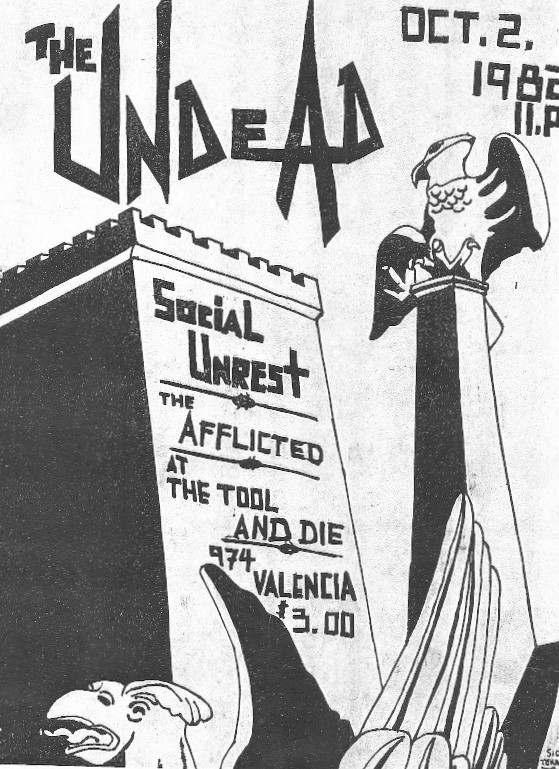
Sid Terror And The Undead: As He Nailed The Coffin Shut On The Band, I Wondered - Is There Life After Death For Sid?

Originally published in Rave-Up #13 (natch!) 1988
Interview by Devorah Ostrov

The 1984/1985 Sid Terror and the Undead lineup
L-R: Sid Terror, Hans Hunt, Trent Addams & Joe Dirt
Like their namesakes, Sid Terror and the Undead returned to life a year ago to bring some excitement to a decaying local music scene. Now, with their job still incomplete, the Undead have decided to call it quits and quietly slip back into their grave. While there was still a semblance of life left in the band, Rave-Up got together with Sid and bassist Hans Hunt to discuss the task they'd chosen.

Rave-Up: Interestingly, Sid Terror and the Undead is breaking up only a year after reforming. What's the reason behind the split?

Flyer for the Last Show Ever!!! Sid Terror and 
the Undead with The Phantom Creeps 
(January 16, 1988 at 
Chatterbox) 
Sid: The band was put back together as a one-year experiment with a self-imposed expiration date of January 16, 1988. The reason being that if we were not signed in that time, then we would move on. We almost made it. There was some interest from a few different labels, but it would have taken a lot more nurturing to get signed, and I'm one for weighing my options and sticking to my own promises. Our final show was exactly one year and one day from our "Resurrection Show."

Rave-Up: There was quite a lot of time between the break-up of the original Undead and this new version [of which Sid was the only original member]. What happened during that time?

Sid: I just wanted to take some time off and work on my films. I do a lot of special effects work for films, and I wanted to get that better established.

Rave-Up: It seems like the first version of the Undead was a lot more punk, maybe even hardcore, than the new band.

Sid: I don't think we were ever hardcore because I never liked hardcore music, and for a very short time would I even consider it a punk band. We started out making fun of a recently dead rock star [Sid Vicious], who I had a very slight resemblance to. This pissed off a lot of people, so we intensified it, just as a statement to say: "Stop taking yourselves so seriously. Rock 'n' roll is supposed to be fun!" Our sound was based on raw rock 'n' roll, with the subject matter being weird horror films. After all, we were horny teenage rock 'n' roll delinquents who loved horror movies!

The 1987 lineup 
L-R: Hans Hunt, Sid Terror, 
Luis Valentino & Joe Dirt
Rave-Up: Because of the band's name, did promoters tend to book you with "death rock" shows?

Hans: Well, sometimes... Actually, we had a problem on our last tour of getting booked with a lot of hardcore bands opening up for us.

Sid: Which did not go well at all. I'd say half the shows on the tour were misbooked. They really didn't know what to do with us. In Portland, we actually got on the bill with a speed metal band. They came up to us after the show and said, "How do you guys keep playing so long and so hard? " And we're not the kind of band that plays super hard or super fast.

Rave-Up: You mentioned your film work earlier, and I know you have a real passion for film and video. Is your music influenced more by films rather than by other bands?

Sid: Sometimes. I listen to everything, and I just assimilate it all. I don't set out to write one particular song, but for some reason, I'll see a film and the title will stick with me, or whatever, and I'll use that for a song.

Rave-Up: What were the most influential films for you?

Sid: Vampira films, Marilyn Monroe, Ed Wood films... My favorite film is Brian De Palma's Phantom Of The Paradise. [The Undead song "Sinister Urge" is based on an Ed Wood movie, and the group takes its name from a fictitious band that appeared in Phantom Of The Paradise.]

Sid Terror's Undead - Coffin Buster CD reissue
Rave-Up: Don't you have a family history of involvement in B-grade horror films?

Sid: My great-grandfather on my mother's side was Max Schreck, who played the vampire in the silent version of Nosferatu.

Rave-Up: I want to talk about your video work for a minute. Didn't you do some award-winning work for a Greg Kihn video?

The Undead with Social Unrest &
the Afflicted at The Tool and Die
October 2, 1982
 (Artwork by Sid Terror)
Sid: I was nominated for Best Effects in a Rock Video for "Jeopardy." That was the first video I did with him.

Rave-Up: What kind of special effects did you use in it?

Sid: Tons of zombie stuff. It took place in a church, and everyone turned into zombies or mutated Siamese twins!

Rave-Up: Do you have a favorite special effect?

Sid: In this one film I did called Disciple Of Dracula [not yet released], at the end of the film, when the vampire finally gets it, we did a lot of things that haven't really been done on film — kind of like a meltdown!

Rave-Up: Is it true that the Undead were asked to do some songs for the Return Of The Living Dead Part II soundtrack?

Sid: They were interested in some songs we had recorded, but because we didn't like the deal, we didn't go for it. They wanted all kinds of publishing rights, and we wouldn't be able to play the songs live or put them on our own album. So, we decided against it.

Rave-Up: Now that you've had a chance to look back on the career of Sid Terror and the Undead, do you have any regrets?
Sid poses beside the headstone of 
Sophie M. beloved wife of A. Loser

Sid: The Undead was a hell of a fun band to be in. I wouldn't trade all those good times for anything. We may never live down all the stuff we did, but by the same token, I don't necessarily want to relive it all, either. I mean, who wants to be Sid Terror "Teenage Vampire" forever? Not me!

Rave-Up: Your last show featured the "onstage suicide" of Sid Terror. By doing that, did you bring an end to the character you've become one with over the years?

Sid: "Sid" committed suicide when he stepped off the stage at the end of the final show. He no longer exists except in our fond memories and worst nightmares. There's still a lot of Sid in my personality, naturally. It's like Bruce Wayne and Batman. But from now on, you'll see only me onstage, and I'll be using my real name which is... *

* In the original article, I transcribed what I heard as "Bobby Omen," which seemed appropriate. I've since found out what Sid's real name actually is, and it seems I got it slightly wrong. But I still prefer Bobby Omen!