 |
Poster for Dwight Twilley's 1984 Jungle album
|
By Devorah Ostrov
"Someday, Dwight Twilley will be a star," insisted Greg Shaw in the March 1978 "special power pop issue" of Bomp! magazine. By that point, Twilley and his best friend Phil Seymour had already been playing together for eleven years; they'd released two finely crafted LPs and scored a Top 20 hit with the brilliant "I'm on Fire." So, Shaw's optimistic prediction wasn't far-fetched. What's weird is that despite his best efforts over the ensuing years, a run of bad luck meant that Twilley's career stubbornly stalled at revered cult hero.
Recently, The Right Stuff (part of the EMI-Capitol Music Group) released XXI, a CD compilation featuring 21 songs (including two new tunes) that Twilley felt showcased the best material of his recording career. And next year, the label plans to reissue both albums by the Dwight Twilley Band with bonus tracks and annotated booklets written by Twilley. It seemed like a good reason to have a chat about his history and find out what he's been up to lately. I found him living in Tulsa and working on some new material.
* * *
 |
| Phil Seymour & Dwight Twilley (Shelter Records publicity photo) |
Twilley attended Tulsa's prestigious Thomas Edison Preparatory School, where the popular students played football and participated in social clubs. "I was more sort of the artist guy," he says. "I was in the artist/musician clique."
The Intruders setlist included covers of chart hits like "Little Honda" and "Kansas City," as well as hip instrumentals of the day, like the Ventures' "Walk, Don't Run." After winning a Battle of the Bands competition, the Intruders were hired to play a set during the school assembly; it was the highpoint of their career. "We must have been pretty good," muses Twilley.
Although they didn't officially meet until 1967 at a matinée showing of A Hard Day's Night, Phil Seymour lived "just around the block" from Twilley, and they'd occasionally seen each other.
In his exhaustive biography of Twilley, Kent Benjamin terms their encounter: "One of the most fortuitous meetings since the church picnic at which Paul McCartney met John Lennon." (You can read Kent's full bio here.)
During this interview, Twilley notes that the Beatles' feature film debut had been released three years earlier. "So, it wasn't like people were rushing to go see it. But they had this special deal: if you brought a kid with you, you got in for free. I brought my little brother, and Phil brought somebody. So, it's like, here's this line of little tiny toddlers and there's only two people that are tall enough to pass through the turnstile. It was kind of obvious!"
"After the movie," comments Twilley, " we went directly over to my house and started recording that very day."
He can't remember what they recorded that afternoon ("God only knows!" he exclaims when I ask), and he claims not to recall the first song he wrote. But he knows exactly what equipment he used: "I had a Stella guitar, which I put pickups in. It was something you could get at Sears for like $29. And I had a Silvertone amp. And I think Phil already had a set of Ludwig drums."
The teenagers called themselves Oister, signifying that their two halves made up a whole. Kent Benjamin's biography states: "From the beginning, they conceived a partnership with both singing lead vocals that would take them to the top of the charts."
Although their first hit record was still a few years away, over the next several months the duo perfected their two-part harmonies while Twilley penned dozens of songs, which they recorded and pressed onto cheap acetates for their friends.
In an interview with Terry Hermon for the fanzine Bucketfull of Brains, Twilley talked about one of the acetates: "Oister Presents Swirling Clouds was the first LP Phil and I recorded. It was done mostly in Phil's bedroom & my garage. We had twelve acetates made at the local radio station. We couldn't afford to put it on vinyl. I still have one and I think a couple more are still in existence. However, I'm not sure if they would still play."
So smitten were Twilley and Seymour with the Fab Four, no other music really mattered to them. When I ask what else they listened to, Twilley answers vaguely, "We were right in the middle of the country, so we probably heard a lot of everything that passed by."
"We kind of thought that the Beatles invented rock 'n' roll," he states, "and Elvis was just a guy in movies."
Which is why the next part of the story is so ironic.
By 1969, their musical ambitions had outgrown the confines of their Midwestern bedrooms, so Twilley and Seymour decided Memphis was the place to go. "We couldn't afford to go to New York or Los Angeles," Twilley says matter-of-factly.
"So, we packed up my '58 Chevy and took our tapes to Memphis. We were driving down the street and just thought we'd pick the first record company that we saw — and it happened to be this company called Sun Records. We walked in and met some guy named Phillips..." He pauses for a second to let the name sink in. "...and this meant nothing to us. He listened to our tape, and he liked it."
One report suggests they met Jerry Phillips, the son of label founder Sam Phillips, but Kent Benjamin's bio states it was his brother Judd. Whichever Phillips it was, he swiftly dispatched them to the Tupelo, Mississippi studio of Ray Harris, a former Sun recording artist and co-owner of Hi Records.
"It was really funny," declares Twilley, "because we thought the Beatles had invented everything. And when he started playing us these old Sun records, we were like, 'Wow! That snare drum sounds a lot like Ringo's snare drum. And that guitar part sounds like something George did.' Pretty soon, we got a full education!"
The rockabilly pioneer (who Twilley once described as "scary") also told the two boys, "Y'all sing like pussies."
"Which we did," agrees Twilley. "At the time, we were kind of folky, kind of like Simon & Garfunkel."
Twilley has always credited Harris for toughing up their sound and adding elements of swaggering Southern rockabilly to their clean British pop influences. "We had kind of a late Elvis renaissance," he says, "and our music became a mixture of the Beatles and Elvis-type rockabilly."
Twilley and Seymour made a few trips to Tupelo, and they recorded several tracks with Harris — although none have surfaced. "I have some of them," he discloses. "Some of them might see the light of day one of these days."
Back in Tulsa, they recruited local guitarist Bill Pitcock IV, but Twilley's a bit hazy on the details of how that came about. "I think I met Bill through Phil," he guesses. "They'd played in some bands together or something."
Pitcock's grandfather let them use a tiny room above his shop, which was turned into a home recording studio with a Teac 4-track and a little Shure PA mixing board. "We put carpets on the walls and insulated it," recalls Twilley, "and we lugged a piano up the stairs."
They "recorded like crazy" above Pitcock Electric. "That's where we really sort of homed in on our sort of sound and what we were doing," says Twilley.
Twilley and Seymour were also involved in a couple of interesting side-projects around this time. To make some money, Twilley formed a cover band with Pitcock and Jerry Naifeh called 1950: "We just played songs from the '50s real fast. We'd play sororities and fraternities. We'd do the gig and eat as much of their food as we could, but it wasn't anything we were trying to do anything with."
Twilley also appeased his parents (who only "occasionally" supported his desire to be a musician) and followed up high school with a "semester or two" at college. Meanwhile, Seymour hooked up with El Roacho, a combo of Tulsa crazies that producer Steve Katz once referred to as "an old-fashioned stoner medicine show of a band." Kent Benjamin's biography divulges that Seymour bailed on El Roacho on the eve of the group's recording date.
"And the funny thing was," he adds, "it only took us about a week to get signed!"
In an odd twist of fate, the guys drove 1,400 miles and signed to Tulsa-based Shelter Records almost before they'd unpacked. It wasn't that Twilley had been unaware of his hometown record label; he'd just studiously avoided it.
"Everybody in Tulsa wanted to get onto Shelter," he points out. "And every band in town was trying to sound like Leon Russell. We felt like complete outcasts. And we'd heard that they were kind of confused by us. You know, 'What's this English rockabilly thing doing in the middle of Tulsa?'"
Founded in 1969 by Oklahoma native Leon Russell and British record producer Denny Cordell, Shelter took pride in its relatively small roster and laid-back workshop atmosphere. With recording facilities in LA and Tulsa, Shelter had developed into one of the most unique and successful independent record companies of the early '70s. Sharing his hippie-infused business philosophy with Billboard magazine in 1973, Cordell said: "I'm looking for universal music that will reach people be it rock, gospel, country, blues or what have you. I want the kind of music that transcends categories and appeals to the emotions."
The Oister demo that caught Cordell's attention contained early versions of "You Were so Warm" and "Rock Yourself, Son" as well as some tunes that would appear on Twilley's later solo LPs. But Cordell only heard it by chance.
"We'd recorded our songs on a Teac 4-track," says Twilley, "and we needed to mix them down to stereo to be able to play somebody a tape." Tulsa singer Dean Grider made them an offer: he would loan them his Teac 2-track in exchange for putting his voice onto a Twilley composition called "Love Is a Train."
"So, we took off our vocals and put his vocals on it," continues Twilley. "He got that, we mixed down our tapes, and a couple of weeks later we went to Los Angeles."
Grider was right behind them, and for some ridiculous reason, his first stop in LA was Shelter Records.
"We hadn't even considered going to Shelter Records in LA!" Twilley chortles. "Why would we go to Shelter in LA when it was down the street in Tulsa? So, he played them 'Love Is a Train,' and they loved the song. Then he made a big mistake. He said, 'Well, hell... they've got 14 or 15 more of 'em!' So, the first thing you know, they're screaming at us to please come over. They heard our tape and were just knocked out by it, and they signed us."
No one knows what happened to Dean Grider. "I owe him some thanks," acknowledges Twilley.
Did they have any idea that it was going to be such a big hit?
"You know what?" he nearly shouts. "We thought they were all going to be big hits!"
Centered on a massively engaging hook line ("You ain't, you ain't, you ain't got no lover"), the deceptively simple three-minute tune was recorded at The Church on November 27, 1974. Reminiscing about the song in the liner notes to XXI, Twilley writes: "Since the apartment where we had been staying had no furniture, I remember Phil and I sitting on the floor working out the harmonies. Fortunately, there was an old radio that Bill was able to plug his guitar into. I think that the sound of his guitar through that old radio played a role in how we treated the song in the studio."
The Dwight Twilley Band's debut 45, "I'm on Fire" b/w "Did You See What Happened?" was issued the following April with surprisingly little fanfare. But the lack of promotion didn't really matter, as radio stations coast to coast picked up on it, and the song rapidly climbed the charts to #16. Bomp! magazine enthused that it "cut through the AM dross like a hot knife." And The San Francisco Chronicle termed it "the best debut single by an American rock 'n' roll band ever."
"That impressed us," gushes Twilley.
In his review for the May 1975 issue of Phonograph Record magazine, Marty Cerf raved: "For the moment there are but two titles that have any meaning for me. One is 'Tell Her No' by Del Shannon. The other is the first release by the Dwight Twilley Band. 'I'm on Fire' is surely one of the most interesting pop releases I've come across since 'September Gurls' and 'When My Baby's Beside Me' by Alex Chilton and Big Star."
The official line was that "Shark" was ditched for fear of it being perceived as a cash-in on that year's Jaws craze. In Trouser Press, Twilley brushed it off as "a company freak-out."
But things were beginning to unravel at Shelter. Russell and Cordell dissolved their partnership, which resulted in a legal quagmire. Meanwhile, MCA terminated its distribution deal with the label. The follow-up to "I'm on Fire" was delayed while Cordell looked for a new deal, and by the time "You Were so Warm" b/w "Sincerely" was finally released, Shelter was going down.
In an interview with Jordan Oakes in his fanzine Yellow Pills, Twilley recalled: "The week when 'You Were so Warm' hit the charts, the record company disappeared. I remember calling up the promotion department, and I was told that there was no longer a promotional department."
"It was a whole big train wreck," Twilley states. And it held up the release of Sincerely, their debut album, for over a year.
So, for most of 1975, the Dwight Twilley Band carried on recording ... and recording ... and recording some more. "We had a period where nothing was going to be released," he explains, "and Cordell basically said, 'keep recording.'"
"In the end," says Twilley, "we had way more than two albums worth of stuff for Sincerely." Even fan favorites like "Did You See What Happened?" and "Rock Yourself, Son" were bumped from the final LP — giving rise to the mystique of the "B album."
"What difference did it make?" inquired Trouser Press writer Jim Green about recording in the UK.
Cordell finally worked out a new licensing/distribution deal with ABC Records, and the album (which featured a blurry cover pic of Twilley taken in a photo booth) was released in July 1976. And, still determined to issue three 45s, "Could Be Love" b/w "Feeling in the Dark" soon followed.
But by then, the momentum of "I'm on Fire" had been lost. Even though Rolling Stone called it the "debut album of the year," Sincerely didn't enter the Top 100, and the third single faded away without causing much fuss.
And there weren't many live gigs to promote Sincerely; just a handful of dates during October and November 1976 took in Southern California, the Midwest, and a corner of the East Coast. In his review of the LP, Robert Christgau remarked that Twilley's "natural habitat seems to be the studio (a forty-track when he has his druthers)." Likewise, Jim Green theorized, "Living up to the unusual production ideas on their discs must have presented a problem or two."
When I ask what their early shows were like, Twilley chuckles and simply says, "confused."
"I probably was more confident in the studio when I was younger," he offers. "We knew a lot more about recording because we'd done it more than getting out and performing. So, it took us awhile. But regardless of that, we got good reviews. Some of the shows I thought were terrible got great reviews! So, who knows?"
"We did it in LA," says Twilley. "After we'd bounced all over the country and all over the world doing Sincerely, we decided that Twilley Don't Mind should be like a studio album. So, it was all done in one place at one time over a period of a couple of months instead of a year."
Perhaps because of these restrictions, this LP (issued in September 1977, through Shelter's deal with Arista Records) portrayed a more conventional sounding pop group than Sincerely. For LA Times music columnist Robert Hilburn, it "lacked the biting edge of the debut." And Twilley once told Trouser Press readers: "Of all the albums, it's my least favorite, because it's the only album done academically."
In early 1978, apparently fed up with the group's inability to move forward and his own anonymity, Seymour ended his tenure with Twilley and embarked on a solo career.
In Trouser Press, Jon Young noted that Seymour "had been much more of a contributor than the billing indicated." He added, "An outsider might have surmised that Seymour was upset at not getting his share of the credit." To which Twilley countered, "I think Phil felt a little bad about that, that it was unfair to him. I was the leader of the band and I wrote the songs, but we did work together equally. We were definitely 50/50 partners."
"I think Phil wanted to get out from behind the drums," Twilley tells me, "and he was such a great singer. It probably seemed like we only lasted a minute, but we'd worked together for a long time. So, he wanted to do a solo thing and we'd done so much up to that point, it sort of made sense."
Seymour released two solo records, and in 1981 he had a hit with "Precious to Me." In 1984 he joined the Textones, but shortly afterwards he was diagnosed with lymphoma. Seymour fought the disease for eight years but passed away in 1993 at the age of 41 — sadly ending the speculation that he and Twilley might get back together again. "We really wanted to," verifies Twilley. "Even in the last few years, we had talked seriously about getting together and doing a reunion. But unfortunately, Phil's health really didn't permit it."
"Phil was my best friend," reflects Twilley. "He was my partner. He was an extremely talented person, and he had a terrific sense of humor. It was really unfortunate."
Still operating under the Shelter/Arista deal, Twilley was recorded at Shelter Studios in LA and released in 1979. Although old friends Bill Pitcock IV and Jerry Naifeh were on board, it was the first time Twilley had worked with co-producer Noah Shark — who had just completed You're Gonna Get It for Tom Petty and the Heartbreakers.
While Shark and Twilley continued their partnership for the next few years, the friction between Shelter and Arista was already evident.
In the Trouser Press interview with Jon Young, Twilley stated: "There was a bit of a problem between Arista and Shelter. Arista, to my mind, is a big, pretty straight company. Shelter was a small, stoned company. Their philosophies didn't get along at all. They argued a lot, so from the start, it didn't look too optimistic as far as being successful."
Twilley recounts a favorite story about these recording sessions, which illustrates the differing attitudes: "For atmosphere, we put up 150 strands of twinkling Christmas lights and coated the entire studio in aluminum foil. And that's the way the studio looked while we were recording." He thought it was "pretty trippy!" But the tale ends with Arista head Clive Davis asking, "Doesn't this confuse you?"
Twilley had an overall more melodic AOR sound than the previous two albums, with a liberal dose of strings and violins applied on some numbers. (Although only composer/ arranger Jimmy Haskell is credited on the LP, the notes for XXI disclose that a 22-piece orchestra was employed on "Out of My Hands.")
On the other hand, an Arista advert for the LP pinched this line from Rolling Stone scribe Mikal Gilmore: "Rock 'n' roll immortality would seem to be a matter of predestination."
In his biography, Kent Benjamin notes that only seven of the ten tracks included on Twilley were new compositions. "Runaway," he says, "was originally written for Phil to sing, and contained an extra verse. 'Alone in My Room' was also a latter-day Dwight Twilley Band song. 'Betsy Sue' had always been a highlight of the band's few live shows as far back as 1976."
"'Betsy Sue' was really old," confirms Twilley. Referring back to one of my earlier questions, he adds, "Now, that might have been one of my first songs. I wrote that when I was 15."
"Betsy Sue," a rockabilly raver in the style of "TV" would have been a perfect choice for a 45. Or maybe "Alone in My Room," which Robert Hilburn singled out for its "shadowy, sexy Tom Petty-like lure." I'd even make an argument for "Darlin" — a gorgeous tune that featured Seymour on backing vocals — although that would no doubt defeat the purpose of a solo album.
"It was pretty bad," recalls Twilley when I ask about the video's concept. "It was just me standing there with a light and some twinkly things behind me singing the song. And then the logo of my name lights up at the end of it."
In March, Robert Hilburn told LA Times readers that Arista had invited the press and "industry bigwigs" to the Whisky to "formally unveil the new Twilley." He also wrote that Twilley was preparing for a major tour with a series of low-profile warm-up dates, the first of which had just taken place at the Woodsound in Monrovia, California.
Meanwhile, Twilley's career hit a snag that kept his next album in limbo for three years. So, what was going on between 1979 and 1982?
Recording for the follow-up to Twilley began ordinarily enough in 1979. Before the end of the year, Arista issued a single featuring the Twilley-penned "Somebody to Love" b/w a cover of the Barrett Strong classic "Money." At this stage, both songs were scheduled to be included on a forthcoming LP called Blueprint.
At one point in 1980, Blueprint actually appeared on Arista's release sheets, but neither Twilley or the label were entirely pleased with it, and that version was shelved.
Kent Benjamin picks up the story: "Twilley continued to work on Blueprint through 1980, recording new songs, revisiting some old Dwight Twilley Band material, and cutting new versions of some of the tracks. At least twice, the album came close to being released again before being pulled."
While Twilley struggled to finish Blueprint, his contractual option with Shelter slipped through the cracks and expired. The topic of which label he was signed to then became a legal issue that stopped him from being able to work at all for some time.
"Was I on Arista? Was I on Shelter? Or was I free? It took a couple of years and 100 lawyers to get it figured out," says Twilley. "Some genius lawyer finally said, 'Look, you're on Arista.' And then EMI stepped in and bought me out of Arista."
By then it was 1982, and much of Blueprint was scrapped as Twilley began work on Scuba Divers — his first offering for EMI.
But his cover of "Money," included in early Blueprint tracklistings, ultimately didn't make it. "It wasn't a Dwight Twilley song; that was probably the main reason," he says.
Two Blueprint songs, "Then We Go Up" and "I Love You so Much," were given to Phil Seymour to re-record for his first solo album. Other numbers dropped along the way included "Rock Yourself, Son" and "Tiger Eyes" (both had been kicking around since the sessions for the first Dwight Twilley Band LP), as well as a solo version of "Shark (In the Dark)," and "Sky Blue" — which had roots dating back to the original Teac tapes.
In fact, "Sky Blue" was the first of Twilley's songs to be played on the radio (KGOU), but one of the last to see the light of day.
"It was Phil's cousin in Oklahoma City who played it," comments Twilley. "We probably had some really funky tape of it. It was a song that we recorded all the time. We were never really quite happy with it; we always wanted to record it again. We recorded it everywhere! We recorded it in Tulsa. We recorded it in London. We recorded it in LA. We recorded it in Tupelo. We probably recorded it more times than any other song!"
Twilley describes Scuba Divers as a "scrapbook" album. "I had tracks that I'd cut for Arista, tracks I'd cut for EMI, and tracks I'd cut on my own," he says. "I was walking around with tapes under my arms to different studios. I had so many different things going on."
Twilley toured in promotion of Scuba Divers through the summer of '82 with a group that included Susan and John Cowsill, as well as Bill Pitcock IV. (Pitcock could also be found backing up Phil Seymour. "Bill was kind of in both camps," states Twilley.) During the tour, MTV aired a special hour-long set filmed at Rockabilly's in Houston, and a clip from the show remained in heavy rotation on the music channel for several months.
In the July 1982 issue of Trouser Press magazine, Twilley said he was "basically a pretty happy guy these days."
The word dilapidated could be used to define the hole-in-the-wall building Twilley nicknamed "Studio No." Located in La Cresenta a few minutes north of LA, in 1983, it became Twilley's hang-out while he worked on Jungle — his next (and most commercially successful) album.
"I'd go there by myself and write songs," he says. "And later in the evening, some musicians would come over and we'd record 'em. The thing about Studio No was they'd say, 'Did you guys get anything done last night?' And we'd say, 'No.' They'd say, 'Did the equipment work okay?' 'No.' 'Well, did it sound good?' 'No.' The great thing about Studio No was you knew that no matter what you did, it would always sound better somewhere else. A lot of times, you'll do a demo and it'll sound better than the record. And that bums you out. But at Studio No, you were always assured that no matter what you did, if you took it somewhere else, it would sound better."
According to the notes for XXI, most of the material for Jungle was written and demoed at Studio No. However, Twilley tells me that the irresistible power-pop hit "Girls" was demoed "a couple of times in different little studios. I kind of had that one real well prepared when I went in to record it." Adding Tom Petty's "distinctive twang" (as Kent Benjamin characterizes it) on the counterpoint vocals was a later stroke of genius. "We had been talking about having Tom come down," says Twilley. "Once I had the song, it seemed obvious that it would be a good one for him."
Co-produced by Noah Shark, Mark Smith and John Hug, Jungle was issued in early 1984, and "Girls" peaked at #16 on Billboard's Hot 100 chart in April (it was #2 on the separate Top Tracks chart).
Director Mark Robinson (whose résumé included Tina Turner's "What's Love Got to Do with It?") based the video for "Girls" on the silly teen flick Porky's. Twilley stared as the football coach, Playboy bunnies were cast as cheerleaders, and Textones' singer Carla Olson filled in for Petty — a clever ruse that Twilley takes credit for.
(As well as the MTV-friendly version of the video, there's also an R-rated variant paid for by the Playboy channel!)
In his review of Jungle for Star Hits magazine, David Sprague noted that Twilley's "original Beatles-rockabilly fixations have given way to a soulfully metallic edge more like that of Bryan Adams." And nowhere is Twilley's ease and confidence with this style more evident than on the LP's lead track, "Little Bit of Love," which again featured Susan Cowsill on harmonies.
EMI issued "Little Bit of Love" as the follow-up single to "Girls," but without the same promotional push, it came to a standstill at #77 in the charts. A third single from Jungle — a remixed version of "Why You Wanna Break My Heart" — was released as part of the soundtrack for the movie Body Rock. The film flopped and took the 45 down with it. (These days, the soaring ballad is probably better known as the tune Tia Carrere sings in Wayne's World.)
By 1985, it was clear that EMI was no longer interested in Twilley. So, when a fast-talking independent radio promoter (who should probably remain nameless) with a custom label said, "I can make you a star," Twilley listened. He was bought out of his contract with EMI, and work began on Wild Dogs, his final studio album before this interview.
I've never actually seen a copy of Wild Dogs, I confess.
The Right Stuff press release that came with XXI jokingly refers to the record as having "mysteriously vanished in the Jersey swamplands when one of the label's chief executives was indicted on payola charges."
But it was no laughing matter.
"Basically," states Twilley, "I was sort of romanced away from EMI with the idea that there was going to be this terrific promotion department. So, I spent about a year writing the songs and putting together what I thought was going to be the big follow-up to the Jungle album. About two weeks before the album came out, I was watching television. On NBC news, they were showing FBI footage of the president of my record company with the Gambino brothers. And the next day, every artist on the label was dropped — except me, of course. Probably because the record was already in the pipeline. And the day after that, I'm on some other label called CBS Associated. Nobody knew me; I didn't know anybody there. They just basically buried the album. You know, there was supposed to be a video and the whole thing. It was all just swept under the table. It was really a drag."
The two Wild Dogs numbers included on XXI take Twilley full circle, back to the beginning in Tulsa and his friendship with Seymour.
The title track (which features Bill Pitcock IV on acoustic guitar) "is kind of like a tribute to the days above the shop — the wackiness and the echo," says Twilley. He composed the second song, an incredibly moving ballad called "Shooting Stars," after learning that Phil had been diagnosed with terminal cancer. "I asked him to come to the session and sing on the record," Twilley writes in the CD's booklet. "I never told him or anyone about the origin of the tune."
Artwork (Twilley's first lithograph, titled "Out in the Rain," is now for sale) and demoing material for a yet to be released LP called The Luck has kept him busy.
He also authored Questions From Dad, a parenting book based on his long-distance relationship with his daughter. (Born to his first wife Linda in 1980, she's the focus of the song "Dion Baby" from Scuba Divers.) The book won an award from the Children's Rights Council and found Twilley being interviewed on The Today Show and speaking in Washington. "It seemed like a good thing to do at the time," he says about writing the book. "But I'm glad it's over and done and out of the way. It was really strange to go on TV with no guitar. I just didn't like it!"
The 1994 Northridge earthquake prompted Twilley to return to Tulsa. "My studio and the house were so badly damaged, I had to move out. I had to move everything I owned out of my house. At that point, you think — do I really wanna move down the block?"
But not much else has changed. Twilley states that there's been some record company interest following his appearance at SXSW last year. "I'm recording some demos right now," he says. "I've got a great new live show, and I'm really back in the swing of things. I plan on making a lot of music, walking around on stages, and going into recording studios. And I hope people will be hearing from me."
Twilley: You know what's funny about that? That song is so popular with little kids. A lot of our friends have XXI, and their kids crank up the CD and dance to it in the yard.
Q: In the CD booklet, you say that you've updated the lyrics to allow for VCRs and cable channels...
Twilley: Yeah, 'cause I do it live a lot. A few years back, I said: "Hold me close/We've got the VCR/It's better than our parents had it/At a drive-in in a car." And in the last year, I've added: "Pay per view/Four or five channels/Where they're dancing in the nude."
Q: I want to ask about some of the songs from Sincerely that you didn't include on XXI.
Twilley: Okay.
Q: Like some of my favorites...
Twilley: I know. It was hard to just take a couple of songs from each album. There were ones I wanted... I had a lot of different, weird reasons for what I picked.
Q: Why didn't you chose "Could Be Love" and "You Were so Warm"?
Q: What about "Three Persons"?
Twilley: Love that song! It's one of my faves!
Q: So, why didn't you didn't include it on XXI?
Twilley: There were a lot of songs that were real hard to decide on. Some of the decisions were based on having too many sort of acoustic rock songs. If there's a Best of Dwight Twilley 2, it will surely be on there.
Q: In the booklet, you mention that you hadn't met Leon Russell before you started recording for Shelter.
Twilley: No, we didn't meet Leon until after "I'm on Fire" was a hit. Because we were from Tulsa, a lot of people thought, "They must have gotten in with Leon." It was exactly the opposite! But it turned out to be cool. He invited us up to his home studio, and we cut some things with him. We had a great time!
Q: I was going to ask how you recorded the vocals on "Looking for the Magic," but apparently, you didn't use any special technique. In the CD booklet, you said it was a "scratch vocal."
Twilley: Yeah... I even tried to do a real vocal, but I liked the live one better.
Q: Will you ever release the version with the proper vocals?
Twilley: I doubt if it exists. I'd have to go back to the multi-track. You never know, it might be on there.
Q: What's the story behind the blurry photo you used for the cover of Sincerely?
Twilley: It's funny because The Right Stuff is reissuing that album and Twilley Don't Mind, and I talk about this in the liner notes. What happened was... It was really Denny Cordell's idea. We had a real nice professional photo, and it was slated to be the cover before all the stuff went down. One day, Phil and I put grease in our hair... There was this old miniature golf course; it was probably off Hollywood Boulevard. I'm sure Errol Flynn probably played golf there. We went over there and got in the photo booth machine and took all these wacky pictures. When we showed them to Cordell, he just loved them. He used two of them for the "I'm on Fire" single. He thought they looked like something from the Museum of Modern Art. Basically, he said, "If you put a normal good-looking photo on the cover, no one will pay any attention to it. But if you put this on the cover, people will never forget it." And I think he was right.
Q: I've always wondered, is "Trying to Find My Baby" a true story? You're very specific about the time of day that you're stuck on the freeway.
Twilley: As far as I remember, there wasn't any actual event. But it sounds like it, doesn't it? It is a driving kind of song. I like songs like that. When you hear the song, you can almost imagine yourself behind the wheel. That was also our first song that was in an actual motion picture; it was in Up the Academy.
Q: I remember that film!
In his exhaustive biography of Twilley, Kent Benjamin terms their encounter: "One of the most fortuitous meetings since the church picnic at which Paul McCartney met John Lennon." (You can read Kent's full bio here.)
 |
The members of the Dwight Twilley Band pose in
the pages of Germany's Bravo magazine
|
"After the movie," comments Twilley, " we went directly over to my house and started recording that very day."
He can't remember what they recorded that afternoon ("God only knows!" he exclaims when I ask), and he claims not to recall the first song he wrote. But he knows exactly what equipment he used: "I had a Stella guitar, which I put pickups in. It was something you could get at Sears for like $29. And I had a Silvertone amp. And I think Phil already had a set of Ludwig drums."
The teenagers called themselves Oister, signifying that their two halves made up a whole. Kent Benjamin's biography states: "From the beginning, they conceived a partnership with both singing lead vocals that would take them to the top of the charts."
Although their first hit record was still a few years away, over the next several months the duo perfected their two-part harmonies while Twilley penned dozens of songs, which they recorded and pressed onto cheap acetates for their friends.
In an interview with Terry Hermon for the fanzine Bucketfull of Brains, Twilley talked about one of the acetates: "Oister Presents Swirling Clouds was the first LP Phil and I recorded. It was done mostly in Phil's bedroom & my garage. We had twelve acetates made at the local radio station. We couldn't afford to put it on vinyl. I still have one and I think a couple more are still in existence. However, I'm not sure if they would still play."
* * *
So smitten were Twilley and Seymour with the Fab Four, no other music really mattered to them. When I ask what else they listened to, Twilley answers vaguely, "We were right in the middle of the country, so we probably heard a lot of everything that passed by."
 |
Collect them all!
One of a series of punk/new wave
bubblegum cards
|
Which is why the next part of the story is so ironic.
"So, we packed up my '58 Chevy and took our tapes to Memphis. We were driving down the street and just thought we'd pick the first record company that we saw — and it happened to be this company called Sun Records. We walked in and met some guy named Phillips..." He pauses for a second to let the name sink in. "...and this meant nothing to us. He listened to our tape, and he liked it."
One report suggests they met Jerry Phillips, the son of label founder Sam Phillips, but Kent Benjamin's bio states it was his brother Judd. Whichever Phillips it was, he swiftly dispatched them to the Tupelo, Mississippi studio of Ray Harris, a former Sun recording artist and co-owner of Hi Records.
"It was really funny," declares Twilley, "because we thought the Beatles had invented everything. And when he started playing us these old Sun records, we were like, 'Wow! That snare drum sounds a lot like Ringo's snare drum. And that guitar part sounds like something George did.' Pretty soon, we got a full education!"
The rockabilly pioneer (who Twilley once described as "scary") also told the two boys, "Y'all sing like pussies."
 |
| Arista Records advert for Twilley Don't Mind |
Twilley and Seymour made a few trips to Tupelo, and they recorded several tracks with Harris — although none have surfaced. "I have some of them," he discloses. "Some of them might see the light of day one of these days."
Back in Tulsa, they recruited local guitarist Bill Pitcock IV, but Twilley's a bit hazy on the details of how that came about. "I think I met Bill through Phil," he guesses. "They'd played in some bands together or something."
Pitcock's grandfather let them use a tiny room above his shop, which was turned into a home recording studio with a Teac 4-track and a little Shure PA mixing board. "We put carpets on the walls and insulated it," recalls Twilley, "and we lugged a piano up the stairs."
They "recorded like crazy" above Pitcock Electric. "That's where we really sort of homed in on our sort of sound and what we were doing," says Twilley.
Twilley and Seymour were also involved in a couple of interesting side-projects around this time. To make some money, Twilley formed a cover band with Pitcock and Jerry Naifeh called 1950: "We just played songs from the '50s real fast. We'd play sororities and fraternities. We'd do the gig and eat as much of their food as we could, but it wasn't anything we were trying to do anything with."
 |
| Oister - released in 2017 on HoZac Records Pre-Dwight Twilley Band 1973-74 Teac Tapes hozacrecords.com/dwight-twilley-band |
By the fall of 1974, Oister was ready to go to Los Angeles and get a record deal. "It was just that simple," laughs Twilley. "We were so naïve. It wasn't like we were big-headed, or anything. We just didn't know that it was supposed to be hard to get a record deal."
"And the funny thing was," he adds, "it only took us about a week to get signed!"
 |
| Promo poster for the Sincerely album |
"Everybody in Tulsa wanted to get onto Shelter," he points out. "And every band in town was trying to sound like Leon Russell. We felt like complete outcasts. And we'd heard that they were kind of confused by us. You know, 'What's this English rockabilly thing doing in the middle of Tulsa?'"
Founded in 1969 by Oklahoma native Leon Russell and British record producer Denny Cordell, Shelter took pride in its relatively small roster and laid-back workshop atmosphere. With recording facilities in LA and Tulsa, Shelter had developed into one of the most unique and successful independent record companies of the early '70s. Sharing his hippie-infused business philosophy with Billboard magazine in 1973, Cordell said: "I'm looking for universal music that will reach people be it rock, gospel, country, blues or what have you. I want the kind of music that transcends categories and appeals to the emotions."
The Oister demo that caught Cordell's attention contained early versions of "You Were so Warm" and "Rock Yourself, Son" as well as some tunes that would appear on Twilley's later solo LPs. But Cordell only heard it by chance.
"We'd recorded our songs on a Teac 4-track," says Twilley, "and we needed to mix them down to stereo to be able to play somebody a tape." Tulsa singer Dean Grider made them an offer: he would loan them his Teac 2-track in exchange for putting his voice onto a Twilley composition called "Love Is a Train."
 |
"I'm on Fire"
Japanese picture sleeve 45
|
Grider was right behind them, and for some ridiculous reason, his first stop in LA was Shelter Records.
"We hadn't even considered going to Shelter Records in LA!" Twilley chortles. "Why would we go to Shelter in LA when it was down the street in Tulsa? So, he played them 'Love Is a Train,' and they loved the song. Then he made a big mistake. He said, 'Well, hell... they've got 14 or 15 more of 'em!' So, the first thing you know, they're screaming at us to please come over. They heard our tape and were just knocked out by it, and they signed us."
No one knows what happened to Dean Grider. "I owe him some thanks," acknowledges Twilley.
* * *
One of the first things their label did was change the group's name. "We were Oister all the way up until we got signed," states Twilley, "but Denny Cordell thought my name was so wacky that it had to be the name of the band." In a 1982 Trouser Press interview, Twilley told Jon Young: "I always thought 'Dwight Twilley' was a creepy name, but it was catchy."
Although the new appellation (which seemed to minimize Seymour's position to that of a back-up musician) caused hurt feelings down the road, Twilley asserts: "Actually, Phil had to talk me into it." He also observes that they used Oister for their production credit. "We hoped it would eventually be understood that it was a partnership," he says.
The second thing Shelter did was send them back to Tulsa to familiarize themselves with the studio's 16-track deck housed in a renovated church and maybe demo some material. However, Twilley reveals: "The very first night we walked in, Phil took me aside and said, 'Dwight, let's make a hit single.' And the first recording we made was 'I'm on Fire.'"
Although the new appellation (which seemed to minimize Seymour's position to that of a back-up musician) caused hurt feelings down the road, Twilley asserts: "Actually, Phil had to talk me into it." He also observes that they used Oister for their production credit. "We hoped it would eventually be understood that it was a partnership," he says.
 |
| Sincerely LP - back cover photo |
Did they have any idea that it was going to be such a big hit?
"You know what?" he nearly shouts. "We thought they were all going to be big hits!"
Centered on a massively engaging hook line ("You ain't, you ain't, you ain't got no lover"), the deceptively simple three-minute tune was recorded at The Church on November 27, 1974. Reminiscing about the song in the liner notes to XXI, Twilley writes: "Since the apartment where we had been staying had no furniture, I remember Phil and I sitting on the floor working out the harmonies. Fortunately, there was an old radio that Bill was able to plug his guitar into. I think that the sound of his guitar through that old radio played a role in how we treated the song in the studio."
The Dwight Twilley Band's debut 45, "I'm on Fire" b/w "Did You See What Happened?" was issued the following April with surprisingly little fanfare. But the lack of promotion didn't really matter, as radio stations coast to coast picked up on it, and the song rapidly climbed the charts to #16. Bomp! magazine enthused that it "cut through the AM dross like a hot knife." And The San Francisco Chronicle termed it "the best debut single by an American rock 'n' roll band ever."
"That impressed us," gushes Twilley.
In his review for the May 1975 issue of Phonograph Record magazine, Marty Cerf raved: "For the moment there are but two titles that have any meaning for me. One is 'Tell Her No' by Del Shannon. The other is the first release by the Dwight Twilley Band. 'I'm on Fire' is surely one of the most interesting pop releases I've come across since 'September Gurls' and 'When My Baby's Beside Me' by Alex Chilton and Big Star."
 |
| Advert for the "Could Be Love" single |
According to Twilley, Shelter planned to issue three 45s before the first album came out, and during a performance on American Bandstand, the group introduced "Shark" as their next single. But the song, which Greg Shaw described as a "charming pop number with a hard-edged guitar sound," wouldn't materialize until years later when it was included on a Del Rack "best of" CD.
The official line was that "Shark" was ditched for fear of it being perceived as a cash-in on that year's Jaws craze. In Trouser Press, Twilley brushed it off as "a company freak-out."
But things were beginning to unravel at Shelter. Russell and Cordell dissolved their partnership, which resulted in a legal quagmire. Meanwhile, MCA terminated its distribution deal with the label. The follow-up to "I'm on Fire" was delayed while Cordell looked for a new deal, and by the time "You Were so Warm" b/w "Sincerely" was finally released, Shelter was going down.
In an interview with Jordan Oakes in his fanzine Yellow Pills, Twilley recalled: "The week when 'You Were so Warm' hit the charts, the record company disappeared. I remember calling up the promotion department, and I was told that there was no longer a promotional department."
"It was a whole big train wreck," Twilley states. And it held up the release of Sincerely, their debut album, for over a year.
So, for most of 1975, the Dwight Twilley Band carried on recording ... and recording ... and recording some more. "We had a period where nothing was going to be released," he explains, "and Cordell basically said, 'keep recording.'"
 |
Autographed promo poster for Twilley Don't Mind
(found on ETSY)
|
No less than four different studios were used in the making of Sincerely. Some songs, such as "I'm on Fire," were recorded at The Church. "TV" was done at Sunset Sound in Los Angeles, and the haunting title track — which Twilley confides was "probably inspired by some steamy little Tulsa girl" — was completed in Leon Russell's home studio outside Tulsa.
And even more material was recorded with producer Robin Cable at London's Trident Studios, although only one song from those sessions (the appropriately titled "England") ultimately made it onto the record.
"What difference did it make?" inquired Trouser Press writer Jim Green about recording in the UK.
 |
Phil Seymour & Dwight Twilley
LP insert photo for Sincerely
|
"Gave me a cold," replied Twilley.
Cordell finally worked out a new licensing/distribution deal with ABC Records, and the album (which featured a blurry cover pic of Twilley taken in a photo booth) was released in July 1976. And, still determined to issue three 45s, "Could Be Love" b/w "Feeling in the Dark" soon followed.
But by then, the momentum of "I'm on Fire" had been lost. Even though Rolling Stone called it the "debut album of the year," Sincerely didn't enter the Top 100, and the third single faded away without causing much fuss.
The time spent recording in England also meant they hadn't been able to capitalize on the success of "I'm on Fire" while it was in the charts. "That was a real setback for us," accepts Twilley. "We didn't realize what was happening until we got home, and it was all over the radio."
And there weren't many live gigs to promote Sincerely; just a handful of dates during October and November 1976 took in Southern California, the Midwest, and a corner of the East Coast. In his review of the LP, Robert Christgau remarked that Twilley's "natural habitat seems to be the studio (a forty-track when he has his druthers)." Likewise, Jim Green theorized, "Living up to the unusual production ideas on their discs must have presented a problem or two."
When I ask what their early shows were like, Twilley chuckles and simply says, "confused."
"I probably was more confident in the studio when I was younger," he offers. "We knew a lot more about recording because we'd done it more than getting out and performing. So, it took us awhile. But regardless of that, we got good reviews. Some of the shows I thought were terrible got great reviews! So, who knows?"
 |
Twilley Don't Mind - The Right Stuff CD reissue (1997)
Features three bonus tracks produced by Noah Shark
and reinstates the cover preferred by the band.
|
Unlike its predecessor, the band's sophomore effort, Twilley Don't Mind, was finished and on sale in record stores in what most people would deem a reasonable amount of time. And this time, they stayed put during the recording process.
"We did it in LA," says Twilley. "After we'd bounced all over the country and all over the world doing Sincerely, we decided that Twilley Don't Mind should be like a studio album. So, it was all done in one place at one time over a period of a couple of months instead of a year."
There was no messing around or heaps of unused material with Twilley Don't Mind. Only one song ("Falling in Love") was left off, and that was due to a recording glitch. As Kent Benjamin's bio emphasizes: "They had decided in advance exactly what was going to be on it, and that's just what they recorded."
Perhaps because of these restrictions, this LP (issued in September 1977, through Shelter's deal with Arista Records) portrayed a more conventional sounding pop group than Sincerely. For LA Times music columnist Robert Hilburn, it "lacked the biting edge of the debut." And Twilley once told Trouser Press readers: "Of all the albums, it's my least favorite, because it's the only album done academically."
But Jordan Oakes was still a huge fan. "To me, that album gave birth to the true Twilley style," he proclaimed in Yellow Pills.
For some people, it was the little things that made Twilley Don't Mind so wonderful. Greg Shaw once said that he loved the way Twilley and Seymour sang the line "so get outta my way…" on “Trying to Find My Baby." And Twilley laughs when I tell him that his breathy "Oh, mercy" and deep sigh at the start of "Looking for the Magic" made my teenage knees go weak. "It was just a spontaneous thing," he admits. "It was a live track, and we were just having a good time that night." And he points out: "Tom was playing on that, too."
For some people, it was the little things that made Twilley Don't Mind so wonderful. Greg Shaw once said that he loved the way Twilley and Seymour sang the line "so get outta my way…" on “Trying to Find My Baby." And Twilley laughs when I tell him that his breathy "Oh, mercy" and deep sigh at the start of "Looking for the Magic" made my teenage knees go weak. "It was just a spontaneous thing," he admits. "It was a live track, and we were just having a good time that night." And he points out: "Tom was playing on that, too."
 |
Top students Phil & Dwight display their gold stars.
|
Twilley first met labelmate Tom Petty when the Heartbreakers were working on their debut album at Shelter's LA studios, and they became friends. "We sort of helped each other out along the way," he says.
Twilley contributed backing vocals to "Strangered in the Night" while Seymour featured on "Breakdown" and "American Girl." In return, Petty played guitar on "Looking for the Magic."
There was a short tour to promote Twilley Don't Mind, with dates at the Roxy in LA and the Old Waldorf in San Francisco. After which, they headed to the Midwest to open for Brand X (the Phil Collins-led jazz-fusion project) and Wishbone Ash at the Fox Theater in St. Louis. Writing about the '77 tour in his biography, Kent Benjamin notes that "the band turned in some remarkable shows, in spite of sometimes being booked as the opening act to some extremely ill-suited punk acts and over-the-hill rockers."
Besides the tour, some unusual promotion was also arranged for Twilley Don't Mind. If you were a child in 1977, you might have seen the Dwight Twilley Band (with guest bassist Tom Petty making his TV debut) on the short-lived Saturday morning kids' show Wacko. If you were old enough to be a fan of the Dwight Twilley Band, you probably slept through it.
"It was like a Laugh-In kind of thing," explains Twilley, "and the band was a regular feature." During the show's ten-episode run, the guys lip-synced their way through four tunes off Twilley Don't Mind, and some of their performances can now be found on YouTube. (Here's a link to "That I Remember": www.youtube.com)
Although Twilley Don't Mind did better chart-wise than Sincerely, it wasn't considered a triumph. Still, Shelter/Arista stuck to the plan that didn't work for the first album and released three singles, including "Trying to Find My Baby" and "Looking for the Magic" — both of which should have been sure-fire hits, but for some reason weren't.
 |
Photo: Marc Mayco
From Trouser Press (November 1977)
|
"The singles didn't do well," Twilley concedes. "We couldn't quite figure it out."
In early 1978, apparently fed up with the group's inability to move forward and his own anonymity, Seymour ended his tenure with Twilley and embarked on a solo career.
In Trouser Press, Jon Young noted that Seymour "had been much more of a contributor than the billing indicated." He added, "An outsider might have surmised that Seymour was upset at not getting his share of the credit." To which Twilley countered, "I think Phil felt a little bad about that, that it was unfair to him. I was the leader of the band and I wrote the songs, but we did work together equally. We were definitely 50/50 partners."
"I think Phil wanted to get out from behind the drums," Twilley tells me, "and he was such a great singer. It probably seemed like we only lasted a minute, but we'd worked together for a long time. So, he wanted to do a solo thing and we'd done so much up to that point, it sort of made sense."
He maintains there was no rift between the two friends: "We helped each other out. I wrote songs for Phil's solo albums and sang on some of the records, and he sang on some of mine. We were always in contact. And also, if anything good happened in Phil's career, it helped me. And anything in my career helped Phil. Whenever they talked about me, they'd talk about Phil. Whenever they talked about Phil, they'd talk about me."
Seymour released two solo records, and in 1981 he had a hit with "Precious to Me." In 1984 he joined the Textones, but shortly afterwards he was diagnosed with lymphoma. Seymour fought the disease for eight years but passed away in 1993 at the age of 41 — sadly ending the speculation that he and Twilley might get back together again. "We really wanted to," verifies Twilley. "Even in the last few years, we had talked seriously about getting together and doing a reunion. But unfortunately, Phil's health really didn't permit it."
"Phil was my best friend," reflects Twilley. "He was my partner. He was an extremely talented person, and he had a terrific sense of humor. It was really unfortunate."
* * *
 |
Arista advert for Dwight Twilley's self-titled solo LP
|
"Boy, that's a good question," responds Twilley when I query how long it took to put together his self-titled solo debut. "I think we spent quite a while on that. It might have been like six months or something."
Still operating under the Shelter/Arista deal, Twilley was recorded at Shelter Studios in LA and released in 1979. Although old friends Bill Pitcock IV and Jerry Naifeh were on board, it was the first time Twilley had worked with co-producer Noah Shark — who had just completed You're Gonna Get It for Tom Petty and the Heartbreakers.
While Shark and Twilley continued their partnership for the next few years, the friction between Shelter and Arista was already evident.
In the Trouser Press interview with Jon Young, Twilley stated: "There was a bit of a problem between Arista and Shelter. Arista, to my mind, is a big, pretty straight company. Shelter was a small, stoned company. Their philosophies didn't get along at all. They argued a lot, so from the start, it didn't look too optimistic as far as being successful."
Twilley recounts a favorite story about these recording sessions, which illustrates the differing attitudes: "For atmosphere, we put up 150 strands of twinkling Christmas lights and coated the entire studio in aluminum foil. And that's the way the studio looked while we were recording." He thought it was "pretty trippy!" But the tale ends with Arista head Clive Davis asking, "Doesn't this confuse you?"
Twilley had an overall more melodic AOR sound than the previous two albums, with a liberal dose of strings and violins applied on some numbers. (Although only composer/ arranger Jimmy Haskell is credited on the LP, the notes for XXI disclose that a 22-piece orchestra was employed on "Out of My Hands.")
 |
Dwight Twilley with Susan Cowsill & Carla Olson
Photo: Gary Nichamin
|
"For the songs that [the strings and violins] were used on, it just seemed like the right thing to do," says Twilley. "It was fun."
While the orchestra did imbue "Out of My Hands" with an elegant late-period Beatles feel, not everyone appreciated this new direction. Creem's J.M. Bridgewater took Twilley to task over the tune, suggesting there was "obviously a sensibility screw loose somewhere — leading off a pop album with a Genesis in search of Badfinger dirge..."
While the orchestra did imbue "Out of My Hands" with an elegant late-period Beatles feel, not everyone appreciated this new direction. Creem's J.M. Bridgewater took Twilley to task over the tune, suggesting there was "obviously a sensibility screw loose somewhere — leading off a pop album with a Genesis in search of Badfinger dirge..."
On the other hand, an Arista advert for the LP pinched this line from Rolling Stone scribe Mikal Gilmore: "Rock 'n' roll immortality would seem to be a matter of predestination."
In his biography, Kent Benjamin notes that only seven of the ten tracks included on Twilley were new compositions. "Runaway," he says, "was originally written for Phil to sing, and contained an extra verse. 'Alone in My Room' was also a latter-day Dwight Twilley Band song. 'Betsy Sue' had always been a highlight of the band's few live shows as far back as 1976."
"'Betsy Sue' was really old," confirms Twilley. Referring back to one of my earlier questions, he adds, "Now, that might have been one of my first songs. I wrote that when I was 15."
"Betsy Sue," a rockabilly raver in the style of "TV" would have been a perfect choice for a 45. Or maybe "Alone in My Room," which Robert Hilburn singled out for its "shadowy, sexy Tom Petty-like lure." I'd even make an argument for "Darlin" — a gorgeous tune that featured Seymour on backing vocals — although that would no doubt defeat the purpose of a solo album.
 |
| Dwight Twilley - publicity photo circa 1982 |
Instead, the label issued "Out of My Hands" b/w "Nothing's Ever Gonna Change so Fast," followed by "Runaway" b/w "Burnin' Sand" (a non-LP track that marked Susan and John Cowsill's first recording with Twilley).
Neither single charted, although a seldom seen promotional video was made for "Out of My Hands." But with MTV still a couple of years away, the need for this kind of marketing tool was admittedly limited, and Kent Benjamin remarks: "Dwight hated the video and it's never been seen since, so its very existence is unknown to most fans."
Neither single charted, although a seldom seen promotional video was made for "Out of My Hands." But with MTV still a couple of years away, the need for this kind of marketing tool was admittedly limited, and Kent Benjamin remarks: "Dwight hated the video and it's never been seen since, so its very existence is unknown to most fans."
"It was pretty bad," recalls Twilley when I ask about the video's concept. "It was just me standing there with a light and some twinkly things behind me singing the song. And then the logo of my name lights up at the end of it."
In March, Robert Hilburn told LA Times readers that Arista had invited the press and "industry bigwigs" to the Whisky to "formally unveil the new Twilley." He also wrote that Twilley was preparing for a major tour with a series of low-profile warm-up dates, the first of which had just taken place at the Woodsound in Monrovia, California.
 |
Twilley and his backing band are the
subject of a Jungle-era Creem Profile.
|
"It was the typical first show," Twilley informed Hilburn. "Everything that could go wrong did go wrong. The monitors didn't work, the guitar fuzz boxes didn't come on. But it really turned out well because it made everybody in the band more determined. We just poured it on. The audience really reacted well. We got encore after encore."
Was it scary the first time he went onstage without Phil, I wonder?
"No. Actually, I was more concerned about recording. My main concern was the harmonies. Even though somebody might be a great singer, that doesn't mean they'll have the blend that you need. I was just fortunate enough to have had a relationship with Susan Cowsill."
Was it scary the first time he went onstage without Phil, I wonder?
"No. Actually, I was more concerned about recording. My main concern was the harmonies. Even though somebody might be a great singer, that doesn't mean they'll have the blend that you need. I was just fortunate enough to have had a relationship with Susan Cowsill."
Prior to 1979, the last time most of us had seen Susan Cowsill, she was a cute-as-a-button 9-year-old, playing tambourine and singing "The Rain, the Park, and Other Things" next to her identically dressed mother and brothers on national television.
When a mutual road manager mentioned her to Twilley, the now accomplished musician and vocalist had recently reunited with some of her siblings to work on an album of new material called Cocaine Drain (which remained unreleased until 2008). "I was interested in Susan," says Twilley. "So, I decided to come down to one of their shows and meet her."
Thanks to Dwight Twilley, the question "Whatever happened to the Cowsills?" was answered. And for almost a decade, Susan took over as his harmony/backing vocalist while her brother John often joined them on drums.
Meanwhile, Twilley's career hit a snag that kept his next album in limbo for three years. So, what was going on between 1979 and 1982?
 |
Concert poster for Dwight Twilley
at the Love Garden - March 7, 2015
|
"Oh, it was just another one of the things I kept getting into," he says nonchalantly. I imagine him casually waving away the unpleasant question on the other end of the phone line.
Recording for the follow-up to Twilley began ordinarily enough in 1979. Before the end of the year, Arista issued a single featuring the Twilley-penned "Somebody to Love" b/w a cover of the Barrett Strong classic "Money." At this stage, both songs were scheduled to be included on a forthcoming LP called Blueprint.
At one point in 1980, Blueprint actually appeared on Arista's release sheets, but neither Twilley or the label were entirely pleased with it, and that version was shelved.
Kent Benjamin picks up the story: "Twilley continued to work on Blueprint through 1980, recording new songs, revisiting some old Dwight Twilley Band material, and cutting new versions of some of the tracks. At least twice, the album came close to being released again before being pulled."
While Twilley struggled to finish Blueprint, his contractual option with Shelter slipped through the cracks and expired. The topic of which label he was signed to then became a legal issue that stopped him from being able to work at all for some time.
"Was I on Arista? Was I on Shelter? Or was I free? It took a couple of years and 100 lawyers to get it figured out," says Twilley. "Some genius lawyer finally said, 'Look, you're on Arista.' And then EMI stepped in and bought me out of Arista."
By then it was 1982, and much of Blueprint was scrapped as Twilley began work on Scuba Divers — his first offering for EMI.
 |
| Scuba Divers - EMI (1982) |
A reworked version of "Somebody to Love" (the A-side of the 1979 Arista 45) made the final tracklisting for Scuba Divers and was reissued as an EMI single. "I wrote a new verse," says Twilley, "and I think we over-dubbed a couple of guitars and remixed it."
But his cover of "Money," included in early Blueprint tracklistings, ultimately didn't make it. "It wasn't a Dwight Twilley song; that was probably the main reason," he says.
Two Blueprint songs, "Then We Go Up" and "I Love You so Much," were given to Phil Seymour to re-record for his first solo album. Other numbers dropped along the way included "Rock Yourself, Son" and "Tiger Eyes" (both had been kicking around since the sessions for the first Dwight Twilley Band LP), as well as a solo version of "Shark (In the Dark)," and "Sky Blue" — which had roots dating back to the original Teac tapes.
In fact, "Sky Blue" was the first of Twilley's songs to be played on the radio (KGOU), but one of the last to see the light of day.
"It was Phil's cousin in Oklahoma City who played it," comments Twilley. "We probably had some really funky tape of it. It was a song that we recorded all the time. We were never really quite happy with it; we always wanted to record it again. We recorded it everywhere! We recorded it in Tulsa. We recorded it in London. We recorded it in LA. We recorded it in Tupelo. We probably recorded it more times than any other song!"
Twilley describes Scuba Divers as a "scrapbook" album. "I had tracks that I'd cut for Arista, tracks I'd cut for EMI, and tracks I'd cut on my own," he says. "I was walking around with tapes under my arms to different studios. I had so many different things going on."
 |
| Dwight Twilley Back cover photo from XXI |
A plethora of co-producers (Geoff Workman, Chuck Plotkin, and Noah Shark & Max) worked with Twilley on the final ten songs, which somehow still managed to sound like a coherent LP. And tunes like the hook happy "I Think It's That Girl" and the lovely ballad "Touchin' the Wind" easily stand alongside Twilley's best work.
Twilley toured in promotion of Scuba Divers through the summer of '82 with a group that included Susan and John Cowsill, as well as Bill Pitcock IV. (Pitcock could also be found backing up Phil Seymour. "Bill was kind of in both camps," states Twilley.) During the tour, MTV aired a special hour-long set filmed at Rockabilly's in Houston, and a clip from the show remained in heavy rotation on the music channel for several months.
In the July 1982 issue of Trouser Press magazine, Twilley said he was "basically a pretty happy guy these days."
* * *
 |
| "Girls" - Japanese picture sleeve 45 |
"I'd go there by myself and write songs," he says. "And later in the evening, some musicians would come over and we'd record 'em. The thing about Studio No was they'd say, 'Did you guys get anything done last night?' And we'd say, 'No.' They'd say, 'Did the equipment work okay?' 'No.' 'Well, did it sound good?' 'No.' The great thing about Studio No was you knew that no matter what you did, it would always sound better somewhere else. A lot of times, you'll do a demo and it'll sound better than the record. And that bums you out. But at Studio No, you were always assured that no matter what you did, if you took it somewhere else, it would sound better."
According to the notes for XXI, most of the material for Jungle was written and demoed at Studio No. However, Twilley tells me that the irresistible power-pop hit "Girls" was demoed "a couple of times in different little studios. I kind of had that one real well prepared when I went in to record it." Adding Tom Petty's "distinctive twang" (as Kent Benjamin characterizes it) on the counterpoint vocals was a later stroke of genius. "We had been talking about having Tom come down," says Twilley. "Once I had the song, it seemed obvious that it would be a good one for him."
Co-produced by Noah Shark, Mark Smith and John Hug, Jungle was issued in early 1984, and "Girls" peaked at #16 on Billboard's Hot 100 chart in April (it was #2 on the separate Top Tracks chart).
 |
Dwight Twilley
"Look Ma No Band" - 2017 acoustic tour poster
|
"I was always looking for something like that," he says about the song's inspiration. "It's just that stupid little thing that nobody had thought of. As far as I know, before that, no one had ever had a hit song called 'Girls.' It was just so obvious. I went around for a couple of weeks while I was working on the song, and I just asked people, 'What's the deal? You know, this whole thing about girls?' And somebody would say one thing, and somebody would say the classic thing: 'You can't live with 'em, you can't live without 'em.' So, I just collected a whole bunch of information about... the whole thing."
Director Mark Robinson (whose résumé included Tina Turner's "What's Love Got to Do with It?") based the video for "Girls" on the silly teen flick Porky's. Twilley stared as the football coach, Playboy bunnies were cast as cheerleaders, and Textones' singer Carla Olson filled in for Petty — a clever ruse that Twilley takes credit for.
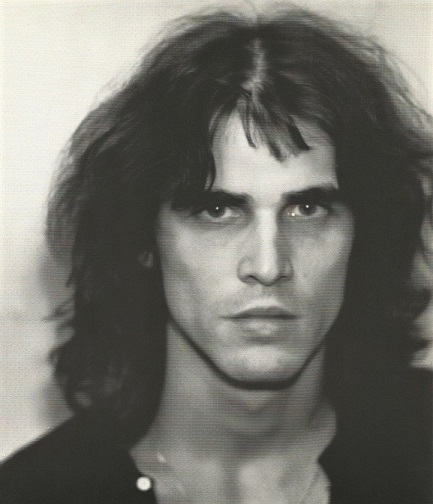 |
Dwight Twilley - The Right Stuff publicity photo
Photo: Zox
|
"That was the great thing about working with Mark," Twilley told goldenageofmusicvideo.com. "He let us bring in some of our own ideas. The shaving cream and the flip were mine. And the football player out on the field playing for the little cheerleader? My idea! Yeah, and the squeal too!"
(As well as the MTV-friendly version of the video, there's also an R-rated variant paid for by the Playboy channel!)
In his review of Jungle for Star Hits magazine, David Sprague noted that Twilley's "original Beatles-rockabilly fixations have given way to a soulfully metallic edge more like that of Bryan Adams." And nowhere is Twilley's ease and confidence with this style more evident than on the LP's lead track, "Little Bit of Love," which again featured Susan Cowsill on harmonies.
EMI issued "Little Bit of Love" as the follow-up single to "Girls," but without the same promotional push, it came to a standstill at #77 in the charts. A third single from Jungle — a remixed version of "Why You Wanna Break My Heart" — was released as part of the soundtrack for the movie Body Rock. The film flopped and took the 45 down with it. (These days, the soaring ballad is probably better known as the tune Tia Carrere sings in Wayne's World.)
By 1985, it was clear that EMI was no longer interested in Twilley. So, when a fast-talking independent radio promoter (who should probably remain nameless) with a custom label said, "I can make you a star," Twilley listened. He was bought out of his contract with EMI, and work began on Wild Dogs, his final studio album before this interview.
I've never actually seen a copy of Wild Dogs, I confess.
 |
| The elusive Wild Dogs LP - CBS Associated (1986) |
Twilley's not surprised. "Hardly anybody did," he says.
The Right Stuff press release that came with XXI jokingly refers to the record as having "mysteriously vanished in the Jersey swamplands when one of the label's chief executives was indicted on payola charges."
But it was no laughing matter.
"Basically," states Twilley, "I was sort of romanced away from EMI with the idea that there was going to be this terrific promotion department. So, I spent about a year writing the songs and putting together what I thought was going to be the big follow-up to the Jungle album. About two weeks before the album came out, I was watching television. On NBC news, they were showing FBI footage of the president of my record company with the Gambino brothers. And the next day, every artist on the label was dropped — except me, of course. Probably because the record was already in the pipeline. And the day after that, I'm on some other label called CBS Associated. Nobody knew me; I didn't know anybody there. They just basically buried the album. You know, there was supposed to be a video and the whole thing. It was all just swept under the table. It was really a drag."
The two Wild Dogs numbers included on XXI take Twilley full circle, back to the beginning in Tulsa and his friendship with Seymour.
The title track (which features Bill Pitcock IV on acoustic guitar) "is kind of like a tribute to the days above the shop — the wackiness and the echo," says Twilley. He composed the second song, an incredibly moving ballad called "Shooting Stars," after learning that Phil had been diagnosed with terminal cancer. "I asked him to come to the session and sing on the record," Twilley writes in the CD's booklet. "I never told him or anyone about the origin of the tune."
 |
"Out in the Rain"
Twilley's first lithograph is available at:
|
Twilley pretty much disappeared after the Wild Dogs fiasco — although there were reissues aplenty of his back catalog and the 1993 DCC release of the Great Lost Twilley Album. Kent Benjamin contends that due to the payola/mafia scandal, "Twilley found himself effectively blackballed from the music business."
Artwork (Twilley's first lithograph, titled "Out in the Rain," is now for sale) and demoing material for a yet to be released LP called The Luck has kept him busy.
He also authored Questions From Dad, a parenting book based on his long-distance relationship with his daughter. (Born to his first wife Linda in 1980, she's the focus of the song "Dion Baby" from Scuba Divers.) The book won an award from the Children's Rights Council and found Twilley being interviewed on The Today Show and speaking in Washington. "It seemed like a good thing to do at the time," he says about writing the book. "But I'm glad it's over and done and out of the way. It was really strange to go on TV with no guitar. I just didn't like it!"
The 1994 Northridge earthquake prompted Twilley to return to Tulsa. "My studio and the house were so badly damaged, I had to move out. I had to move everything I owned out of my house. At that point, you think — do I really wanna move down the block?"
But not much else has changed. Twilley states that there's been some record company interest following his appearance at SXSW last year. "I'm recording some demos right now," he says. "I've got a great new live show, and I'm really back in the swing of things. I plan on making a lot of music, walking around on stages, and going into recording studios. And I hope people will be hearing from me."
* * *
 |
Dwight Twilley & Phil Seymour - cover of the Live From Agora CD
|
Q: I'm so happy that you included "TV" on XXI! It's always been one of my favorite songs.
Twilley: You know what's funny about that? That song is so popular with little kids. A lot of our friends have XXI, and their kids crank up the CD and dance to it in the yard.
Q: In the CD booklet, you say that you've updated the lyrics to allow for VCRs and cable channels...
Twilley: Yeah, 'cause I do it live a lot. A few years back, I said: "Hold me close/We've got the VCR/It's better than our parents had it/At a drive-in in a car." And in the last year, I've added: "Pay per view/Four or five channels/Where they're dancing in the nude."
Q: I want to ask about some of the songs from Sincerely that you didn't include on XXI.
Twilley: Okay.
Q: Like some of my favorites...
Twilley: I know. It was hard to just take a couple of songs from each album. There were ones I wanted... I had a lot of different, weird reasons for what I picked.
Q: Why didn't you chose "Could Be Love" and "You Were so Warm"?
 |
| Sincerely LP - Shelter/ABC Records (1976) |
Twilley: I didn't use any songs that had Phil on lead vocals. I wrote those songs personally for Phil, and I consider them to be his songs. For me to do a Best of Dwight Twilley CD and put one of Phil's songs on it... I don't think I should be taking advantage of Phil's talent. Hopefully, in the near future, there'll be a Best of Phil Seymour CD and those will be part of that package.
Q: What about "Three Persons"?
Twilley: Love that song! It's one of my faves!
Q: So, why didn't you didn't include it on XXI?
Twilley: There were a lot of songs that were real hard to decide on. Some of the decisions were based on having too many sort of acoustic rock songs. If there's a Best of Dwight Twilley 2, it will surely be on there.
Q: In the booklet, you mention that you hadn't met Leon Russell before you started recording for Shelter.
Twilley: No, we didn't meet Leon until after "I'm on Fire" was a hit. Because we were from Tulsa, a lot of people thought, "They must have gotten in with Leon." It was exactly the opposite! But it turned out to be cool. He invited us up to his home studio, and we cut some things with him. We had a great time!
 |
| "I'm on Fire" - German picture sleeve 45 |
Twilley: Yeah... I even tried to do a real vocal, but I liked the live one better.
Q: Will you ever release the version with the proper vocals?
Twilley: I doubt if it exists. I'd have to go back to the multi-track. You never know, it might be on there.
Q: What's the story behind the blurry photo you used for the cover of Sincerely?
Twilley: It's funny because The Right Stuff is reissuing that album and Twilley Don't Mind, and I talk about this in the liner notes. What happened was... It was really Denny Cordell's idea. We had a real nice professional photo, and it was slated to be the cover before all the stuff went down. One day, Phil and I put grease in our hair... There was this old miniature golf course; it was probably off Hollywood Boulevard. I'm sure Errol Flynn probably played golf there. We went over there and got in the photo booth machine and took all these wacky pictures. When we showed them to Cordell, he just loved them. He used two of them for the "I'm on Fire" single. He thought they looked like something from the Museum of Modern Art. Basically, he said, "If you put a normal good-looking photo on the cover, no one will pay any attention to it. But if you put this on the cover, people will never forget it." And I think he was right.
Q: I've always wondered, is "Trying to Find My Baby" a true story? You're very specific about the time of day that you're stuck on the freeway.
 |
HoZac Records concert poster - Dwight
Twilley with Pezband at Reggie's Music Joint
|
Q: I remember that film!
Twilley: It was pretty bad.
Q: Was there supposed to be a third Dwight Twilley Band album?
Twilley: Yeah, there would have been if we'd stayed together.
Q: Would any of the songs from your first solo album have been on it?
Twilley: "Darlin" would probably have been a Twilley Band song.
Q: In the press release that came with XXI, you say something to the effect of "back then they called it rock 'n' roll and now they call it power pop..."
Twilley: Yeah, it was just rock 'n' roll back then.
Q: It sounds like you're unhappy with the term power pop.
Twilley: You know, it doesn't really matter to me. I was also the "father of new wave" a few years back. I'm new wave one day and power pop the other and rock 'n' roll sometimes. You know, whatever. In a way, I don't like the way that music has gotten so segmented. It's like there's so many different kinds of things. It was a lot more fun when everybody was just trying to make great rock records.
Q: In his review of Twilley, Robert Christgau wrote that you "obsessively synthesized the Southern and pop-rock traditions — like a cool Alex Chilton." Were you aware of Big Star?
Twilley: No. I'd heard about them, but I'd never heard their records. I never listened to records, hardly.
Q: What about the Raspberries?
Twilley: Yeah. You could hear the Raspberries on the radio.
Q: I guess what I'm trying to get at is, the music you were making in 1975 wasn't the norm for that time period.
Twilley: No, it wasn't.
Q: Was there supposed to be a third Dwight Twilley Band album?
Twilley: Yeah, there would have been if we'd stayed together.
Q: Would any of the songs from your first solo album have been on it?
Twilley: "Darlin" would probably have been a Twilley Band song.
Q: In the press release that came with XXI, you say something to the effect of "back then they called it rock 'n' roll and now they call it power pop..."
Twilley: Yeah, it was just rock 'n' roll back then.
Q: It sounds like you're unhappy with the term power pop.
Twilley: You know, it doesn't really matter to me. I was also the "father of new wave" a few years back. I'm new wave one day and power pop the other and rock 'n' roll sometimes. You know, whatever. In a way, I don't like the way that music has gotten so segmented. It's like there's so many different kinds of things. It was a lot more fun when everybody was just trying to make great rock records.
 |
Twilley Don't Mind - Shelter/Arista Records (1977)
with the Clive Davis-approved cover photo
|
Twilley: No. I'd heard about them, but I'd never heard their records. I never listened to records, hardly.
Q: What about the Raspberries?
Twilley: Yeah. You could hear the Raspberries on the radio.
Q: I guess what I'm trying to get at is, the music you were making in 1975 wasn't the norm for that time period.
Twilley: No, it wasn't.
Q: But there were a few scattered bands across the country, and I just wondered if everyone was aware of each other.
Twilley: I know I wasn't [laughs]. If it wasn't on the radio... and I didn't even listen to the radio very much. I was never one of those guys that had to rush out to hear what everybody else was doing. I always thought that if an important record came along, it would always be put in my face. And I think it usually was.
Q: There's supposedly a line in "Looking for the Magic" that's the beginning of a theme on nuclear war...
Twilley: Yeah, "Stay a while til the city is a desert."
Q: And you continue that theme with "Out of My Hands."
Twilley: "When the walls around you melt/You can't pretend." [Laughs] It's funny too, 'cause I'm recording a song right now called "No World."
Q: Is nuclear war something that you're really concerned about?
Twilley: No, not at all. It's just an interesting mental picture. Just something to kind of poke at people about 'cause it's such a bizarre concept. It's just a goofy little thing.
Q: Do you keep in touch with Susan Cowsill?
Twilley: Yeah! In fact, on New Year's Eve I did a show here with Leon Russell at Cain's Ballroom. One of my players had a contract he couldn't get out of, so Susan flew in and did the show with me — and it was just terrific!
Q: Tell me about your show at SXSW last year.
Twilley: You know, I didn't know if anybody was going to come to my show. Did they remember me? Would they like it? Had everything changed? About 30 minutes before I went on, there were like 25 people standing around in this huge area. And I'm thinking, "hmmm..." But sure enough, 15 or 20 minutes before we went on, it was packed. And the audience was just great! And I knew when I saw people singing along that everything was okay.
(I've recently updated this interview from 1996 with information that wasn't available at the time.)
Twilley: I know I wasn't [laughs]. If it wasn't on the radio... and I didn't even listen to the radio very much. I was never one of those guys that had to rush out to hear what everybody else was doing. I always thought that if an important record came along, it would always be put in my face. And I think it usually was.
Q: There's supposedly a line in "Looking for the Magic" that's the beginning of a theme on nuclear war...
Twilley: Yeah, "Stay a while til the city is a desert."
Q: And you continue that theme with "Out of My Hands."
 |
Old Waldorf listing from
the 1977 tour (Sept 9 & 10) |
Q: Is nuclear war something that you're really concerned about?
Twilley: No, not at all. It's just an interesting mental picture. Just something to kind of poke at people about 'cause it's such a bizarre concept. It's just a goofy little thing.
Q: Do you keep in touch with Susan Cowsill?
Twilley: Yeah! In fact, on New Year's Eve I did a show here with Leon Russell at Cain's Ballroom. One of my players had a contract he couldn't get out of, so Susan flew in and did the show with me — and it was just terrific!
Q: Tell me about your show at SXSW last year.
Twilley: You know, I didn't know if anybody was going to come to my show. Did they remember me? Would they like it? Had everything changed? About 30 minutes before I went on, there were like 25 people standing around in this huge area. And I'm thinking, "hmmm..." But sure enough, 15 or 20 minutes before we went on, it was packed. And the audience was just great! And I knew when I saw people singing along that everything was okay.
(I've recently updated this interview from 1996 with information that wasn't available at the time.)