Friday, 14 July 2017

While Buzzcocks Toured The USA In Support Of Their 1996 CD "All Set," Their Record Company Abruptly Folded.

By Devorah Ostrov

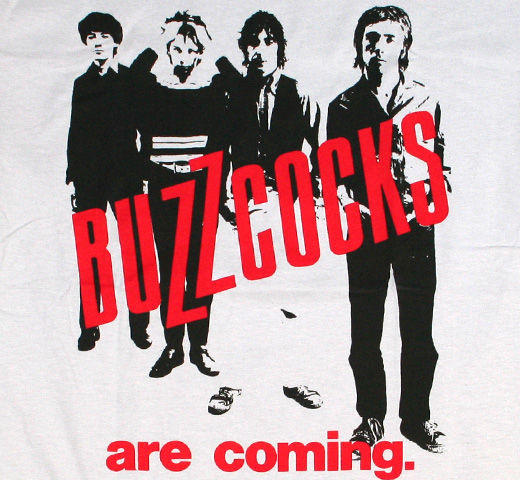
Buzzcocks are coming.
(circa 1979 poster)
It was Tuesday, July 23, 1996, when Buzzcocks pulled into San Francisco on the West Coast leg of a 26-date US tour in support of their new CD All Set.

The group, formed by Pete Shelley and Howard Devoto in 1976 after they saw the Sex Pistols, was headlining Bimbos that night but their label, I.R.S. Records, had abruptly folded a few days earlier, leaving the band without financial backing and the CD with no promotion.

I found Pete standing alone and unrecognized in the middle of the club following their soundcheck. Surprisingly upbeat given the circumstances and suddenly unburdened of any previously arranged constraints on his time, Pete was happy to spend an hour chatting with a fanzine writer. According to Pete, things had been going well before I.R.S. closed its doors, with sold-out shows in New York and Boston.

Q: Were you given any indication that this was going to happen while the band was on tour?

PETE: None whatsoever. Originally, I.R.S. were trying to wrest themselves away from EMI. But the financial backing fell through. So, EMI have just swallowed it up.

Buzzcocks at the time of this interview - I.R.S. promo pic
Tony Barber, Steve Diggle, Pete Shelley, Philip Barker
Q: What's going to happen?

PETE: I have no idea! We're still waiting on the outcome of it. We don't know if we'll get put onto one of the "EMI group of companies" or if we'll go off to Miles Copeland's new label.

Q: He has a new label?

PETE: He has a new one, which will be coming out through... EMI [laughs]. It's all a corporate thing!

Q: You're not completely out in the cold, then?

PETE: No. Well... we don't know who we're with yet.

Q: When you were on LIVE 105 earlier, you played "Totally from the Heart" and "What Am I Supposed to Do" off the new CD. Are those the two songs that you're pushing?

PETE: Well... they were. I think the 45 release has been stalled. It's on hold.

Q: Was there supposed to be a video for one of the songs?

PETE: There was... for "Totally from the Heart." We were supposed to shoot it before we started the tour, but then it got changed to the end of the tour.

Japanese All Set CD (Real Cool Records - 1996)
Contains three additional songs written by Steve Diggle
Q: And now it's too late?

PETE: It doesn't look like it's going to happen.

Q: The songs on All Set are every bit as good as the material on the earlier Buzzcocks' LPs. It's funny, I never expect a band that's been around for so long to be as good as they were in the beginning.

PETE: It's a rare thing but it is possible.

Q: "Totally from the Heart" is such a great pop song! I sort of wish there was a lyric sheet, as I'm sure I'm missing some of the nuances.

PETE: I never liked having lyrics inside the booklet. People don't get the chance to make up their own minds about what I'm singing about.

Q: That's true. But your lyrics are so full of clever wordplay, I would think you'd want people to know exactly what you're saying.

PETE: In Japan, they always include lyric sheets.

Q: That's understandable!

The classic 1970s Buzzcocks lineup with Steve Garvey & John Maher
PETE: Yes! But this time, surprisingly, the record company in Japan sent over a copy of all the lyrics, and there were surprisingly few alterations.

Q: Do they make big mistakes?

PETE: Sometimes [laughs].

Q: Is the group popular in Japan?

PETE: Well, we've been over there three or four times. And we're going back over in September to do six shows.

UA advert for the "Orgasm Addict" 45
Q: Even without record company support?

PETE: It's a different record company in Japan. We're signed to Real Cool Records; we got a split deal.

Q: That was lucky! The band had been broken up for eight years when it reformed in 1989. I read somewhere that the release of the Product boxset inspired you to get back together. Is that true?

PETE: Yes, it was concurrent with that. There were rumors that we were back together, and we started getting offers. We had an offer from our agent in the States. He said, "How come you haven't been in touch?" And we said, "Well, the band's not exactly back together." He offered us a tour and we said, "Okay, we'll give it a try." So, the original band got back together.

Q: What happened to [drummer] John Maher and [bassist] Steve Garvey after that? Why did they decide to leave again?

PETE: It takes it out of you a bit — touring. They have their home pursuits. They're home-based.

Q: Is Buzzcocks a day-to-day concern now, or do you just get together to record and tour?

PETE: It's a day-to-day thing. It's a consuming passion!

"Ever Fallen in Love" lyrics 
Smash Hits magazine
Q: If I'm not mistaken, a few days ago it was the band's 20th anniversary.

PETE: That's right, yes, last Saturday! We were playing in Vancouver.

Q: Did you do anything special?

PETE: I think we drank rather more than we should have done! Apart from that, no. We just had a good show.

Q: The story goes that you and Howard Devoto were in school together when you formed the group.

PETE: In college... I was doing electronics, and Howard was doing Humanities.

Q: At the Bolton Institute of Technology?

PETE: That's right. Well researched.

Q: Howard had put a notice up saying he was looking to form a band?

PETE: Yes.

Q: And you were the only one who responded?

PETE: Uhmm... There were a few others. There was one guy who used to play bass. We used to rehearse on Wednesday afternoons in his bedroom. Although, unfortunately, some weeks we couldn't rehearse because his father was working nightshifts and sleeping during the day. But then it just petered out, and it was just me and Howard writing songs together.

Buzzcocks at the Roxy Club
Q: You also did some recording prior to that, back in '74?

PETE: Well... It was just a home recording. I was just messing about.

Q: And you used a homemade oscillator for that?

PETE: Yes! It was in a hobby magazine. So, I got my soldering iron out and built it. I made a little printed circuit board. It was all open, and I found that if I actually touched the components, it would change the nature of the... noise.

Q: Were you into German bands at the time? Kraftwerk, Tangerine Dream, Can...

PETE (nods and smiles): Yeah! I was well into Krautrock.

Q: Your home recording was released in 1980 as Sky Yen. How did that come about?

PETE: A friend [Francis Cookson] and I started a record company to put out more... uh... obscure pieces of music — Groovy Records. That was our second release.

Q: The early history of Buzzcocks really starts with you and Howard going to London to see the Sex Pistols in 1976. Can you tell me about that?

PETE: Yes, we saw a review. It must have been the end of February, the last week of February. We saw a review of this band called the Sex Pistols who had played at the Marquee. They were bad and nobody liked them. And they did a cover of "No Fun." Me and Howard were both big Stooges fans, so we thought it would be a good idea to check them out. See what they were like. See what the potential competition was like. So, we went down to London and saw two shows. We got to chatting with them and found out that they wanted to do some shows outside of London.

Early Buzzcocks lineup with Howard Devoto
Q: So, you and Howard arranged a show in Manchester?

PETE: At the time, Howard was doing the pop-rock column in the local listings magazine. He hunted around and found that we could hire this little hall [the Lesser Free Trade Hall]. Not the big one [the Free Trade Hall], that's where the Halle Orchestra play. We could get it for about £32 a night. We thought, "We're getting a PA and some lights — there's £2. And we can get the Sex Pistols to come up, and we can play with them!" Unfortunately, we didn't get a band together by the time of the first show, which was June 4th. But by the second show on July 20th, we had the bass player [Steve Diggle] and the drummer [John Maher] — and we were in action!

Q: Is it true that Steve Diggle was supposed to meet up with someone else at that first Pistols' show, but in a case of mistaken identity Malcolm McLaren introduced him to you?

Pete Shelley:
"I think we tended to see the dark cloud
rather than the silver lining."
PETE: Yes, Steve had arranged to meet up with someone outside the Free Trade Hall because there was a bar nearby. He was stood outside, and I was in the box office taking the money. Malcolm McLaren went outside while the support band was on. There was a little blackboard with "Live From London: The Sex Pistols!" chalked on it, and he was doing his showman routine: "Roll up! Roll up! Come see this band! They're really great!" He knew we were looking for a bass player, and he went over to talk to this guy who was waiting to meet someone. He said, "Are you the bass player?" And this guy said, "Yes." Malcolm came back to the box office window and said, "Here's your new bass player! His name's Steve."

Q: Who was Steve really supposed to be meeting? Did they turn out to be anyone famous?

PETE: I dunno. About fifteen minutes later, Steve did come in with another guitarist. It might have been the guitarist he was meant to be meeting. I don't think they did anything.

Q: Were you aware of the emerging punk scene in London when you first saw the Sex Pistols play?

PETE: No. At that time, I don't think there were many other punk bands.

Q: As far as you knew, it was just the Sex Pistols?

PETE: As far as I knew, it was just me and Howard. Until we saw the Sex Pistols. Then we thought, "Oh, there are other people who feel the same way!"

Poster for The Screen on the Green Midnight Special
featuring the Sex Pistols, the Clash & Buzzcocks
Q: Would you describe yourself and Howard as being "angry young men"?

PETE: Uhmm... I think we tended to see the dark cloud rather than the silver lining.

Q: In the beginning, Buzzcocks seemed to purposefully align themselves with the punk movement, even though the press was condemning it as being quite a violent scene.

PETE: There was no violence; that was the strange thing about it. Most of it was exaggerated.

Q: Wasn't someone stabbed at a Buzzcocks' show?

PETE: Yes, but we didn't see it actually happening. The police turned off the PA, but the backline was still working, so I sang "Orgasm Addict" through a megaphone.

Q: Does it surprise you that twenty years on, there's still a punk scene?

PETE: Well, it's quite a simple formula. If we hadn't been doing it, I think somebody else would've invented it.

Q: But the fact that it wasn't supposed to last forever was part of what made it exciting.

Buzzcocks on the cover of
Smash Hits magazine - 1979
PETE: I can see what you mean, but it wasn't exactly like that. The whole idea was that it was supposed to be fun. And you might as well just do it, rather than wait until you learned how to play.

Q: But you guys obviously knew how to play before Buzzcocks.

PETE: Well, secretly... yes. But the whole thing was to make it look like you couldn't really play. To have a certain relaxed attitude, rather than being proficient.

Q: Buzzcocks supported the Sex Pistols at their massive Finsbury Park show a month ago, and in a few weeks the Pistols are playing the Shoreline Amphitheatre in Mountain View as part of the "Filthy Lucre" tour. But I just want to say how happy I am that you're playing clubs on this tour!

PETE: We're playing clubs out of necessity. We couldn't sell enough tickets to play Shoreline.

Q: But I love that you're still accessible, and fans can still say hello!

PETE: It's the best way to be. I'd hate to be closeted away.

Q: And you guys still have integrity.

PETE: I think the Sex Pistols still have integrity.

Q: Do you?

Pete Shelley: "We started to do demos for a fourth Buzzcocks' 
album and they ended up becoming the Homosapien album."
PETE: Definitely. As well as doing it for the money, there's also the thing that they wanna have a final farewell as a band.

Q: Do you think this will be it? Their final farewell?

PETE: I dunno... They may do something else. It's hard to tell.

Q: They haven't even released a new record. At least you guys are still writing and recording new material.

PETE: Oh, yeah. There is that.

Q: Three years ago, you released Trade Test Transmissions, which was the first new Buzzcocks' record since A Different Kind of Tension in 1979. Was it strange going into the studio fourteen years later to record as Buzzcocks?

PETE: No, we'd spent a lot of time in the studio doing demos and things. But trying to convince record companies that this band is back together, and is still credible, has been a bit of an uphill struggle.

Q: Why is that?

PETE: Because record companies more or less like bands that they can manipulate.

Q: And they can't manipulate you guys?

PETE: Well, they haven't really tried all that hard. But I think that's what's at the back of their minds.

Poster advertising Buzzcocks, Siouxsie & the Banshees,
and Subway Sect at the Roundhouse
Q: You're saying that the band is prepared to stick to its guns and do what it thinks is best?

PETE: Yeah. Which is what punk is all about, not being swayed from your convictions.

Q: Around the time of the Love Bites LP, some longtime fans and music writers criticized the group for "selling-out." Did that worry you?

PETE: I didn't pay much attention to it. It's a thing which always happens as soon as somebody has an idea, the next wave of people come along and try to dogmatize it. And anybody who doesn't agree with their definition is a heretic. All kinds of bands have been said to have sold-out. Like the Clash singing "I'm So Bored with the USA" and spending so much time over here.

My autographed copy of A Different Kind Of Tension
Q: Why did Buzzcocks break-up in 1981?

PETE: Well, surprisingly... our record company [United Artists] got eaten up by EMI! And we weren't getting along with the people at EMI, and we ran out of money. Things were going nowhere fast. We started to do demos for a fourth Buzzcocks' album, and they ended up becoming the Homosapien album.

Q: So, some of the songs on your first solo album would have been on the fourth Buzzcocks' LP?

PETE: Yes.

Q: Are there recordings of Buzzcocks doing the song "Homosapien"?

PETE: No, not as far as I know.

Q: With the Homosapien LP, it seems like you got back into electronic music in a big way. You said in a Trouser Press interview at the time, "It's just myself and machines."

PETE: Yes, well... When we were doing the demos, it was just me in the studio and [producer] Martin Rushent. We got a synthesizer and a sequencer — a micro composer, it was called. And we just started doing demos using that. The second one we did was "Homosapien." It took about 18 hours to record it and mix it. Over the next two days, we did another two tracks, and then we started looking around for a record company that was interested in it.

Poster advertising the "Spiral Scratch" EP
Q: Are you playing any of your solo material on this tour?

PETE: No, it's just Buzzcocks' stuff. We've got enough of that!

Q: What songs are you doing tonight?

PETE: I think we're doing five or six off All Set, and three or four off Trade Test Transmissions, and the rest are off various albums and singles.

Q: Are you doing "Harmony in My Head"?

PETE: Yes!

Q: I read an interview where Steve said that his songs, like "Harmony in My Head," are more aggressive than the songs you write. Do you agree with that?

PETE: He tends to think that, but it's not my personal opinion.

Q: Where did Tony Barber [bassist] and Phil Barker [drummer] come from? How did they come to join the band?

PETE: We held auditions. They heard about the auditions and wanted to do it. I'd met Tony before; I knew he was a fan and he knew the songs. That's usually a good starting point, if you know all the songs! This is actually the longest-lasting lineup; it'll be four years in September.

Q: In the UK, the band has had a long list of singles in the charts, with "Ever Fallen in Love" reaching number 12. Yet I'd still be tempted to describe Buzzcocks as "underrated."

Pete Shelley advertises the July 20, 1976 concert with
the Sex Pistols, Slaughter and the Dogs & Buzzcocks at 
Manchester's Lesser Free Trade Hall.
Photo: Kevin Cummins
PETE: I'd agree with underrated.

Q: Do you think that's because you were based in Manchester as opposed to London?

PETE: I suppose that had a part to play. I mean, the thing is, the people that really like Buzzcocks, really like Buzzcocks — and they understand why they like us. Whereas other people don't see what all the fuss is about. I mean, we just have the reputation of being a good band, but sometimes that's not enough.

Q: And you've never gone out of your way to make a big splash.

PETE: Nah.

Q: Are you still based in Manchester?

PETE: No, I've been living in London for the past 11 years.

Q: Wow! I so much associate Buzzcocks with Manchester, I never thought you'd leave.

PETE: At one point I thought I'd never leave it, but they offered me a flat in London and I took it.

Q: What about Steve?

PETE: He moved down about three years ago.

Buzzcocks pose with Debbie Harry during Blondie's 1978 European tour
Photo: Chris Stein
Q: All Set was recorded at Fantasy Studios in Berkeley. Did someone recommend that studio?

PETE: Well, it's the studio that [producer] Neill King works out of. He'd just done an album for Menswear, who are friends of ours in London, and it had a great guitar sound. And when we were thinking about who we'd like to have produce the album, his name came up. Then we found out he'd also done the guitars on the Green Day albums. We just wanted to work with someone who knew how to treat a band with guitars. It was good because he's an Englishman! He's been living over here for eight or nine years, so he's got American studio ears. But he's got the same references as us and knows all the people we know, which made it easy to communicate.

Friars Aylesbury - Buzzcocks on Wednesday
Motorhead & Girlschool on Saturday!
Q: How long were you in the Bay Area for?

PETE: About five weeks. We'd just done a tour of South America, and we came straight from Sao Paulo.

Q: Did you go to Amoeba Records while you were here?

PETE: Yes!

Q: Are you a record collector?

PETE: I'm not, but Tony is. He's fanatical.

Q: Are you familiar with San Francisco now? Can you get around on your own?

PETE: Uhmm... a little bit.

Q: Did you do all the touristy things?

PETE: I didn't, no. I was in the studio all the time. No rest for me, 12-hour days.

Q: You didn't even ride on a cable car?

PETE: No.

Q: You mentioned that Neill King did the guitars on the Green Day albums. Did you meet Green Day while you were recording?

"Totally from the Heart" CD single
PETE: No, they were on tour.

Q: Are you interested in new punk groups like Green Day, Rancid, the Offspring...?

PETE: Uhmm... I do own some CDs.

Q: What's the music scene like in the UK now?

PETE: It seems to be mired in Britpop at the moment.

Q: Do you like Oasis and Blur?

PETE: I think Oasis are popular. And Blur are poppy.

Q: Do you go to see bands that were influenced by Buzzcocks?

PETE: It's sometimes impossible not to notice them. I have a growing collection of CDs and demo tapes from bands who cite us as an influence.

Q: Have you thought about producing some of them?

PETE: I've been asked on occasion, but it's never materialized.

Pete Shelley: "I have a growing collection of CDs and
demo tapes from bands who cite us as an influence."
Q: I'd like to ask you about some of the songs on All Set. Could you tell me a bit about "Point of No Return"?

PETE: I wrote "Point of No Return" in 1987. It was on a tape of "stuff to do things with." What's it about? Uhmm... that's a difficult one.

Q: What about the song "Some Kinda Wonderful"?

PETE: That's from 1986! I was asked to do a song for the film [a coming-of-age teen flick starring Eric Stoltz, Mary Stuart Masterson, and Lea Thompson].

Q: That was my initial thought when I saw the song title! But it's not included on the movie soundtrack.

PETE: No, it wasn't used. So, I just put it into a pile of cassettes.

Q: What about "Give It to Me"? What's the story behind that?

PETE: That's from 1984. In Britain, I did the music for the Tour de France — the intro and credits. "Give It to Me" is a version of that.

Advert for Buzzcocks' debut LP
Another Music In A Different Kitchen
United Artists - 1978
Q: Are there any new songs on this CD?

PETE: Yeah... [laughs] The new ones are "Totally from the Heart," "Hold Me Close," "Kiss and Tell," "What You Mean to Me," and "Pariah."

Q: "Totally from the Heart" and several other songs on All Set seem like fairly straightforward love songs without your usual cynicism. Do you think you've softened around the edges a bit over the years?

PETE: Not really... There's still plenty of hooks and barbs in there, things that you might not hear right away! "Totally from the Heart" has the message: "From now on is the time for becoming/One by one we can take control..."

Q: What do you mean by that?

PETE: That people are in control of their own lives and destiny.

Q: But at the same time, you're saying that you're scared of being alone and without this person.

PETE: It isn't really about a person. It's about people in general, about expectations.

Q: Something which has been pointed out about your lyrics, is that they're not gender specific. You don't use the words "she" or "he."

PETE: I try to avoid them.

Buzzcocks with support band Joy Division - Rainbow Theatre
Q: It's something you do on purpose?

PETE: Yes.

Q: Why?

PETE: For myself, it means I can transfer the feelings and thoughts onto anyone.

Q: While maintaining an air of ambiguity?

"Love You More" sheet music
words and music by Peter Shelley
PETE: Ambiguity... There's a lot to be said for it!

Q: Is that something you've always been consciously aware of?

PETE: Yeah... more or less. I mean, somebody in New York gave me a copy of this interview that they'd done with me back in '80/'81, and in it, I said that the thing about writing songs is that you can be vague and direct at the same time. There's a lot of reading between the lines to be done.

Q: It doesn't matter if you're male or female; you can relate the song to yourself.

PETE: Yeah, yeah! You can relate to it. I mean, if "Ever Fallen in Love" had any references to a specific gender, it wouldn't have been so universally accepted. Anything to do with relationships, there's I and You — and that's all you need, really.

Q: It's like you've set yourself this lyrical constraint, but in turn, it makes your songs more interesting. Buzzcocks are the only rock band I know of that does that on a conscious level.

PETE: It's sometimes on a par with... There was a French author who wrote a book without using the letter E [La Disparition by Georges Perec, written in 1968]. And then somebody translated it into English and avoided using the letter E as well.

Q: So... it's unreadable!

Pete Shelley: "If 'Ever Fallen in Love' had any
references to a specific gender, it wouldn't have been
so universally accepted."
PETE: No, it's supposed to be readable, but... It's just a literary trick!  It's hard to think up ways to be both vague and direct at the same time [laughs].

Q: Have you thought about collecting your lyrics into a book of poetry?

PETE: I've put all my lyrics up on the internet. All except the new ones, and I'll do them when I get back. I've got a website with all that stuff on it. My plan is to do a set of annotated lyrics where I'll tell stories about what the songs mean.

Q: What about writing a book of fiction?

PETE: No, I always find that reality is stranger than fiction!

Q: Is the song "Without You" on All Set about someone specific?

PETE: No, not really. I mean, sometimes I do have a person in mind when I'm writing a song. But then other people can fit in as well. So... no, it isn't about anybody specifically.

Q:
How about "Hold Me Close"?

PETE: "Hold Me Close" started off with an idea that I had on a tape, and it was really fast. Tony said, "Let's try it a bit slower." And I said, "How much slower?" Because I don't like... you know...

Pete Shelley on the cover of the NME
June 17, 1978
Q: Buzzcocks aren't exactly known for ballads!

PETE: No, not really. I think that's the closest we've come in a long while. It just came about from that. As soon as we slowed it down, it took on a different character. I think it's quite "European."

Q: How about "What You Mean to Me"?

PETE: It's a bit more poetical than I usually get. It's all: "roads past stormy seas" and "darkening skies."

Q: And finally, what was the inspiration behind "Pariah"? It's the strangest song on the CD!

PETE: I'd worked out the riff, and the word "pariah... pariah..." just kept going through my head. I looked up pariah in the dictionary to see how to spell it, and it said that it comes from the drummer caste in Hindu — they were meant to be the lowest of the low and were shunned by everyone else. Because the song has lots of drums in it, that seemed to be the right title for it. And I got the quote "as above so below" from Hermes Trismegistus.

Q: You're obviously quite a literary person.

PETE: I have read books!

Q: What are your favorite books?

Promo poster for the Love Bites album
PETE: I like the Argentinian writer [Jorge Luis] Borges. And I like Robert Anton Wilson [best known for The Illuminatus! Trilogy], and Philip K. Dick, and William Burroughs...

Q: I'm surprised that you were studying electronics at college and not literature.

PETE: I had the qualifications to get onto the electronics course but not a literary course. But after doing two years of electronics, I dropped out and started doing Humanities.

Q: Were your parents disappointed that you formed a band instead of starting a career?

PETE: Well, the only career I could think of really was repairing TVs.

Q: You'd be a TV repairman if not for Buzzcocks?

PETE: Yeah! But I thought, there has to be something more to life.

Q: Were your parents supportive of your decision?

PETE: Yes, I suppose so. I mean, they didn't forbid me from doing what I wanted to do. The more successful we were, the more they liked it!

Q: I want to go back and ask you about Jets Of Air. That was your band before Buzzcocks?

Pete Shelley: "The only career I could think of really was repairing TVs."
PETE: Yes, that was the first band that I formed.

Q: What was that group like?

PETE: It was a mixture of, uhmm... David Bowie, Roxy Music, and the Velvet Underground. It was like proto-punk, with noisy elements.

"Orgasm Addict" tour poster
Q: Who else was in that band?

PETE: The only other person you'd know was Garth [from an early Buzzcocks lineup].

Q: Did Jets of Air ever record anything?

PETE: Not really. I mean, not in the studio sense. There's a couple of rehearsal tapes, that's all.

Q: I've always wanted to ask you about the surname you chose to go by. Did you choose the name Shelley because you liked the poet?

PETE: People used to ask, "After the poet?" And I used to say, "It was the name I was going to be called if I was a girl." It would have been after Shelley Winters. So I used to say, "It's after Shelley Winters." Then I saw Shelley Winters on a chat show, and she was really called Shirley, but she changed it to Shelley after the poet. So, it is after the poet by a roundabout route!

Q: And can you clear up a rumor I've heard? Is it true that Bernie Rhodes wanted to steal you away from Buzzcocks and put you in a band with Keith Levine?

PETE: That's correct! Yes! I got a phone call from him just after Howard left. I also got a phone call from Rob Lloyd of the Prefects.

Q: Do you still talk to Howard? Do you still see him?

Ad for the "Love You More"/"Noise Annoys" 45
PETE: I haven't seen him for about a year. The last time I saw him, we went to see this play about the Sex Pistols. It was set in the Hotel Miyako in San Francisco. It was supposed to be based on the last day of the band. And we were saying, "Malcolm didn't talk like that!" Haha!

Q: So, you and Howard are still friends?

PETE: Yeah.

Q: He left on good terms, then?

PETE: Yeah. He was in the final year of his degree. His tutors took him to one side and said, "If you don't do the work, you won't get a degree." He'd done two years of psychology before that, and he wasn't getting a grant anymore. He was working during the summer and over the holidays to get the money to go to university. It was really important to him.

Q: Would you consider having him join the band onstage for a special show, or maybe as a guest appearance?

PETE: He hasn't since 1978. Buzzcocks and Magazine did a show at the Lesser Free Trade Hall for a documentary that Tony Wilson was doing.

Q: Was that the only time Buzzcocks played with Magazine?

Caroline Records advertisement for the
Trade Test Transmissions LP
PETE: I think so, yeah.

Q: What's Howard doing these days?

PETE: He's working at a photo library. He's a librarian.

Q: Have you ever thought about leaving music and getting a day job?

PETE: I've never had the desire to work. I gave up my day job the day before the Sex Pistols' show.

Q: What were you doing?

PETE: I was a trainee computer operator.

Q: Finally, what's the weirdest thing you've ever done to get in free to a rock concert?

PETE: Uhmm... Besides saying I was on the guestlist when I wasn't?

Q: That depends. Who was playing?

PETE: I dunno. It was just because they were serving late. I had no interest in the band.

Tuesday, 4 July 2017

Dee Snider: I Asked The Twisted Sister Frontman To Name His Five Desert Island Discs

Previously unpublished. This was meant to accompany an article about Dee Snider's new band Widowmaker in a 1992 issue of American Music Press.

Twisted Sister's Stay Hungry LP
Photo: Mark Weiss
By Devorah Ostrov

Short on time at the end of a telephone interview about Widowmaker, Dee Snider's press agent told him he could only answer one more question before moving on (presumably to chat with a journalist with more clout than myself).

Knowing what a huge rock 'n' roll fan he is, I asked Dee to name his five Desert Island Discs — thereby ensuring that I totally screwed up whatever time had been allotted to everyone else! 

Unfortunately (or perhaps ironically), American Music Press didn't have the space to include this list with the article. But luckily, I still have the transcript! Now, I can finally reveal Dee Snider's Desert Island Disc choices circa 1992...


1. Montrose 
Montrose (Warner Bros. 1973)
"It's just classic, timeless, heavy rock 'n' roll. Great singing, great playing. It still holds up!"


2. Alice Cooper 
Killer (Warner Bros. 1971)
"I like a lot of stuff afterwards, but 'You Drive Me Nervous' and 'Under My Wheels' — that to me is Alice at his best!"


3. Queen
Queen II (EMI/Elektra 1974)
"I was one of the first Queen fans. That album is one of the greatest albums of all time! It really has such DEPTH! You could spend years with it and not get all the nuances."


4. The Sex Pistols 
Never Mind The Bollocks Here's The Sex Pistols (Virgin 1977)
"The anger and aggression are just devastating! It's a DRIVEN record, with as much metal credibility as Montrose 1. And its simplicity is brilliant!"


"You're really putting a gun to my head here. If I could, I would say a compilation of the Bad Co. catalog. But if I can't say that, I'll say..."


5. Led Zeppelin 
Led Zeppelin II (Atlantic 1969)
"Legendary vintage playing and singing. Every instrument SPEAKS on that record. The song quality: 'Heartbreaker,' 'Whole Lotta Love,' 'Living Loving Maid' … It's got such musical depth!"


As Dee had by now forgotten about all the other interviews he was supposed to do, I pressed on.

Q: I notice that you've stuck completely to the '70s with your list. (Led Zeppelin II was released in 1969, but it's close enough.)

Dee: That's pretty sickening, isn't it? That's because... Although there are many bands that I enjoy from the '80s... Just to show you bands I'm listening to now — Chilli Peppers, Faith No More, Guns N' Roses, of course, Skid Row, Kings X, Pantera, Metallica, Black Crowes, Nirvana... I like the Seattle scene a lot. I think there's a lot of great bands! Maybe I'm just incapable at this point of getting into a band the way I got into it before I was a performer. I listen to them now, not as a fan so much as it's more analytical. And they don't sparkle as much, in the way the bands of my youth did. You kinda looked up at them; I saw them on pedestals and there was a certain glamour. Now, any record that comes out, I see as my peers. So, I'm looking at my peers and going, "Wow! They have a great record!" The Nirvana thing is really cool! But when you're looking at equals, it doesn't have the romance that the bands of your youth did. I realize that we seem that way to our fans, but once you break through that door, the romance goes out the window, and you have a much more realistic view of it.

For some reason, I must have professed my undying devotion to Slade. I'm guessing I said something idiotic because I didn't bother to transcribe it. However, Dee replied in a most unexpected way — which kept him on the phone for another 10 minutes.

Slade - Slayed? (Polydor 1972)
Dee: Slade!!! You're a Slade fan!? I LOVE Slade!!! I met Noddy Holder, and I was bowing. "I'm not worthy." I never mentioned them because people are like, "Who?" You were a BIG Slade fan?

It would seem I said yes. Again, I didn't transcribe whatever it was I said, but Dee's voice lowered from its usual roar to something resembling a conspiratorial whisper.

Dee: All right... I've never told anybody this, only because they wouldn't really appreciate it. I wonder sometimes where I get ideas for songs. Remember their song "I Won't Let It 'Appen Agen"? 

Dee then sang the chorus to Slade's 1972 stomper, followed by Twisted Sister's signature slogan: "'It's not gonna 'appen, and no, it won't 'appen/I won't let it 'appen agen.' Well... 'We're not gonna take it, no, we ain't gonna take it/We're not gonna take it anymore.'"

He also kindly proffered a line-by-line comparison of the two tunes:

"It's not gonna 'appen, and no, it won't 'appen..."

"We're not gonna take it, no, we ain't gonna take it..."

"I won't let it 'appen..."

"We're not gonna take it..."

"Agen..."

"Anymore..."

"It's really subtle 'cause it's not the same melody," he added. "But the way it's laid out, it's the same pattern. And the rhythm of it is identical to Slade's song. I realized that years later. I'm a HUGE Slade fan! I saw Slade, and the next day I bought three of their albums. I was just decimated! They just blew me away! I have to go. It's been great talking to you. Two kindred spirits! And the last thing I wanna say is BABY! BABY! BABY!"

* * *

For my full interview with Dee Snider, including a frank discussion about his post-Twisted Sister career and the dilemma of voting democrat in 1992, please go here:
devorahostrov.blogspot.com/2018/07/dee-snider

Saturday, 24 June 2017

Nikki Sudden & Dave Kusworth: The Legend Of The Jacobites

Originally published in Teenage Kicks, Spring/Summer 1999
By Devorah Ostrov

Once upon a time in the 1970s, in a faraway country known as England (where the word color contains an unnecessary "u" and the orange juice supply is unpredictable), there lived two beautiful boys with tousled hair and an obsessive fondness for scarves and crushed velvet.

One of these boys, who dubbed himself Nikki Sudden (or occasionally Nikki Mattress), was busy leading a quirky art-pop band called Swell Maps, which included his younger brother Epic Soundtracks on drums. The other boy went by the surprisingly ordinary name of Dave Kusworth.

Just out of school, Kusworth was toiling away on a dreary factory assembly line in Birmingham — although these days, he claims not to recollect what it was he was assembling. "I just... y'know... put this thing onto that thing..." he says vaguely when asked. Was that when he decided to become a rock star? "I've always been a rock star!" Kusworth insists.

Nikki Sudden & Dave Kusworth
Great American Music Hall - SF 3/1999
Photo: Devorah Ostrov
March 1999: Kusworth and Sudden, idolized cult figures individually and dual leaders of the revered but commercially unsuccessful Jacobites, are sitting backstage at the Great American Music Hall in San Francisco. Later tonight, the Jacobites (the live lineup now includes drummer Mark Williams and bassist Mark Pritchard) will play to a rapt and enthusiastic audience. This is partly because the band — which issued its eponymous pop/rock/folk-infused debut album some 15 years ago — is touring America for the first time!

The tour is in support of the group's latest release, God Save Us Poor Sinners (Bomp! Records), but tonight they stick to the punchier tracks like "Teenage Christmas" while mixing in several flamboyant pop tunes from their back catalog. Songs like "Over and Over," "Pin Your Heart to Me," and "Shame for the Angels" let them downplay their sometimes heavy Dylan tendencies and show off like their other heroes — the New York Dolls, the Faces, the Stooges, T. Rex, and the Rolling Stones.

Kusworth especially has all the cool rock 'n' roll moves down pat: cigarette dangling from his mouth, rail-thin body wrapped around the microphone stand, arms punctuating the lyrics with elegant flourishes. He's truly a sight to behold! But, like Kusworth says, he's always been a rock star.

L-R: Mark Williams, Dave Kusworth, Mark Pritchard, Nikki Sudden
Great American Music Hall - San Francisco, California 
Photo: Devorah Ostrov
This Johnny Thunders/younger Keith Richards lookalike actually grew up worshiping guitar-god Mick Ronson. "Ronson was my ultimate hero," Kusworth states. "The first concert I ever saw was Bowie with the Spiders From Mars, with Ronson. I was quite lucky; it was their last tour."

Kusworth (with longtime cohort Dave Twist on drums) formed his first group, TV Eye, in 1977. "When we played our first gig," he reflects, "we had just gotten the band together. We had no songs; we didn't even have a name. Somebody offered us this festival gig. We said we were in a band, but we didn't have...  anything. I just remember locking ourselves in a room all night with a guitar and learning five or six songs."

The Jacobites' self-titled debut - released 1984
Too glam for the punks and too punk for the rockers — "We were much more like the New York Dolls and the Stooges than any of the English bands," comments Kusworth — TV Eye was short-lived with only one track ("Stevie's Radio Station") on a fanzine-issued disc to their name.

However, there was one momentous (though barely remembered) night when Kusworth's TV Eye crossed paths with Sudden's Swell Maps.

"The first time I saw Dave, he was with TV Eye," remarks Sudden. "They were playing at the Crown in Nottingham, I think."

"You actually supported us!" interjects Kusworth. "But I didn't talk to you."

When TV Eye broke up, Kusworth and Twist formed the Subterranean Hawks, legendary for their aggressive use of acoustic guitars and an engaging pop tune (written by the group's vocalist, Stephen Duffy) called "Big Store."

Sudden also moved on. After the break-up of Swell Maps, he released a couple of solo LPs and took to rock journalism, writing for ZigZag and the New York Rocker. "I just did it for something to do," he says. "I went to New York and ended up interviewing Johnny Thunders. And I thought I might as well do some other articles. But I used to have to take a gram of speed every time I wrote an article — and I would get paid just about enough to buy the gram of speed!"

Nikki Sudden
Great American Music Hall - SF 3/1999
Photo: Devorah Ostrov
One day in 1980, as Sudden recalls, he encountered a couple of the Subterranean Hawks and arranged to interview them. "I met Steve Duffy. Him and Dave Twist came into Rough Trade with a tape. I heard it and thought it was brilliant! So, I went to see them in Birmingham. Dave [Kusworth] and I started talking, and we said if the Hawks ever broke up, we should form a band."

The Subterranean Hawks stayed together until the end of 1981 and issued one 45 ("Words of Hope" b/w "Sense of Ending") on their own Five Believers Records. Their version of "Big Store" became track two of the fanzine disc mentioned above. "It's very rare," Kusworth helpfully points out.

According to legend, Sudden and Kusworth initially performed together as the Six Hip Princes at the Royal George in May 1982. But it wasn't until '84, with a lineup based around Sudden and Kusworth on shared vocals and guitars, Soundtracks on drums, and bassist Mark Lemon (along with assistance from assorted friends including Tyla from Dogs D'Amour), that the Jacobites released their self-titled debut LP.

They took their name from a failed 17th-century political uprising and borrowed a few musical concepts from the Hawks. "Their whole thing with acoustic and electric guitars was a big influence on the Jacobites," acknowledges Sudden. The first album also featured a reworked version of "Big Store" — credited to Sudden and suffixed (Orig). "Like the Dolls did with 'Frankenstein,'" notes Kusworth.

Flyer for the Jacobites show at
The Great American Music Hall in SF
Songs like "Kiss You Twice" and "Hurt Me More" underscored the group's heart-on-its-sleeve romanticism, while "Kings and Queens" and "Silver Street" were steeped in gorgeous poetical imagery. Taking notice of Sudden's "Dylanesque" vocals, one reviewer wrote: "Imagine a folky Johnny Thunders growing up in the English countryside and learning to play guitar by listening to 'Knockin' on Heaven's Door' with a bottle by his side."

A handful of EPs marked the band's indie-chart success, and the ambitious double album, Robespierre's Velvet Basement, soon followed — all issued on import-only labels. It wasn't until 1986, with Twin/Tone's release of The Ragged School, a 12-track sampler of their career to that point, that America was properly introduced to the Jacobites.

Unfortunately, by then, the Jacobites had played their last gig and would disband soon after. The rift is sometimes explained away as "touring difficulties." In actuality, "We couldn't stand each other!" exclaims Sudden.

Once the laughter dies down, he becomes more diplomatic. "I did a tour and Dave was supposed to come, but he didn't turn up."

"I had a lot of problems," counters Kusworth. "I'd split up with my wife at the time. It was very emotional."

My "Shame for the Angels" EP - autographed by
Nikki and Dave!
Kusworth was also disillusioned with the constant coming and going of group members — each new release featured different players, and live shows varied the lineup still more.

"I wanted to have a band," he emphasizes. "I don't know what Nikki wanted, but that's what I really wanted it to be. When we first thought about doing the Jacobites, I thought that we'd have a stable band."

"Epic always played drums on the records," says Sudden, "but he couldn't always do gigs with us."

"And we did a lot of things with no rehearsals," continues Kusworth. "We'd just go and play with different people. I just wanted to get a real tight act together."

So, over the next several years, Sudden and Kusworth concentrated on solo careers.

Sudden teamed up for various projects with the likes of the Birthday Party's Rowland S. Howard, Jeremy Gluck from the Barracudas, and Jeffrey Lee Pierce from the Gun Club. REM even brought him to Georgia, so they could take over (or help with, depending on who you talk to) the recording of 1991's The Jewel Thief.

Nikki Sudden
Great American Music Hall - SF 3/1999
Photo: Devorah Ostrov
Meanwhile, Kusworth put together the Bounty Hunters. His lyrics expressed his grief over divorce  ("The first Bounty Hunters' record has an incredible amount of songs about it," he says), and furthered his "quest for beauty in the underbelly" (as one rock critic nicely put it) through material described as "Led Zep II crossed with Blind Faith."

1993's Howling Good Times finally brought Sudden and Kusworth back together as the Jacobites. (Supposedly, they buried the hatchet with the CD reissues of the first two Jacobites' records.) The LP's poppy title track was lifted from the Subterranean Hawks' catalog, but overall the album was a ramshackle affair, with the loose feel of a living room jam session. However, their lineup stabilized, at least for recording purposes, with Glenn Tranter and Carl Eugene PicĂ´t on guitar and bass, respectively, and Mark Williams on drums.

Two years later, the band released Old Scarlett, a somewhat somber effort, which nonetheless featured Kusworth's perfect pop anthem "Over and Over" and proved that the Jacobites were back in earnest.

Missing from the revamped Jacobites, of course, was Epic Soundtracks. Even during the group's first round, Soundtracks had kept up a separate existence with Crime and the City Solution. During the Jacobites split, he was drumming for These Immortal Souls, and when that outfit folded, he went solo. But any chance of Soundtracks re-joining the Jacobites ended on November 6, 1997, when the 38-year-old passed away in his sleep.

"I miss him every day," says Sudden. "I used to get really angry at him for dying; it was such a stupid thing to do."

Dave Kusworth
Great American Music Hall - SF 3/1999
Photo: Devorah Ostrov
In early '98, two tribute shows — one in London, the other in Berlin — were held in Soundtracks' honor. Joining the Jacobites in celebrating Soundtracks' life were Thee Hypnotics, Jeremy Gluck and Robin Wills from the Barracudas, and a reunited Swell Maps.

Both nights were recorded and, following the Berlin gig, the Swell Maps (with Robby Schmidt on drums) entered the studio for the first time in 18 years.

"We did a couple of new songs," hints Sudden. "One is called 'Colditz Story.' And we did some old songs which at the time never got recorded."

Will these recordings ever come out?

"One day," he smiles enigmatically. "It needs to be mixed. I don't know what name it'll come out under. Maybe we'll just keep it for the box set. We've got lots of stuff for the box set!"

Sudden also reveals that he's compiling a tribute album to his brother. "The Jacobites and the Swell Maps have done their tracks. Evan Dando wants to be on it, and I want to get Brian Wilson, Carole King, and Jimmy Webb. Epic loved them! But I'd only want to use their versions if they're really good."

Soundtracks' life and music and are also touchingly remembered on the Jacobites' new CD. They cover two of his songs on God Save Us Poor Sinners — one chosen by Sudden ("The Wishing Well") and one by Kusworth ("She Sleeps Alone").

Dave Kusworth and Nikki Sudden
Photo from the Lost In A Sea Of Scarves LP (1985)
Kusworth maintains that he made his selection on the spur of the moment ("Nikki said, 'Pick a song.' And I was like, 'Oh, Christ...'"), but the darkly melancholic tune suits him well.

"The words..." he tries to explain. "It reminded me of something that... I felt that the Jacobites could do that one. And we could do it in our own kind of style. And I hope, God bless him, that he would appreciate what we did with the song. I think he would. We did our best, Epic!"

Sudden's own poignant farewell, "Elizabethan Balladeer," trimmed from its original eighteen minutes to a more workable eight, closes the CD.

My "Teenage Christmas" 45 - autographed by
Nikki and Dave!
"And music came to his ears
The whole time he was alive
And no one ever knew just what
to say or do to him
To prove he didn't need to make this sacrifice..."

Sudden actually began writing the song several months before his brother's death. However, he says, "when Epic died, I recorded another two versions with Glen Tranter. I just made up the lyrics, transcribed them all, and used the best ones to make the song."

"He can never remember all the words!" jokes Kusworth.

"No..." admits Sudden. "I can remember most of them, though. It's got 24 verses!"

Released in 1998, God Save Us Poor Sinners was two years in the making. "It took us a long time to finish it," allows Sudden. "And Dave had a broken arm when we recorded three of the tracks." But it was worth the wait, as the album includes some of the strongest Jacobites' material to date.

From the Stones-style romp of the title track and the defiant strut of "Heartbreaks," to the sublimely romantic "I'll Care for You" and the power-pop fun of "Teenage Christmas" — it's a classic all the way. And topping it off is the Kusworth-penned rocker, "Cramping My Own Style," a tune that would've made the Small Faces proud!

Nikki Sudden
Great American Music Hall - SF 3/1999
Photo: Devorah Ostrov
The release also marks a rare US distribution deal for the group, which was instrumental in bringing them to America. "Bomp releasing God Save Us is a godsend," states Sudden.

For Sudden, who's toured here before on his own, it's old hat. But Kusworth is still a bit bewildered by America. "He's just been sitting in my dining room drinking wine for the past five days," laughs bassist Pritchard, who hooked up with the band in Los Angeles.

"It's a hell of a lot more conservative here than I thought it would be," observes Kusworth. "The people are nice. Everybody I've met has been pretty cool and laid back. But the laws... You have to watch where you drink and smoke. That's weird for me to get used to."

Although they're currently busy with the Jacobites, both Sudden and Kusworth plan to carry on with solo projects.

Once this US tour is done, Sudden will begin a 55-date European jaunt in promotion of his just issued Red Brocade album (as backup, he'll be using members of the Chamberstrings, a group which also worked with Soundtracks).

He'd also like to collaborate with Jeremy Gluck again. "We released Buffalo Bill in 1987," he muses. "We thought that 12 years was enough time to wait for another one!"

God Save Us Poor Sinners 
(Bomp! Records 1998)
Kusworth has formed the Tenderhooks (with Dave Twist) and is demoing new material. Meanwhile, his cover of the Stones' "Sympathy for the Devil" is scheduled for release on Jeff Dahl's Ultra Under label.

Nowadays, Sudden makes his home in Berlin, where he's working on a novel based on his song "The Bagman and the Twangman" from The Jewel Thief.

"I wrote a play for BBC Radio based on the song," he says, "and then I started writing the book. It's called Albion Sunrise — Albion being the old name for England. I've written about half of it. I'm up to about 150,000 words. It's enough for two novels!"

Sudden also continues to flirt with rock journalism. Most recently, he wrote a rave review of the new Black Crowes' album for the fanzine Bucketfull of Brains. "Apart from the Black Crowes, and the Jacobites, and the Stones, I don't think there's any real rock 'n' roll bands left," Sudden firmly declares.

*  *  *

Nikki Sudden
Great American Music Hall - SF, 3/1999
Photo: Devorah Ostrov


Nikki Sudden suffered a heart attack following a gig at the Knitting Factory in New York and passed away on March 26, 2006. He was 49 years old.


Dave Kusworth
Great American Music Hall - SF, 3/1999
Photo: Devorah Ostrov


Very sadly, on September 19, 2020, it was reported that Dave Kusworth had passed away in his sleep. He was 60 years old.