 |
The classic five-piece Hot Rods lineup
L-R: Barrie Masters, Dave Higgs, Steve Nicol, Paul Gray
and Graeme Douglas
|
By Devorah Ostrov
When I saw Eddie and the Hot Rods at the Half Moon in Putney in 2001, it had been 23 years since I first saw them in San Francisco.
Barrie Masters, the group's lead singer since its formation, sat down with me for an interview before the band went onstage. We talked about the history of the Hot Rods for my fanzine, Teenage Kicks, but I never felt like the interview was truly finished.
But they're still gigging, and I may get to talk to Barrie again. In the meantime, with the help of several sources to fill in the gaps, I figure it's time this story got published. (Update: Although the Hot Rods are still gigging, Barrie sadly passed away in October 2019. This interview with him remains unfinished.)
* * *
"THE HOT RODS are careering through 'Get Out of Denver' at a speed so close to the velocity of sound itself that the song seems to end several minutes before it began when — for what seems like the seventy-second or seventy-third time that evening — half the P.A. system curls up and goes to sleep." (Charles Shaar Murray, New Musical Express, December 11, 1976)
 |
| Lead singer Barrie Masters |
And they would leave their mark with a batch of high-octane EPs and LPs — as well as "Do Anything You Wanna Do," arguably one of the best pop singles ever recorded.
Although they achieved some amount of recognition and chart success, fame and fortune eluded them. A mixture of bad timing, lack of record company support, and being ripped-off by their manager (not to mention a possible curse) led to the original lineup calling it quits in 1981. To say they deserved so much more is an understatement.
* * *
"Boring as Belgium," is how Hot Rods' lead singer Barrie Masters defines life in Canvey during the early '70s. "It was dreadful. That's why we started a band." Barrie was still in school when the group formed and was known locally as a championship boxer.
"When you were a young kid you either got into boxing like I did," he explains, "or you got arrested for hanging about on the streets. There was nothing to do. Really. There were no youth clubs. There was nothing like that. We started a group at school because we wanted something to do. It was just through boredom."

In the beginning, they were called Buckshee and they saw themselves as an R&B band. However, in his chronicle of England's pub rock scene No Sleep Till Canvey Island, Will Birch classifies Buckshee as a glam rock group. During the interview, Barrie only allows that they were originally called "something stupid, but I can't remember what it was."
"We literally played anything and anywhere," states Barrie. "Anywhere anyone would let us play! Bingo halls... We even played a school fete."
Within a few months of their formation, Buckshee were looking for a lead guitarist to replace Pete Ward. Dave Higgs (who sadly died from cancer in 2013) answered their advert in the window of Chris Stevens Music Shop. "When Dave joined, that's when we actually got serious about it," says Barrie. "Dave was the one who said, 'You can do this seriously. You can charge money for playing, instead of just getting a few beers out of people.'"
Dave Higgs was slightly older than the rest of the guys. "He was really old," remarks Barrie. "He was about 24!" And he had some experience. Most notably, Dave had previously played with a Canvey outfit called the Fix, which featured future Dr. Feelgood members Lee Brilleaux and Wilco Johnson. He'd also been in trouble with the law. "Before Dave joined the band," confides Barrie, "he'd had a 'government-sponsored holiday.' They were gonna lock him up and put him in the madhouse 'cause of drugs and stuff like that."
In the ad, the group listed the Rolling Stones and the Who as their influences. But those weren't the only bands the boys were listening to.
"People used to think I was weird because I was listening to blues stuff, like the J. Geils Band," says Barrie. "And obviously, there were the Kinks, the Yardbirds — all the British stuff. Dave was more blues and R&B influenced. He was into the American side of it. He had some albums... I fell in love with his records. And that pushed us towards the R&B side. It's funny, that's when we started getting a lot more work. We started getting offered decent pub gigs."
 |
"Do you remember those old Cruisin' albums?
The guy in those cars was always called Eddie."
|
"People used to think I was weird because I was listening to blues stuff, like the J. Geils Band," says Barrie. "And obviously, there were the Kinks, the Yardbirds — all the British stuff. Dave was more blues and R&B influenced. He was into the American side of it. He had some albums... I fell in love with his records. And that pushed us towards the R&B side. It's funny, that's when we started getting a lot more work. We started getting offered decent pub gigs."
In the early days, they'd been more or less limited to playing around the environs of Canvey Island and neighboring Southend-on-Sea. But as Barrie points out, "Dave was old enough to have a driver's license. He had a job working at a builder's company. He had this open-back builder's truck which we used for gigs. We used to put deck chairs in the back, like you have on the beach. And there was sand; because it was a builder's truck there was sand in the back. And we used to dress up, put sunglasses on and swimming costumes, and drive around. Stupid things! That's when Dave came up with the name — because we had to have a sensible name. The name was changing every time we got a gig."
Why didn't you call it Barrie and the Hot Rods?
"Because Barrie and the... would've sounded STUPID! The only reason it was Eddie and the Hot Rods... We loved the name when Dave came up with Hot Rods! And then we wanted Something and the Hot Rods. Do you remember those old Cruisin' albums? The guy in those cars was always called Eddie. That's how it came about — Eddie and the Hot Rods, and it stuck." (There are also numerous stories about a homemade dummy named Eddie, which was propped up at the back of the stage during their early shows.)
 |
| L-R: Dave Higgs, Barrie Masters, Steve Nicol & Paul Gray |
Paul was a 15-year-old schoolboy when the Hot Rods recruited him. "Paul's dad had to sign our first deal with Island Records," recalls Barrie. "He was a kid! But he had enthusiasm and he was a ballsy little player, even then. So, obviously, he got the job."
"Paul Gray's only young," wrote Mark P. in Sniffin' Glue, "but he's a real drivin' bass player. His main influence, he told me, was Lemmy. Paul first got his playing together jammin' along to his ol' Hawkwind records. He now listens to the MC5 and the Stooges."
With their lineup sorted, the Hot Rods were ready to make the big leap from Canvey to London. "There weren't many regular gigs in Essex," says Barrie. "There was only the pub circuit around London, and we phoned a few of them up. They said, 'Well... we don't know who you are,' and all this. But we lied and bullshitted our way into a couple."
 |
Remember that time Punk Rock came to town?
From ZigZag #60, May 1976
|
Eddie and the Hot Rods made their Kensington debut on May 17, 1975, and secured their place on the London pub circuit with a six-week Saturday night residency at the venue. A history of the Hot Rods featured on the website punk77 credits Dr. Feelgood with getting the young band its first show at the Kensington. The writer goes on to say: "Eddie & The Hot Rods quickly developed an enviable reputation as a live act that provided a combination of 60s style garage r'n'b action and thrills, harking back to the early Rolling Stones gigs at the Railway Hotel in Richmond, but with a more energised and grandstanding flavour."
"This Irish fellow named Matt Farley used to run the Kensington," comments Barrie. "He said, 'I'll take a chance.' The first week there were like ten people there. And Matt said, 'You can come next week if you want to.' We were only getting £10 or £15 for playing. Anyway... The next week twenty people turned up. By the third week it was full, and the fourth week it was heaving. Then suddenly the phones started ringing. And we didn't stop after that! We just got loads and loads of gigs!"
What were those gigs at the Kensington like?
"Very hot and sweaty! It's funny... Everyone always says that we're a live band — we feed off the audience and they feed off us. It's the vibe. But in those days, we were used to playing to old people in bingo halls. So, when people actually came to see us... When we were the main attraction and they were screaming and shouting, we would go even more over the top — running around and climbing over everything... hanging and climbing!"
Barrie also spoke about their early gigs in an interview with ZigZag magazine: "It makes you work 'arder to try to draw the audience's attention. We'd get so frustrated from being ignored, that we ended up pushing the PA over and stuff... that kind of thing actually got them to respond, you know."
 |
| Advert for Life On The Line |
In Punk Diary 1970-1979, author George Gimarc writes that "the bands are on equal footing with the headlining slot alternating from week to week."
"Right!" exclaims Barrie. "Whatever we did, they sort of copied it the week after."
Fred Rath reviewed the October 28th Nashville gig for Sounds and informed his readers: "Eddie and the Hot Rods look like those before-they-were-famous pics you get of the Stones, Yardbirds, etc."
On November 7, 1975, a significant rock 'n' roll juxtaposition occurred — although probably no one took any notice. As part of their regular circuit, Eddie and the Hot Rods played at the Red Cow on Hammersmith Road. Meanwhile, over in Holborn, the Sex Pistols crashed through their set at the Central School of Art and Design. In Punk Diary, Gimarc says: "It's total chaos onstage. The band is barely rehearsed, loose, and even frightened." It was the Pistols' second-ever show.
The Hot Rods continued to play the pub circuit through the end of the year and "it was bloody hard work," says Barrie. "To get a PA together, I had to get a job. I started working on building sites, doing glazing. We had an old van and we used to trek... I used to get up at 5AM to go to work and finish at 4PM. We'd drive straight to the pub, there'd be a bag of clothes and we'd be driving along getting changed. Do the gig, drive home, get into bed, and get up and go to work again. It was a nightmare!"
Lew Lewis played harmonica with the group during your early shows. Was he a friend from Canvey Island?
 |
The Kursaal Flyers with Eddie
and the Hot Rods at The Nottingham
Playhouse - January 18, 1976
|
One story has it that Lew was asked to leave the Hot Rods after he jumped off the stage at Reading University and pelted the group with pint pots. In No Sleep Till Canvey Island, Will Birch maintains Lew was fired after a dressing-room tantrum at Brunel University. Wikipedia states that he left after "falling out with the management."
"All these people kept coming down from record companies, and we didn't believe them. We were like, 'Yeah, of course you are mate.' We told him, 'There's the bar. Go and get us five pints of lager and then we'll have a little chat with you.' So off he'd go... he'd bring 'em back... BANG! We'd shut the door. 'FUCK OFF!' This went on for about three weeks. Someone finally said, 'He really is from a record company. It's a bloke from Island.' They were seriously interested in us."
In 2008, Thompson told the northforksound.blogspot: "I had no real reference point as to what the hell I was doing. I didn't know if they were going to sell records. All I knew was I liked 'em. A lot. They played the kind of music I grew up with but gave it a rawer edge and a life-or-death intensity that was hard to ignore. Their shows were thrilling."
 |
Teenage Depression LP - back cover photo
L-R: Barrie Masters, Dave Higgs, Steve Nicol & Paul Gray
|
During their dressing room meeting, Thompson wanted to speak with the band's manager but couldn't get a straight answer. "He seriously suggested we get a manager," recollects Barrie.
And Dave Higgs knew someone. "Dave knew this bloke called Ed Hollis," says Barrie. "Ed had an amazing record collection!"
Also hailing from Canvey, Ed Hollis was nicknamed "1000 Eddie" as a nod to his record collection. He'd been a DJ at a rock 'n' roll pub called The Top Alex, lived in a caravan, and hung around with Dr. Feelgood. Journalist Tony Parsons once famously described Hollis as a "megalomaniac Canvey Island Kim Fowley."
 |
Announcement of the Hot Rods Nov/Dec
1976 UK tour with support from Aswad
|
At this juncture, the band was known for playing R&B, but playing it a lot faster and with more aggression than anyone else. "Oh, yeah!" roars Barrie. "Because we listened to firms like the MC5. Again, that's where Ed Hollis was a big influence on us — with his record collection. He had stuff that I'd never heard!"
Did he introduce you to the MC5?
"Yeah. I'd never heard of them until then."
And the Stooges?
"Oh, yeah! I'd heard of them; heard the odd track. But Ed knew everything about their history, and he had every record. He had millions of albums! Even then, I think he had over five thousand albums — in a caravan. You couldn't move. And he knew where every one was. He was clever when it came to records, I tell ya."
Did Hollis suggest songs for the group to cover?
 |
Rods play the Marquee five nights in a row
and then rock Reading - August 1977
|
"It was horrifying really. The thing was, when it started happening, we were classed as the number one punk band — because we were first. We thought, that's alright. They found a tag, a name, a label, a pigeonhole... and put us in there. Right? But then, this fashion thing jumped into it. What I knew about fashion, you could write on a stamp. And all these people coming dressed in... I mean, it was a poxy fashion show. I get up there because I like playing this music. It makes me feel good. It makes the people feel good. And that's as far as my thoughts about it went. Then all these bands started coming out of the woodwork, and it was crazy! And they all started because of us. The Jam... the Boomtown Rats... the Clash, obviously. They've all openly admitted that they started because of us."
Trouser Press magazine went so far as to say, "If not for Eddie and the Hot Rods, punk wouldn't have happened." Do you agree with that?
"Right! I don't think it would. I'm not being big-headed or anything, but there wasn't anybody else. Like I said before, there was the pub rock circuit. There were bands like that. And then there was us. There was no one else like us! That's why people used to come and see us. It was just odd to see these four or five geezers playing breakneck speed music with all the energy we could muster and doing it night after night in different places. You'd get kids even then... we'd see them up north... they'd turn up in Holland and Germany... all over... on their holidays following us around. It was a really good feeling, you know. From what we were used to... to suddenly having this adulation. We couldn't understand it. We was normal blokes, really."
 |
Advert for the 1977 Reading Rock Festival
Eddie and the Hot Rods with Uriah Heep &
Golden Earring on Friday, August 26
|
In what could have been a warning to the Hot Rods, the NME's headline read: "Don't look over your shoulder, but the Sex Pistols are coming."
Neil Spencer reported: "I waded to the front and straightaway sighted a chair arching gracefully through the air, skidding across the stage and thudding contentedly into the PA system, to the obvious nonchalance of the bass, drums and guitar." Afterwards, one of the Pistols notoriously quipped, "Actually, we're not into music. We're into chaos." (You can read the full press cutting here.)
At the time, Dave Higgs fumed: "They can't play or nuffink. They just insult the audience. They wrecked our PA. We waited for them to apologise, but they had fucked off." In hindsight, Barrie contends that it wasn't a big deal, and thinks the incident was pre-arranged by the two attention-hungry managers.
"Malcolm McLaren got in touch with Ed Hollis," he observes. "We'd had this meteoric rise to fame, and McLaren said, 'That's what I want to do.' So, Ed said they could support us. You know, all that press bollocks that came out. The truth be known, what a load of rubbish that was! All it was... Johnny Rotten was kicking the monitors. He thought it was funny. And when he came off, someone said, 'Oi! Other people have to use those monitors. Don't fuck it up before they do their show.' He says, 'Alright...' and walks off. McLaren's over in the corner, and he sort of whispers in his ear... Five minutes later I'm stood at the bar with Steve Nicol and he comes over and says, 'So what 'cha gonna do about it?' I said, 'Beg your pardon?' 'What 'cha gonna do about it?' 'Bout what?' 'Bout me smashing the PA up.' I said, 'Nothing. Forget it.'"
Rotten carried on pushing for an argument, and he finally said something that got the reaction he wanted.
"I said, 'What the fuck!?' and I gave him a slap. That's all it was. 'Fuck off! Poxy kids!' Something like that, right? Next thing you know, it's on all the front pages: Fight breaks out between Eddie and the Hot Rods and the Sex Pistols! Ed couldn't bloody move because of some journalist or another. 'Johnny Rotten's threatened that next time he sees you, he's gonna rip your head off.' Like an idiot, I say, 'Him? Rip my head off! I'd love to see that happen! That would make me laugh!' So, all this tit for tat kept going on. And I didn't know... I was a bit green... a bit wet behind the ears... I didn't realize that it was Ed and Malcolm behind it."
Within days of the Marquee gig, Island released the band's initial 45: "Writing on the Wall" b/w "Cruisin' in the Lincoln." Both tunes were self-penned originals by the team of Higgs/ Hollis, who continued to write the group's material through the first LP.
"Malcolm McLaren got in touch with Ed Hollis," he observes. "We'd had this meteoric rise to fame, and McLaren said, 'That's what I want to do.' So, Ed said they could support us. You know, all that press bollocks that came out. The truth be known, what a load of rubbish that was! All it was... Johnny Rotten was kicking the monitors. He thought it was funny. And when he came off, someone said, 'Oi! Other people have to use those monitors. Don't fuck it up before they do their show.' He says, 'Alright...' and walks off. McLaren's over in the corner, and he sort of whispers in his ear... Five minutes later I'm stood at the bar with Steve Nicol and he comes over and says, 'So what 'cha gonna do about it?' I said, 'Beg your pardon?' 'What 'cha gonna do about it?' 'Bout what?' 'Bout me smashing the PA up.' I said, 'Nothing. Forget it.'"
 |
Eddie and the Hot Rods' debut 45
released February 1976 |
"I said, 'What the fuck!?' and I gave him a slap. That's all it was. 'Fuck off! Poxy kids!' Something like that, right? Next thing you know, it's on all the front pages: Fight breaks out between Eddie and the Hot Rods and the Sex Pistols! Ed couldn't bloody move because of some journalist or another. 'Johnny Rotten's threatened that next time he sees you, he's gonna rip your head off.' Like an idiot, I say, 'Him? Rip my head off! I'd love to see that happen! That would make me laugh!' So, all this tit for tat kept going on. And I didn't know... I was a bit green... a bit wet behind the ears... I didn't realize that it was Ed and Malcolm behind it."
Within days of the Marquee gig, Island released the band's initial 45: "Writing on the Wall" b/w "Cruisin' in the Lincoln." Both tunes were self-penned originals by the team of Higgs/ Hollis, who continued to write the group's material through the first LP.
Recorded on Christmas Eve 1975 at Jackson's Studios, with Vic Maile producing, the two songs marked the Hot Rods earliest venture into a recording studio. "It was a real cheapo job to do some demos," says Barrie. He's clearly amused when I ask how long it took to record the 45. "How long is the record? I'm exaggerating, but you know... It was a done-in-a-day job."
Caroline Coon championed the single in her Melody Maker column, but the record flopped. On northforksound.blogspot, Howard Thompson reflects: "Looking back, I don't think anybody in their right mind would have picked either of these songs for a B-side, let alone an A."
 |
L-R: Paul Gray, Graeme Douglas, Steve Nicol, Dave Higgs & Barrie Masters
|
The summer of 1976 was the hottest on record in England, with temperatures hovering around 90 degrees for days on end, and the Hot Rods spent it gigging up and down the country.
On July 17th, they stopped off in Hastings with Caroline Coon in tow. She described the proceedings for Melody Maker readers: "Barrie Masters, Eddie and the Hot Rods' front man, drove his band down to Hastings from London himself — a sweaty, draining, three-hour bang. He parked the battered van in the car park, flung open the door and within seconds, chin stuck out and hair streaming behind him, he stalked the length of the pier and leapt on to the stage of the Pier Pavilion."
 |
Guitarist Dave Higgs on the cover of the NME
September 18, 1975
"With one resounding B flat chord,
Eddie And The Hot Rods save Rock and Roll"
|
Barrie reveals that it was Ed Hollis' idea to do an EP. "He said to Island Records, 'Look, we're not ready to do an album. We wanna put an EP out.' Everyone laughed at us. But then, it's funny, Roxy Music of all people did an EP. Then everyone did them!"
Legend has it that Eddie and the Hot Rods were competing with some Australian upstarts to see who could cram the most people into the Marquee that summer. "We still hold the attendance record," brags Barrie. "The BBC news team was down there filming the kids — the queue was from the door down Oxford Street. It was absolute chaos! We just played as hard and as fast as we could. There were so many people there; St. John's ambulance was ferrying people out all night long. Some people would get into the gig, they'd be there five minutes and just black out. It was so hot!"
In his review of the show for the NME, Roy Carr stated: "The Rods have rejected rock as a polite spectator sport, preferring to involve the punters from the off. When the Rods sweat so does everyone." Carr hastened to insert, "It was only the heat that prevented an all-out riot..."
In early September, with Barrie lip-syncing (badly) to "Get Out of Denver," the group made its first of many appearances on Top of the Pops. "They wanted to know the lyrics," he chuckles. "I had to write 'em out."
 |
| Island promo poster |
"I tried to write 'em down. But I got bored halfway through and wrote down what I thought he [Bob Seger] should have sung."
Did Bob Seger ever say anything to you about the Hot Rods' version?
"No... he said something to some American magazine once. No one had ever heard of Bob Seger in England until we did that. And he didn't even say 'thank you.' He basically brushed it aside."
Before Island released the Hot Rods' first album in November, the label issued one more single — the LP's title track "Teenage Depression" b/w a cover of Sam Cooke's "Shake" — which climbed to #35 in the charts. An entry in Punk Diary discloses that in a bid for radio play, the lyrics to the A-side were altered: "The references to spending money on cocaine are changed to 'things I shouldn't use,' and instead of 'none of your shit' is the innocuous 'button your lip.'"
Work on Teenage Depression was done "in between doing this, that, and the other," says Barrie. "We were always working all night. Ed Hollis loved working all night, not during the day." Punk77 notes: "As a predominantly live band they moved fast. The debut album was done in 4 days."
The group returned to Jackson's and enlisted Vic Maile (who Barrie terms "a lovely bloke") to produce. "Basically," states Barrie, "it was recorded like a live thing — you know, one after the other. It was very crudely recorded, but once we got it down, Vic went to work and did the tarting up. Which wasn't very much. There wasn't much tarting up. Again, it was to keep the power and a live feel about it."
 |
| Teenage Depression (Island Records - 1976) |
When he first heard Teenage Depression, Mark P. protested: "A live album would have been better — that would have been an instant classic." And in Trouser Press, Paul Rambali said: "Their live energy is irrepressible, and although they can get it down on vinyl it lacks the charisma which carries it over on stage."
Contemporary reviews are much more positive: "In late 1976, with punk still a flood of records waiting to happen, Teenage Depression was one of the only things that made it worthwhile to get up in the morning." (Dave Thompson, AllMusic.com)
The album's iconic cover art — a garishly colorized photograph of a young man holding a gun to his head — was designed by Michael Beal (he also designed the cover for Metallic KO that year and LAMF in 1977). According to Barrie, the photo was lifted from an American newspaper story: "It was a kid who robbed a supermarket, and the cops chased him. He was a bit of plonker. He ran into a carpark with walls around it and he couldn't get out. He says, 'If you come near me, I'm gonna blow my head off.' And apparently, he did! That's the last picture of him."
Some UK tour dates kept the Hot Rods occupied through the remainder of the year. Meanwhile, the Anarchy in the UK tour featuring the Sex Pistols, the Clash, the Damned, and the Heartbreakers stopped and started around them.
On November 28th, the Hot Rods played the Greyhound in Croydon. That afternoon, ITV aired a special about punk rock featuring the Sex Pistols, the Clash, and Siouxie and the Banshees.
 |
This pic of Eddie and the Hot Rods somehow found its way onto
the back cover of the Damned's debut album!
Photo: Keith Morris
|
On December 1st, the Sex Pistols appeared on the Today show with host Bill Grundy, and all hell broke loose.
On December 7th, the Hot Rods were at the Manchester Free Trade Hall. That same day, the Bournemouth stop on the Anarchy tour was canceled and hurriedly rescheduled for Sheffield.
By December 19th, the Hot Rods were in Glasgow as the Anarchy tour trundled back to
Manchester for the second time in as many weeks.
On New Year's Eve, the NME listed "Live at the Marquee" as one of the singles of the year, along with Nick Lowe's "So It Goes" and the Sex Pistols' "Anarchy in the UK."
The coming year would start with a publicity gimmick and culminate with a US tour. In between, there was a new addition to the Hot Rods' lineup, another album, and a Top 10 single.
 |
Poster for Eddie and the Hot Rods (with Ultravox) at the Rainbow
Saturday, February 19, 1977 — this show was immortalized
on the "At the Sound of Speed" EP
|
For the Hot Rods, the year really began on Saturday, February 19th at the Finsbury Park Rainbow, where their headlining set was recorded for what would become the "At the Sound of Speed" EP. Memorably, ex-Kursaal Flyer guitarist Graeme Douglas joined the band onstage (although his actual debut with the Hot Rods took place the night before during a warm-up show at Keele University).
 |
Barrie on the cover of Sniffin' Glue #5
November 1976
|
Reminiscing about his first show with the Hot Rods, Graeme writes on his website: "Driving back, coming into Southend as the sun was rising, all was right on the planet. I was doing exactly what I wanted to do and I was having a shit-load of fun. Life doesn't get much better." (You can find Graeme's website here: graemedouglas.co.uk)
The extra guitar also fuelled Ed Hollis' personal vision of the band as a (non-political) English MC5. As Graeme writes: "Ed's ideal line-up was now complete, with myself taking the Wayne Kramer role to Dave's Fred 'Sonic' Smith."
While Graeme was busy becoming a Hot Rod, some Damned fans were bemused to find that their newly purchased copy of Damned Damned Damned featured a photo of Eddie and the Hot Rods. Considered to be the first full-length LP released by a UK punk group, the Damned's debut album was issued on February 18, 1977. But on the back cover of possibly 2,000 copies was a photo of the Hot Rods posing as rats rather than the Damned playing at the Roxy. Stiff Records hoped fans would believe the mix-up was a (record collector's dream) mistake. However, the entry in Punk Diary claims the gimmick "smacks of another marketing scheme ... to drive early sales."
"It was just a joke!" says Barrie. "We were taking the piss out of Rat Scabies during a photo session. Next thing you know, Jake Riviera saw it and said 'BRILLIANT!' He said it was a mistake in order to make it a collector's item."
 |
Back Door Man - from a review by Don Waller
Photo: Donna Santisi
|
"No! I haven't got any copies."
The Hot Rods' first offering of the year was "I Might Be Lying" b/w "Ignore Them (Always Crashing in the Same Bar)," which struggled to scrape the Top 40. The Higgs-penned A-side was fairly standard stuff. But the guitar-driven B-side (based on an actual escapade which ended with the band being thrown out of Belgium; they were also asked to leave Iceland and Sweden) perfectly showcased the promise of the new Douglas/Hollis writing partnership.
The live "Sound of Speed" EP, recorded at the Rainbow back in February, was finally released in June. Its title was taken from a phrase coined by their A&R rep, and the picture sleeve exhibited the post-show carnage inside the venue.
"Hot Rods fans were rowdy, vocal and liked to 'express' themselves," Thompson explained to northforksound.blogspot. On his website, Graeme gives this account: "What was a theatre with stalls became a dance-hall — the seats were trashed by the excited audience and trampled to matchsticks."
The four-song EP featured the Hot Rods' adrenalized take on J. Geils' "Hard Drivin' Man" as well as live versions of three tunes from Teenage Depression. But just how "live" was the Rainbow EP? While editing the tapes, it was discovered that Graeme's guitar hadn't made it onto the multi-track. "Quelle horreur!" writes Graeme. "With little regard to the truth, it was decided that, if I went into the studio and played along in Real Time with the tracks, that would constitute a Live Performance."
Curiously, although he'd joined the group some months earlier, Graeme was credited as appearing courtesy of CBS Records (the label of his previous outfit). Which continued to be the case on all the Hot Rods' recordings. Why was that?
 |
Advert for one of the stops on the 1978 UK tour with
Squeeze and Radio Stars as support
|
"Record companies are like kids," sneers Barrie. "They didn't want him until we did. It's all bollocks!" As a matter of fact, Graeme never signed with Island. Which wouldn't really cause any difficulty unless, you know, he happened to co-write a massive hit record for the Hot Rods.
"Gonna break out of this city
Leave the people here behind
Searching for adventure is the type of life to find
Tired of doing day jobs with no thanks for what I do
I'm sure I must be someone
Now I'm gonna find out who
Why don't you ask them what they expect from you
Why don't you tell them what you are gonna do
You'll get so lonely, maybe it's better that way
It ain't you only, you've got something to say
Do anything you wanna do
Do anything you wanna do"
"Do Anything You Wanna Do" was one of two songs that Graeme was working on at the same time; the other was "Quit This Town." Both would enter the UK singles charts, but only one became Eddie and the Hot Rods' signature tune — and it wasn't "Quit This Town."
 |
"Do Anything You Wanna Do" b/w "Schoolgirl Love"
The picture sleeve 45 featured Aleister Crowley
wearing Mickey Mouse ears. |
"I had been working on an uptempo song about leaving Sarfend," writes Graeme. "I wanted to call it 'Quit This Town,' so I let them hear that..."
The next day, continues Graeme: "A scramble of writing that reminded me of Aleister Crowley's 'Do what thou wilt shall be the whole of the law,' metamorphosed in my brain to the Springsteen-inspired 'Do Anything You Wanna Do.' When Barrie and Ed came round that day, I presented them with working drafts of the two songs."
Released at the end of July (under the snappier "Rods" moniker), "Do Anything You Wanna Do" spent the summer climbing ("unrelentingly" says the entry in Punk Diary) the singles chart, until it got to #9. It was the NME single of the week, and in his review for Sounds, Alan Lewis stated: "I suspect that this record will reach the widest audience so far — slowed down and tuneful enough to get pop air play, hard and fast enough for the street."
In the US, Trouser Press proclaimed: "This is without doubt the best thing they've ever done." While Don Waller's review in Back Door Man included a photo of Graeme captioned: "This man wrote the best pop single of 1977."
Did having a Top 10 hit change your lives?
 |
Life On The Line advert with the group's
1977 US tour schedule
|
"Yeah, really! They'd come from Japan. Obviously, not just to see me [although that would make it a better story]. They'd arrived at something like 2AM. So, they sat and waited. Anyway, the next thing I knew my mother invited them in for a cup of tea. I was in my underpants. 'Oh... arrgh... urgh...wot?' Then, there were a few things like... I went out one Sunday morning, hungover, feeling like shit, trying to get a newspaper and a pint of milk. And everybody's stopping me in the street asking for autographs, and I look like I've been in a car crash. Girls going all silly and things..."
Did it come as a surprise, having a hit single?
"Yeah, it did really. I don't care what anyone says, every pop band would love to have a hit single. And we were lucky enough to have one. But a lot of people get the wrong idea. They think as soon as you've been on Top of the Pops — they think you're stinking rich! So, in your local pub..."
Everyone wants you to buy them a drink?
"No! If you buy them a drink, you're a flash bastard. And if you don't... 'All that money and he can't buy us a drink.' You can't win. It's a funny old situation."
The fabled "Curse of the Hot Rods" has to do with the 45's picture sleeve, as journalist Peter Watts recounts in his blog: "In recognition of his contribution to the song's genesis, the band decided to put Crowley on the cover of the single. But they also felt his glowering visage was not really in the spirit of the band, so manager Ed Hollis attached a slightly comical pair of Mickey Mouse ears to Crowley's head. Great cover, big mistake. According to rumour, this image soon came to the attention of Jimmy Page, a Crowley apostle who lived in Crowley's old house, had a vast collection of Crowley paraphernalia and was fascinated by the occult... The band were told that Page placed a curse upon Eddie and the Hot Rods for their disrespectful treatment of the Great Beast. From that moment, the band were plagued by problems." (You can read the full story here.)
 |
Sitting L-R: Graeme Douglas, Barrie Masters,
Dave Higgs. Standing: Steve Nicol, Paul Gray Photo: Keith Morris |
Eddie and the Hot Rods played the Marquee for five nights in a row during the week leading up to the August Bank Holiday, and on the Friday they "Rocked Reading" — sharing the opening day's bill with Uriah Heep, Golden Earring, and half-a-dozen other heavy rockers.
It had been raining non-stop for weeks before the festival and the wet conditions caused the PA to cut in and out. At www.ukrockfestivals.com/reading-77 John Connell recalls: "Mud. Mud everywhere. Rain and mud. More mud." Despite that, Martin Platt's "most vivid memory was Eddie and the Hot Rods and how they attempted to play once the power was down."
The Hot Rods were already big news in the summer of 1977, and then came this endorsement from MC5 vocalist Rob Tyner: "Now, I realise that it's not fashionable to dig the Rods... Being your basic rock and roller at heart, I really do dig the Rods. Maybe the dudes in plastic bags and fuchsia hair don't know, but the little girls understand... I've developed a real affection for [them] both musically and personally, and I believe that they have the best chance for America of all the bands I've seen here." (Rob Tyner, New Musical Express, October 1, 1977).
Tyner was in the UK to promote the reissue of his group's back catalog, and the NME had commissioned him to write an article about the punk scene. Howard Thompson didn't waste any time introducing him to the Hot Rods, as he told the northforksound.blogspot: "I quickly arranged a one-off deal where the band would back him on a couple of his tunes." The recording sessions for "Till the Night is Gone (Let's Rock)" b/w "Flipside Rock" took place a couple of days after Tyner joined the Hot Rods onstage at the Chelmsford City Rock Festival on September 17th.
 |
Robin Tyner & the Hot Rods
"Till the Night is Gone (Let's Rock)" b/w "Flipside Rock"
That's Graeme Douglas hiding under the redaction tape. |
Despite the curse (and Tyner's suggestion that it was no longer fashionable to dig them), the Hot Rods were still on a roll. Their second LP, Life On The Line, was released on November 4th, to coincide with a major US tour. Technically, the tour began with a handful of shows in Canada; their US debut was at Max's Kansas City for a three-night stand starting on November 10th.
(According to Peter Crowley, Max's music and art director from 1975-1981, they weren't originally scheduled to play the club: "I ran into the Hot Rods at the Marquee in the spring of '77. They told me they were going to make their US debut at the Bottom Line. I steered them to Max's Kansas City.")
Trouser Press columnist Jim Green described the PR circus that met the group in New York: "The Rods had arrived at La Guardia Airport to be greeted by a bunch of journalists and photogs bussed out to meet them by Island, not to mention the three hired 'yobs' staging fake punch-ups for the cameras while publicists handed Rods 45s to any and all passersby — tourists, airline personnel, cops. Who? It's an English punk-rock band."
Barrie states that the Hot Rods played "fifty-six shows in fifty-four days" on their first US tour, and for a few of the dates they supported the Ramones and Talking Heads.
Did you guys like the Ramones?
"Yeah!"
"The Talking Heads were a funny band. If you saw four gigs... one gig would be blinding, one would be good, and two would be mediocre. It was always the same. If they'd done a couple of mediocre gigs, I'd always stay and watch the next couple because you knew they'd do a blinder. It was funny!"
 |
Ramones, Hot Rods and Talking Heads
at the Masonic Auditorium, Detroit - Nov 23, 1977
Handbill designed by Gary Grimshaw
|
"They were the same every night!"
Following New York, the tour went down the East Coast through Annapolis, Washington DC, Baltimore, and Boston. On November 19th, it was back up to the Capitol Theater in Passaic, New Jersey — where Joey Ramone suffered severe burns when a vaporizer exploded in his face.
Winding through the Midwest, the Hot Rods stopped in Pittsburgh, Detroit, Chicago, Milwaukee, and St. Louis. Late November/early December, they were in California for shows at the Mabuhay in San Francisco and the Whisky in Los Angeles.
At least that's the printed tour itinerary, but it's missing several dates, including the Old Waldorf in SF, which almost certainly took place before the Mabuhay.
According to Graeme, who very kindly answered my tour questions via email: "I'm sure there were some more dates that were slotted in during the down time. The Old Waldorf fits. I believe we went from there to the Las Vegas Atlantic Hotel with Robin Trower and Wishbone Ash, then to UCSD in San Diego before driving up the highway to LA with Spencer Davis for three nights at the Whisky. When we got back to NYC, we played NYU with Mink DeVille and CBGBs — not sure what dates those were but definitely just before Christmas."
At the end of the tour, MT Laverty caught up with them for another Trouser Press feature. But having received what they thought was a lackluster reception in New York, the guys were a wee bit disgruntled that day. Under the headline "Eddie and the Hot Rods are so BORED with the USA," Dave Higgs complained about American audiences: "You'd think they were watching television rather than watching a band."
"What was your favorite city of all those you visited on tour?" enquired Laverty.
 |
Eddie and the Hot Rods pose for Trouser Press
in Tommy Dean's office at Max's Kansas City.
Photo: Ebet Roberts
|
"I don't know..." added Graeme helpfully. "Frisco, maybe."
"What American bands have you liked?" Laverty pressed on.
"Uhhh...." stalled Graeme.
"Ask us about the ones we don't like," countered Dave.
On his website, Graeme recalls: "We found it hard to come to terms with the New York City low life that came to the gigs there, although Paul seemed to enjoy himself as junkies and gay boys competed for his attention. We were holed up at the Mayflower, on Central Park West, whilst Ed Hollis had booked himself into the Essex House, a far swankier hotel. He spent most of that tour in NYC, while we schlepped round the country."
Before the Hot Rods left New York, rumor has it they played at CBGBs in exchange for free beer.
"It's true!" laughs Barrie. "We had a party that night!"
While they'd been away, Life On The Line had scaled the UK album charts (it eventually settled at #27), and "Quit This Town" became a Top 40 single.
According to Barrie, the LP took eight days to record (twice as long as the first album). "We just knocked it out," he says. "Because again, we were so busy touring. It was literally, we've got a day off here and a day off there. So we recorded it really, really fast!"
 |
Alternate photo from the "Do Anything You Wanna Do" 45 shoot
L-R: Graeme Douglas, Barrie Masters, Steve Nicol, Paul Gray & Dave Higgs
|
As co-writer of six of the nine tracks on the LP, how much of an influence did Graeme have on this new direction?
"Everyone seems to put it down to Graeme," says Barrie. "I'm not taking it away from Graeme — a lot of it was because of his songwriting. But the band changed. A lot of it was me and Steve, really. We just got fed up. Everything was just like BASH, QUICK, WACK it down and get it out! And we had Steve Lillywhite. He was only a young kid, but he had some great ideas. [Lillywhite is credited as assistant producer along with Graeme Douglas and the Rods; Ed Hollis is listed as the album's producer.] Whenever Ed weren't in the studio, we'd put some stuff down that was really good, different — melodic. So, we were kind of pushing it that way. Ed was trying to push us the other way. There were lots of people pushing and pulling us. Which is good in a way, 'cause in the end, there's a kind of common denominator which comes out — which was that sound. But Steve Lillywhite never gets the credit he was due. He was brilliant that boy. Clever boy!"
 |
| Life On The Line (Island Records - 1977) |
The entry in Punk Diary verifies that "entanglements ensued" with Graeme's former bosses at CBS, and his picture was deleted. For his part, Graeme could be seen sporting a spiffy "CBS SUCKS" t-shirt in publicity pics!
"The album is actually a gatefold," says Barrie, "and Graeme was supposed to be in the middle, but we had to take his picture out. They [CBS] didn't want his picture on it. But there's different covers, depending on the country. There's some that are just a single cover with Steve on the front; I can't remember who's on the back. And others have three people in the middle, and there's some with two. I don't know what the problem was. I never could understand it."
With Life On The Line, the Douglas/Hollis alliance really came to the fore. Graeme has been quoted as saying, "Dave Higgs was the person who wanted me to join the Hot Rods, because he admired my guitar playing and wanted to fatten up the sound a bit with him concentrating on rhythm guitar." Nevertheless, he also replaced Dave as the group's primary songwriter. Indeed, Dave Higgs is only credited with one track on the album: the epic "Beginning of the End."
Did this upset him?
"No, Dave needed a break," states Barrie. "He had too much weight on his shoulders. We were just spreading it around a bit. The only thing we were pissed off about normally, like most of the time, was that we were all writing. But Ed was telling us that Island wants this as a single, and they want these tracks for the album. And it was never any of mine, Steve's or Paul's. There's three tracks on that album which have nothing to do with Ed and Graeme. One day, this bloke from Island said to me, 'We've been fighting to get those on.' And he was serious! I found out that Ed was making shitloads of money. He was a bastard like that. That's why he got the heave. No... it wasn't that. He was getting into drugs."
 |
Christmas Eve 1977 at the Roundhouse
Eddie and the Hot Rods with the Only Ones
|
In Sounds, Chas de Whalley wrote: "I would have expected Christmas Eve with the Rods at the Roundhouse to turn into something of a real party, wouldn't you? Well, strangely enough, it didn't." Punk Diary provides a sobering recap of the year-end polls: "The Hot Rods who were voted on heavily in 1976 are virtually absent from this year's NME Readers Poll. The Sex Pistols dominate the honors, including Best Group, Best Album and Best Single."
"When we came back from the US," reflects Barrie, "the spitting thing had started. Arrrgh! It would get all over everything — equipment, clothes..." In our interview, Barrie cites this as "one of the reasons why we went back to America really quickly." However, it's more likely that the second US tour didn't take place until much later, which Graeme calls a "bad move" on his website.
In early 1978, the Hot Rods undertook a UK tour to promote Life On The Line with Radio Stars and Squeeze as support. On his website, Graeme says, "It was a good tour... and it was one that enhanced our reputation as the most potent live act in the country."
According to Graeme, a quick return visit to the States was discussed at this point, but it was shelved due to a lack of funds. He writes: "A meeting with Island Records, who were also facing bankruptcy, told us that our finances were extremely shaky, even with all the royalties that were accruing."
On the punk77 website, Paul Gray says: "For a band that had constantly toured and sold tons of records, we had little to show for it, and later we realised that we were effectively broke."
Some reports allege that Ed Hollis had badly mismanaged the Hot Rods' affairs and had misappropriated large sums of the band's money to fund a drug habit. Hollis passed away in 1988, probably as a consequence of long-term heroin addiction.
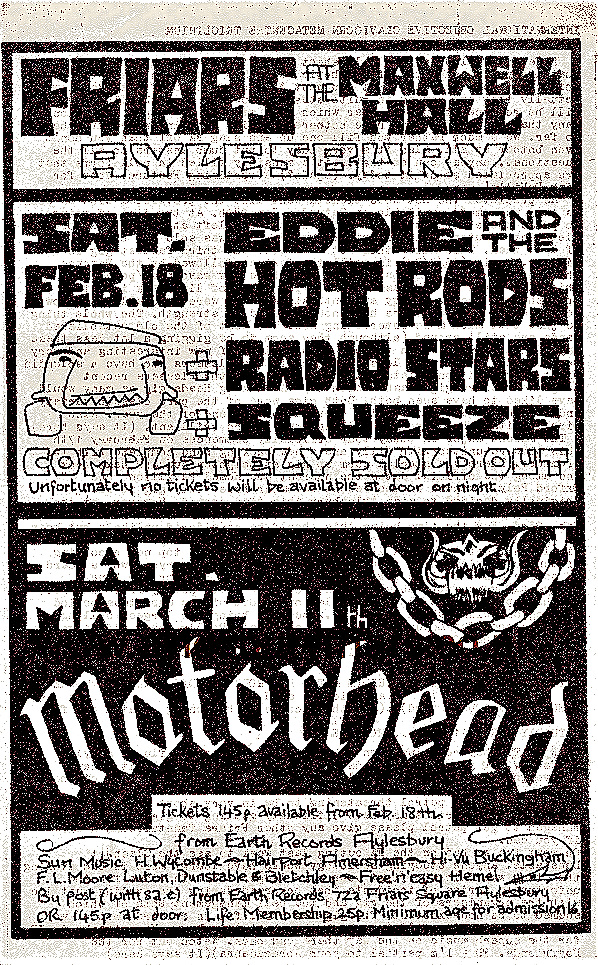 |
Eddie and the Hot Rods
with Radio Stars and Squeeze Friars Aylesbury - February 18, 1978 |
Featuring a cast that included Jools Holland on keyboards, Lee Brilleaux on harp, and Linda McCartney on backing vocals, Thriller — the group's third album and its last on Island Records — wasn't issued until March 1979, a full 16 months after Life On The Line. Presumably, part of the delay was because its predecessor was still selling well.
"Life On The Line sold really well," Barrie emphasizes. "So, Island said take a bit of time with the next one. We'd recorded the first one at Jackson's really cheaply; the second one was recorded in a bleeding church. We said, 'Let's find a proper studio, and we want a proper producer.' So, they got us Peter Ker. He wore tweed jackets and things like that. Gawd!" (Best known for his work with Arthur Brown and Love Sculpture in the 1960s, Ker had recently produced Approved By The Motors).
Barrie continues, "We recorded it at Abbey Road... I know the Beatles used it, but it was built for orchestras. It was all wrong. And the daft thing is, when we did the rough mixes, it sounded like the fucking dog's bollocks! Really good! Even if I say so meself. That album, between mixes, is a real good album. An album I'd be proud to say, 'I did that.' But the finished product is well lame. I'm ashamed of it. I really am."
There's precious little documented information to be found about the Hot Rods' second US tour (even the band are unsure about the actual dates), but it ties in timewise here. "I have a feeling that it would have been the fall of '78, after the recording of Thriller," guesses Graeme in one of our email exchanges. "We played a few shows with the Police and Tom Petty but didn't get back out to the West Coast because we'd run out of money."
Barrie describes the second US tour as "Hard. Bloody. Work."
On his website, Graeme mentions that the Hot Rods were already beginning to splinter: "The band had not been playing together for some time, what with external commitments by Paul and Steve with various Yankee musos, and the edge was gone. What used to be tight was sloppy, although there were still the occasional nights where we performed well."
He's also aware that by then, they'd missed their opportunity. "The audiences were not there. Apart from good attendances when supporting Tom Petty and the Police, we were not earning enough to pay for the tour. We were driving 4-500 miles a day between gigs with no hope in hell of sticking to the 55 m.p.h. speed limit, and no money to pay the inevitable speeding fines. The only way to get paid was to get to the gig, and the only way to get to the gig was to charge the fines to my Visa card. We had to abandon the tour and fly back home."
In March 1979, the group toured the UK in support of Thriller. Opening for the Hot Rods were the Members, who had stormed to #12 in the UK singles charts with "The Sound of the Suburbs" a month earlier and were scoring again with "Offshore Banking Business."
On the punk77 website, Paul Gray states: "[The Members] were actually getting more airplay than us... Where we were starting to sound tired and, dare I say it, jaded, they were fresh and enthusiastic. Looking back on it now we were knackered, we'd been worked to the bone, and there was no fooling the punters. We were drinking loads — a bottle of Jim Beam for me, Southern Comfort for Bazza, Vodka for Dave — it would all be gone before we left the dressing room... What had once been a great adventure had ceased to be fun and, although we wouldn't have admitted it, we were going thru the motions."
The grind of incessant gigging and financial strain had taken its toll. They needed a break, but Barrie grumbles: "No one thought of saying, 'Let's send them to the Canaries for a couple of weeks and let 'em sit on the beach. Let 'em change color from white to bronze. Give 'em some food instead of cocaine.' That never happened. I mean, we had Graeme Douglas — he did tours of hospitals. Literally, out of one hospital, do the gig, then back into the hospital. Move into another hospital, do the gig, into another hospital. Paul Gray spit up blood every day for about a month. Steve was constantly shaking. He couldn't stop shaking for weeks. It was stupid."
In May, the Hot Rods were fighting rumors of a split. The Punk Diary entry for the 29th has all the details: "Talk of a breakup was fuelled by the band being dropped by Island. Their manager, Roger Harding explained that the band is maintaining a low profile while they work up new songs and new stage routines. Paul Gray is currently touring with the Members while Barrie and Steve are playing in a side group called Plus Support. It's uncertain if the Rods are really through or just in a holding pattern. What is clear is that in five short years, the world surrounding them has changed dramatically and they might not be able to compete as Eddie and the Hot Rods."
In August, the Hot Rods were still together (after a fashion) and signed to EMI — although Barrie asserts Island didn't drop the band. Instead, he indicates their manager instigated the move to a new label: "That's when Ed Hollis wasn't getting his own way at Island. Chris Blackwell [Island's founder] said to me, 'If you're gonna go, you have my blessing. I really hope you do well. But remember, you've always got a home here.'"
In 1980, EMI half-heartedly issued the Al Kooper-produced Fish 'n' Chips. It was the Hot Rods' fourth (and final) major label LP, but Barrie calls it "a waste of time."
"EMI spent all this time and money recording it," he argues, "and then said they weren't gonna release it." When the album did "slip out" there was no publicity behind it, and it disappeared without a trace.
Barrie also concedes that they hadn't written enough material to fill the record. "There weren't enough songs. That's why there's some odd bits. That's the only thing I don't like. There's some funny old things!"
Was there any unreleased EMI material?
"There must have been because we were planning another album. It never got recorded, just demoed. I don't know how much there was now or what it was."
Harry Maloney had replaced Ed Hollis, and both Paul and Graeme had left before recording even started on Fish 'n' Chips.
In early 1980, Paul jumped ship and replaced Algy Ward in the Damned. Graeme exited a little earlier due to his deteriorating health. "My diabetic control was slipping," he writes on his website, "and I was experiencing more and more episodes of hypoglycaemia (low blood sugar). This made my judgement quite arbitrary and my behaviour quite weird."
Graeme made his departure during a gig at the London Lyceum when, halfway through the show, he handed his guitar to a photographer and crawled about the stage trying to bite the drummer's ankles. "The memory of Steve valiantly trying to keep time whilst simultaneously bashing Graeme on the head with his sticks is one that will live with me forever," muses Paul on the punk77 website.
Barrie allows that "we did a few bits and pieces on our own for different firms" during the early '80s (such as his own long-term stint with the Inmates, and Steve Nicol spending time with One the Juggler), but he insists that the Hot Rods never really split up.
And really, the band is still going today — albeit with Barrie now the only original member. (Please see the update from Dipster Dean below.)
There's just time to ask a question about one of my favorite Hot Rods' tunes before Barrie has to go. Was the phone number in "Telephone Girl" (838-5924) anyone's actual number?
"Ha! When we wrote it, the number I chose happened to be someone's number in England. So we thought, we'll just find a number that ain't used. Well... that number ain't used in England. We didn't think about any other countries, did we? Oh my god, did we get into trouble! On the first American tour, every time I did an interview... 'We've got a few people who aren't very happy that you used their phone number.' I just kept saying, 'I'm sorry.' We didn't think the record was even gonna come out over there."
(Update: Dipster Dean has noted in the comments section that Barrie and drummer Simon Bowley restarted the Hot Rods in early 2000. The lineup which included Richard Holgarth and Chris Taylor on guitars, Simon Bowley on drums, and Dipster on bass continued to tour and record until Barrie’s death in October 2019.)
"Life On The Line sold really well," Barrie emphasizes. "So, Island said take a bit of time with the next one. We'd recorded the first one at Jackson's really cheaply; the second one was recorded in a bleeding church. We said, 'Let's find a proper studio, and we want a proper producer.' So, they got us Peter Ker. He wore tweed jackets and things like that. Gawd!" (Best known for his work with Arthur Brown and Love Sculpture in the 1960s, Ker had recently produced Approved By The Motors).
Barrie continues, "We recorded it at Abbey Road... I know the Beatles used it, but it was built for orchestras. It was all wrong. And the daft thing is, when we did the rough mixes, it sounded like the fucking dog's bollocks! Really good! Even if I say so meself. That album, between mixes, is a real good album. An album I'd be proud to say, 'I did that.' But the finished product is well lame. I'm ashamed of it. I really am."
There's precious little documented information to be found about the Hot Rods' second US tour (even the band are unsure about the actual dates), but it ties in timewise here. "I have a feeling that it would have been the fall of '78, after the recording of Thriller," guesses Graeme in one of our email exchanges. "We played a few shows with the Police and Tom Petty but didn't get back out to the West Coast because we'd run out of money."
Barrie describes the second US tour as "Hard. Bloody. Work."
On his website, Graeme mentions that the Hot Rods were already beginning to splinter: "The band had not been playing together for some time, what with external commitments by Paul and Steve with various Yankee musos, and the edge was gone. What used to be tight was sloppy, although there were still the occasional nights where we performed well."
He's also aware that by then, they'd missed their opportunity. "The audiences were not there. Apart from good attendances when supporting Tom Petty and the Police, we were not earning enough to pay for the tour. We were driving 4-500 miles a day between gigs with no hope in hell of sticking to the 55 m.p.h. speed limit, and no money to pay the inevitable speeding fines. The only way to get paid was to get to the gig, and the only way to get to the gig was to charge the fines to my Visa card. We had to abandon the tour and fly back home."
 |
Graeme models the latest in CBS SUCKS attire.
Photo from Graeme's website. Photographer is unknown (although it
might have been taken at the same photo session as the one in Tommy Dean's office above). |
In March 1979, the group toured the UK in support of Thriller. Opening for the Hot Rods were the Members, who had stormed to #12 in the UK singles charts with "The Sound of the Suburbs" a month earlier and were scoring again with "Offshore Banking Business."
On the punk77 website, Paul Gray states: "[The Members] were actually getting more airplay than us... Where we were starting to sound tired and, dare I say it, jaded, they were fresh and enthusiastic. Looking back on it now we were knackered, we'd been worked to the bone, and there was no fooling the punters. We were drinking loads — a bottle of Jim Beam for me, Southern Comfort for Bazza, Vodka for Dave — it would all be gone before we left the dressing room... What had once been a great adventure had ceased to be fun and, although we wouldn't have admitted it, we were going thru the motions."
The grind of incessant gigging and financial strain had taken its toll. They needed a break, but Barrie grumbles: "No one thought of saying, 'Let's send them to the Canaries for a couple of weeks and let 'em sit on the beach. Let 'em change color from white to bronze. Give 'em some food instead of cocaine.' That never happened. I mean, we had Graeme Douglas — he did tours of hospitals. Literally, out of one hospital, do the gig, then back into the hospital. Move into another hospital, do the gig, into another hospital. Paul Gray spit up blood every day for about a month. Steve was constantly shaking. He couldn't stop shaking for weeks. It was stupid."
 |
Eddie and the Hot Rods in the centerfold of Look In magazine.
The magazine is dated 1978, however, this photo was most likely taken
on the roof of the K West Radio building in LA during the 1977 US tour.
|
In August, the Hot Rods were still together (after a fashion) and signed to EMI — although Barrie asserts Island didn't drop the band. Instead, he indicates their manager instigated the move to a new label: "That's when Ed Hollis wasn't getting his own way at Island. Chris Blackwell [Island's founder] said to me, 'If you're gonna go, you have my blessing. I really hope you do well. But remember, you've always got a home here.'"
 |
Eddie and the Hot Rods on the cover of Sounds
Poll Winners issue - February 19, 1977
|
"EMI spent all this time and money recording it," he argues, "and then said they weren't gonna release it." When the album did "slip out" there was no publicity behind it, and it disappeared without a trace.
Barrie also concedes that they hadn't written enough material to fill the record. "There weren't enough songs. That's why there's some odd bits. That's the only thing I don't like. There's some funny old things!"
"There must have been because we were planning another album. It never got recorded, just demoed. I don't know how much there was now or what it was."
Harry Maloney had replaced Ed Hollis, and both Paul and Graeme had left before recording even started on Fish 'n' Chips.
In early 1980, Paul jumped ship and replaced Algy Ward in the Damned. Graeme exited a little earlier due to his deteriorating health. "My diabetic control was slipping," he writes on his website, "and I was experiencing more and more episodes of hypoglycaemia (low blood sugar). This made my judgement quite arbitrary and my behaviour quite weird."
Graeme made his departure during a gig at the London Lyceum when, halfway through the show, he handed his guitar to a photographer and crawled about the stage trying to bite the drummer's ankles. "The memory of Steve valiantly trying to keep time whilst simultaneously bashing Graeme on the head with his sticks is one that will live with me forever," muses Paul on the punk77 website.
 |
Eddie and the Hot Rods — New Flag Poster
Official website: www.eddieandthehotrods.com
|
And really, the band is still going today — albeit with Barrie now the only original member. (Please see the update from Dipster Dean below.)
There's just time to ask a question about one of my favorite Hot Rods' tunes before Barrie has to go. Was the phone number in "Telephone Girl" (838-5924) anyone's actual number?
"Ha! When we wrote it, the number I chose happened to be someone's number in England. So we thought, we'll just find a number that ain't used. Well... that number ain't used in England. We didn't think about any other countries, did we? Oh my god, did we get into trouble! On the first American tour, every time I did an interview... 'We've got a few people who aren't very happy that you used their phone number.' I just kept saying, 'I'm sorry.' We didn't think the record was even gonna come out over there."
(Update: Dipster Dean has noted in the comments section that Barrie and drummer Simon Bowley restarted the Hot Rods in early 2000. The lineup which included Richard Holgarth and Chris Taylor on guitars, Simon Bowley on drums, and Dipster on bass continued to tour and record until Barrie’s death in October 2019.)
* * *
Keith's gig list (copied below) shows that the band was driving long distances between consecutive dates, as they crisscrossed sections of the East Coast, Canada, the Midwest, and the South over the course of three-and-a-half weeks.
 |
Advert for the Hot Rods three-night
stand at Max's Kansas City in 1977
(Courtesy of Peter Crowley)
|
21 NYC - Diplomat Hotel
22 Rochester, NY - Penny Arcade
23 Dover, NJ - Showcase
25 Long Island, NY - My Father's Place
26 Boston, MA - Paradise Theatre
27 Buffalo, NY - Stage One
28 Toronto, Canada - The Edge
29 Toronto, Canada - The Edge
30 Detroit, MI - Bookies
October 2: Chicago, IL - Mother's
3 Chicago, IL - Mother's
4 Peoria, IL - 2nd Chance
5 Gary, IN - Harry Hopes
6 Milwaukee, WI - Zaks
7 Minneapolis, MN
9 St Louis, MO - Fourth & Pine
11 Columbia, SC - University (with the Police)
12 Atlanta, GA - Agora Ballroom (with the Police)
13 Atlanta, GA - Agora Ballroom (with Tim Curry)
14 Tuscaloosa, AL - Bama Theatre (with the Police)
15 Nashville, TN - Exit Inn (with the Police)
I am grateful to several websites, books, and magazines for providing information used in my research of the Hot Rods' history. Here's a list of those I found particularly useful:
Websites and Blogs:
www.eddieandthehotrods.com
www.punk77.co.uk
northforksound.blogspot.co.uk
www.rockmine.com
www.philjens.plus.com
www.45cat.com
www.allmusic.com
onlyrockandroll.london
www.southendpunk.com
graemedouglas.co.uk
www.rocksbackpages.com
greatwen.com
ukrockfestivals.com
Wikipedia.com
Books:
No Sleep Till Canvey Island - The Great Pub Rock Revolution by Will Birch (Published 2003 by Virgin Books)
Punk Diary 1970-1979 by George Gimarc (Published 1994 by St. Martin's Press)
Magazines/Fanzines:
New Musical Express
Sounds
Melody Maker
Trouser Press
Back Door Man
Sniffin' Glue
ZigZag


